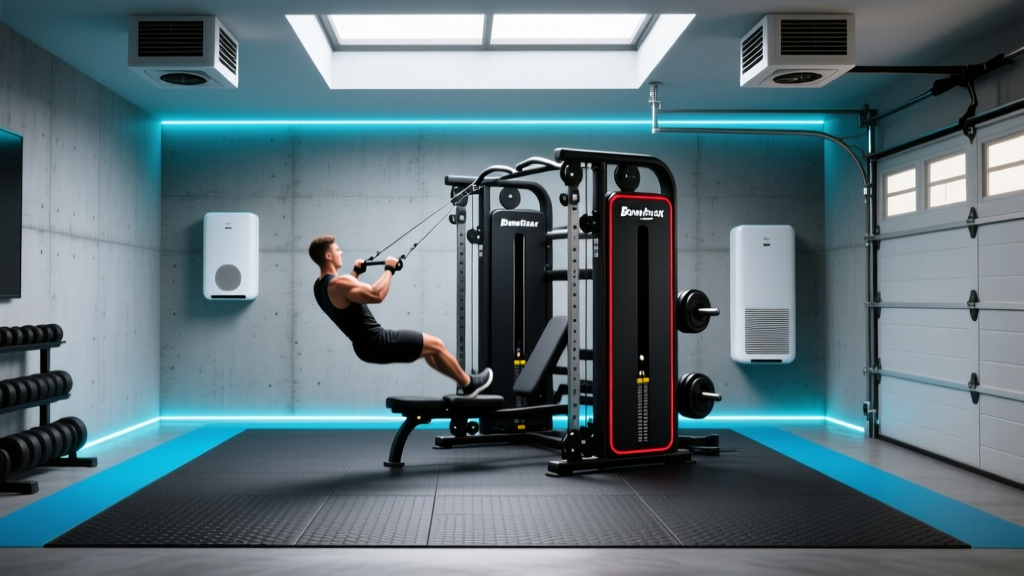
2026 Garage Gym Trends: Flooring, Ventilation & Bowflex Home Gym Models
Analyze 2026 garage gym trends, focusing on heavy-duty flooring and ventilation setups optimized for popular Bowflex home gym models and cable clearances.

The 2026 Garage Gym Paradigm: Environmental Engineering
The home fitness market has undergone a radical transformation over the last few years. As we move through 2026, the era of haphazardly placing a multi-gym on bare concrete is over. Today's garage gym setups are treated as engineered environments, requiring strict attention to thermodynamics, moisture mitigation, and structural load distribution. This shift is heavily driven by the physical requirements of advanced cable-and-rod resistance machines. When integrating popular Bowflex home gym models into a garage space, the interplay between proper flooring and advanced ventilation becomes the primary determinant of both equipment longevity and user safety.
Unlike free-weight racks, which are largely immune to ambient temperature fluctuations, cable-based and polymer-rod-based machines possess critical environmental vulnerabilities. This trend report analyzes the current market standards for garage gym build-outs, providing exact specifications for flooring matrices and ventilation engineering tailored specifically to the footprint and mechanical needs of modern Bowflex systems.
Why Climate Control Dictates Equipment Longevity
Garages are inherently semi-conditioned spaces. They suffer from extreme thermal bridging, where uninsulated concrete slabs and single-pane aluminum doors create massive temperature and humidity differentials. According to the EPA's guidelines on indoor air quality and moisture control, unventilated enclosed spaces can easily reach relative humidity levels above 70% during seasonal transitions. For fitness equipment, this is a death sentence.
High humidity accelerates the oxidation of steel pulleys, frays braided aircraft cables, and degrades the nylon coatings on weight stacks. However, the most critical edge case involves the proprietary resistance technology found in many Bowflex home gym models. Understanding the material science of these machines is mandatory for any garage gym architect.
⚠️ Expert Warning: The Power Rod Temperature Threshold
Bowflex Power Rods are constructed from polyhexamethylene adipamide (a specialized nylon). In unheated garage gyms where temperatures drop below 50°F (10°C), these rods become highly brittle, increasing the risk of catastrophic snapping under load. Furthermore, cold temperatures cause the rods to lose up to 15% of their rated resistance tension. Conversely, in uninsulated garages exceeding 95°F (35°C), the polymer can warp and suffer permanent memory deformation. Maintaining a strict ambient temperature between 60°F and 80°F via targeted HVAC or mini-split systems is not optional; it is a structural requirement for rod-based machines.
Flooring Matrix: Subfloor Protection and Machine Stability
The foundation of any garage gym is the flooring system. Bare concrete is porous, wicking moisture from the soil below (hydrostatic pressure), which leads to condensation directly beneath your equipment. In 2026, the market has standardized around two primary flooring solutions for heavy multi-gyms, moving away from cheap interlocking EVA foam which compresses and destabilizes cable machines during heavy lat pulldowns or leg presses.
| Flooring Type | Thickness | Avg. Cost (per sq ft) | Shock & Stability | Ideal Bowflex Application |
|---|---|---|---|---|
| Vulcanized Rubber Mats (Horse Stall) | 3/4 Inch | $1.80 - $2.20 | High / Extremely Stable | PR1000 / Xtreme 2 SE |
| Commercial Rolled Rubber | 8mm (5/16 Inch) | $2.50 - $3.50 | Medium / Seamless Finish | Revolution / SelectTech Racks |
| Interlocking EVA Foam | 1/2 Inch | $0.80 - $1.20 | Low / High Compression | Not Recommended for Multi-Gyms |
Installation Protocol for Unsealed Concrete
If your garage features an unsealed concrete slab, laying rubber directly on top will trap moisture, leading to mold growth and concrete spalling. The 2026 best practice involves a three-layer subfloor system:
- Vapor Barrier: Lay a 6-mil polyethylene sheeting directly over the concrete, overlapping seams by 12 inches and sealing with moisture-resistant tape.
- Sub-layer (Optional but recommended): A 1/2-inch layer of rigid XPS foam insulation board to provide thermal break and minor shock absorption.
- Wear Layer: 4x6 foot, 3/4-inch vulcanized rubber mats. These mats weigh approximately 100 lbs each, providing sufficient mass to anchor the base of a Bowflex PR1000 without the need for mechanical bolting into the concrete.
Ventilation Dynamics: Calculating CFM for Enclosed Spaces
Proper ventilation in a garage gym is rarely addressed in standard home gym guides, yet it is critical for both human performance and equipment preservation. The ASHRAE Standard 62.1 outlines specific ventilation rates for acceptable indoor air quality, emphasizing the need for mechanical exhaust in spaces where human respiration rates are elevated and volatile organic compounds (VOCs) from rubber flooring or vehicle exhaust may be present.
For a standard two-car garage (approximately 400 square feet with a 10-foot ceiling, yielding 4,000 cubic feet of volume), you must calculate the required Air Changes per Hour (ACH). A vigorous workout space requires a minimum of 6 to 8 ACH to effectively strip heat and humidity.
🧮 The CFM Calculation Framework
To achieve 8 ACH in a 4,000 cu. ft. garage:
Formula: (Volume × ACH) / 60 = Required CFM
Math: (4,000 × 8) / 60 = 533 CFM minimum exhaust capacity.
Action: Install a wall-mounted exhaust fan rated for at least 600 CFM on the leeward side of the garage, paired with passive intake louvers on the windward side to create negative pressure cross-ventilation.
Positioning Bowflex Home Gym Models for Optimal Airflow
Where you place your machine dictates how well it survives the garage environment. Cable machines act as nets for dust, pollen, and moisture. Never position a Bowflex Xtreme 2 SE or similar model directly beneath an uninsulated garage door track or adjacent to a poorly sealed exterior door. Condensation drip from thermal bridging will fall directly onto the lat tower and upper pulley housings, causing internal rust that voids warranties and compromises safety. Always leave a minimum 24-inch gap between the machine's rear stabilizer and the exterior wall to allow for air circulation and cable maintenance access.
Spatial Clearances and Structural Overheads
Market trends show a surge in consumers purchasing refurbished or secondary-market Bowflex units in 2026, often missing the original manuals. When planning your garage layout, you must account not just for the machine's static footprint, but for the dynamic operational envelope. Here are the exact spatial requirements for the most prevalent models:
- Bowflex PR1000: Requires a static footprint of 100" L x 78" W. However, with the lat tower and fully extended cable rows, you must allocate a safe operational zone of 120" L x 102" W. Ceiling height must be a minimum of 82", though 96" is recommended to prevent head-strike during seated overhead presses.
- Bowflex Xtreme 2 SE: Compact base of 53" L x 49" W, but the side cable pulleys require a sweeping radius. Allocate 96" W x 72" L to ensure free movement during crossover fly exercises.
- Bowflex Revolution: Utilizing SpiroFlex technology, this unit requires 54" L x 36" W. It is highly suited for tight garage corners, requiring only an additional 18" on either side for arm articulation.
Final Market Verdict
Building a garage gym around a Bowflex system in 2026 requires moving past the 'set it and forget it' mentality. The financial investment in a high-quality multi-gym must be matched by an investment in the environment that houses it. By deploying a 3/4-inch vulcanized rubber flooring system over a proper vapor barrier, and engineering a mechanical ventilation setup that guarantees at least 6 ACH, you effectively neutralize the primary failure modes of cable and polymer-rod resistance machines. Treat your garage not as a storage shed, but as a climate-controlled laboratory for human performance, and your equipment will easily outlast its warranty by a decade or more.
More gear to consider
All reviews
Weatherproof Guide to Creating a Home Gym Outdoors

Fitness Care and Maintenance: A Practical, Brand-Specific Guide for Home Gym Longevity and Safety
Weider Flex CTS Home Gym: Layout & Space Optimization
Leg Curl Home Gym Comparison: Best Picks for 2026 Remodels

Where to Donate Fitness Equipment: Hidden Costs & Tax Breakdown
