Stability Ball vs BOSU Ball: Space Layouts & How to Store a Yoga Mat
Compare the stability ball vs BOSU ball for compact home gyms. Discover space-saving layouts, footprint specs, and exactly how to store a yoga mat.

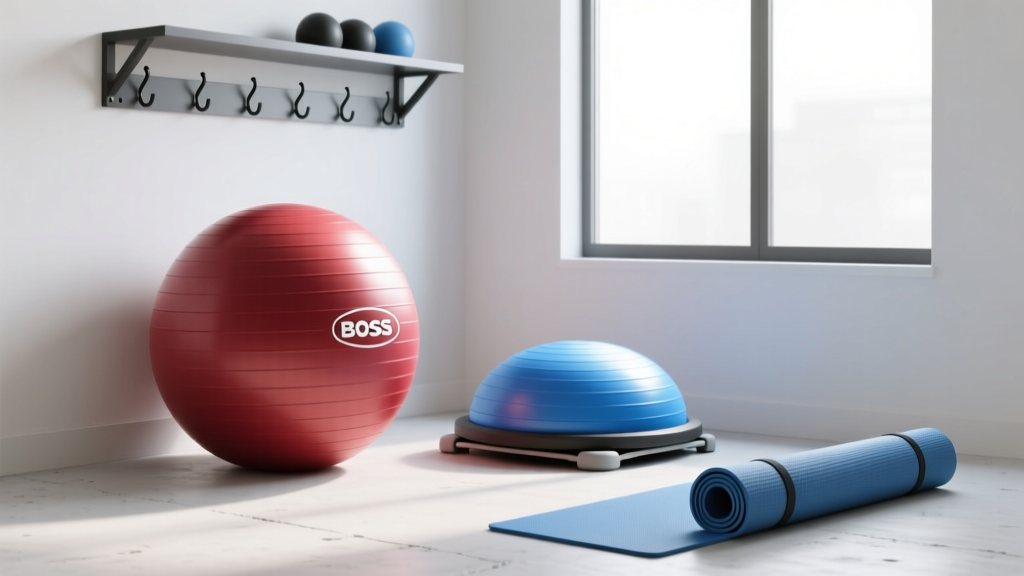
Designing a functional home gym in a compact apartment or spare bedroom requires ruthless spatial efficiency. When incorporating unstable surface training into your routine, you are generally faced with a choice between two iconic pieces of equipment: the traditional stability ball and the BOSU Balance Trainer. While both offer immense proprioceptive and core-strengthening benefits, their physical footprints and storage demands are vastly different.
In this guide, we will break down the stability ball vs BOSU ball comparison strictly through the lens of space optimization and layout design. Furthermore, because no functional floor zone is complete without a mat, we will solve the perennial micro-gym dilemma: how to store a yoga mat without sacrificing your limited square footage.
Footprint & Spatial Analysis: The Raw Numbers
Before drawing up your floor plan, you must understand the difference between an object's static footprint and its dynamic clearance zone. A stability ball might only be 25 inches wide, but performing a rollout or a pike requires a massive safety perimeter to prevent the ball from ricocheting into drywall or glass.
| Equipment | Static Dimensions | Dynamic Clearance Zone | Storage Profile | Avg. Price (2026) |
|---|---|---|---|---|
| 65cm Stability Ball (e.g., TheraBand) | 25.6' diameter | 8ft x 8ft minimum | High (Bulky, rolls away) | $25 - $40 |
| BOSU Pro Balance Trainer | 25' W x 8.5' H | 6ft x 6ft minimum | Low (Flat base, stackable) | $159 - $179 |
According to the historical development of the Swiss ball, these oversized spheres were originally designed for clinical physical therapy rooms with high ceilings and padded walls. Translating that to a 10x10 bedroom means the stability ball will dominate the room's visual and physical space. The BOSU trainer, invented by David Weck, solves this by cutting the sphere in half, providing a flat, stable base that anchors the equipment to the floor.
Layout Design: Zoning Your Compact Fitness Space
When arranging your gear, adopt the 'Anchor and Orbit' methodology. This approach dictates how you place your equipment based on its center of gravity and movement patterns.
The BOSU 'Anchor' Strategy
Because the BOSU features a rigid, flat platform, it can be placed in the corner of a room or flush against a wall when not in use. During a workout, it acts as a fixed anchor point. You only need clearance for your own body's wingspan (roughly 6 feet in diameter). This makes it ideal for narrow galley-style home gyms or spaces tucked behind a sofa.
The Stability Ball 'Orbit' Strategy
A stability ball cannot be anchored. If you place it in a corner, it will roll out the moment you apply uneven pressure. Therefore, it requires a central 'orbit'—a dedicated 8x8 foot zone in the middle of the room. In a small layout, this means you must design your room with modular, easily movable furniture (like folding chairs or lightweight ottomans) that can be pushed against the walls to create the necessary orbit zone on demand.
Space-Saving Pro Tip: If you absolutely must have a stability ball in a micro-apartment, invest in a 'mini' 45cm desk chair stability ball. It provides the active sitting core engagement you want for your home office, but can be easily tucked under a standard 29-inch desk when your workout begins.The Mat Dilemma: How to Store a Yoga Mat in a Micro-Gym
Unstable surface training requires a slip-resistant, cushioned base to protect your joints and your hardwood floors. But once the workout is over, a rolled-up 68-inch cylinder of PVC or natural rubber becomes an annoying tripping hazard. If you are wondering how to store a yoga mat in a space already crowded by fitness gear, here are three architectural solutions tailored for small layouts.
1. The Inverted BOSU Vault
If you chose the BOSU over the stability ball for space reasons, utilize its unique geometry. When you finish your workout, flip the BOSU upside down (dome facing the floor). The rigid, bowl-shaped platform creates a perfect 25-inch circular 'vault'. You can drop your rolled yoga mat, resistance bands, and massage balls directly into this bowl. It keeps your accessories contained, hidden, and completely off the floor.
2. Vertical Tension & Hook Systems
Do not waste valuable floor or shelf space on a mat. Utilize vertical dead space. Standard yoga mats roll into a cylinder roughly 4 to 5 inches in diameter.
- The Door Hinge Hack: Install a heavy-duty, over-the-door towel hook on the top hinge of your bedroom or closet door. Hang the mat by its carrying strap. When the door opens, the mat hides flush against the wall behind it.
- Tension Rod Alcove: If you have a hallway or closet alcove, place a $15 heavy-duty shower tension rod near the ceiling. Drape your mat over the rod, allowing it to hang flat against the wall like a tapestry.
3. Ceiling-Mounted PVC Racks
For dedicated garage or basement gyms with exposed joists, build a simple ceiling cradle. Using two 12-inch pieces of 1.5-inch PVC pipe and heavy-duty plumber's tape, mount the pipes parallel to each other about 6 inches apart on the ceiling. You can slide your rolled yoga mat, foam rollers, and even a deflated stability ball into this overhead rack, completely reclaiming your floor layout.
Biomechanics vs. Spatial Utility: Which Should You Buy?
Space optimization is crucial, but it should not entirely override your training goals. The American Council on Exercise (ACE) frequently highlights the distinct biomechanical differences between these two tools.
Choose the Stability Ball if: Your primary goal is deep core isolation, spinal extension work, and advanced dynamic movements like stability ball pikes or hamstring curls. It is highly affordable ($30), but you must accept that it will act as a massive, rolling piece of furniture in your home.
Choose the BOSU if: Your focus is on ankle/knee proprioception, athletic balance, and unilateral strength training (like Bulgarian split squats). At roughly $160, it is a premium investment, but its flat base and stackability make it the undisputed king of compact home gym layouts.
Frequently Asked Questions
Can I leave my stability ball inflated in a small apartment?
Yes, but keep it out of direct sunlight and away from heating vents. UV rays and concentrated heat degrade the anti-burst PVC material over time, increasing the risk of a sudden rupture. In a small apartment, store it in a dark closet or under a bed if you have a clearance of at least 26 inches.
Does a BOSU ball damage hardwood floors?
The base of a genuine BOSU Pro is made of a rigid, textured polymer that can scratch delicate hardwood or laminate finishes during high-friction exercises like mountain climbers. Always place your BOSU on top of your stored yoga mat or a dedicated 3/8-inch rubber horse stall mat to protect your flooring.
What is the best mat thickness for BOSU work?
For standing balance work on the BOSU dome, a thinner, high-density mat (3mm to 4mm) is ideal. Thick, plush yoga mats (6mm+) compress unevenly under the BOSU's rigid base, introducing an artificial wobble that can compromise your ankle stability and safety.
More gear to consider
All reviews
Stability Ball vs BOSU Ball & Sesame Street Yoga Mat Budget Guide
Jump Rope Setup: Speed, Weighted, Beaded & Pink Yoga Mat Protection

Daiso Yoga Mat Review & Foam Roller Density Guide
Stability Ball vs BOSU Ball Care: Longevity & Yoga Mat Orange Bases

Beyond Liforme Yoga Mat Reviews: Pull-Up Band Sizing