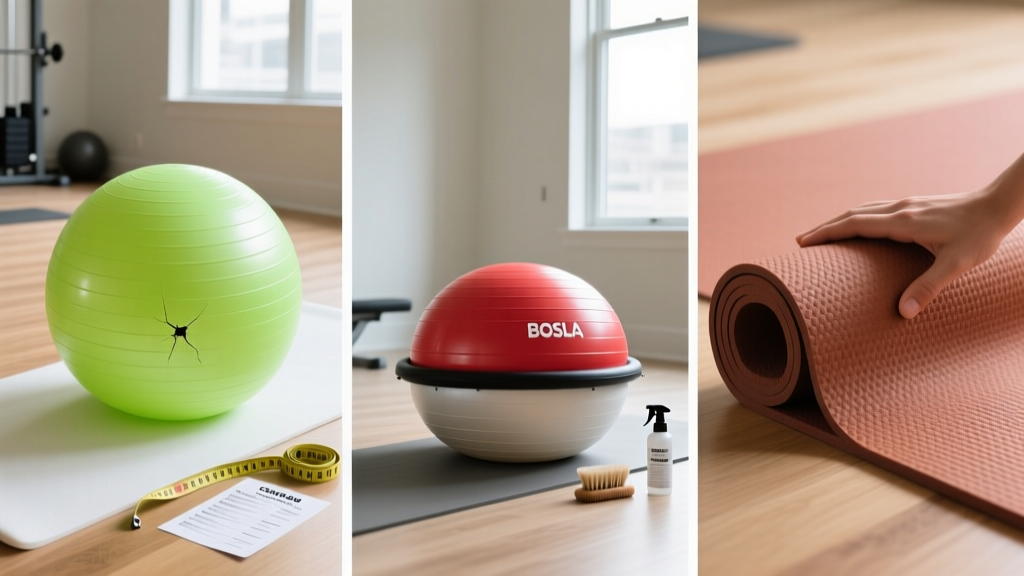
Stability Ball vs BOSU Ball & Yoga Mat Thickness Chart
Compare the BOSU Pro NexGen and TheraBand stability balls for core training, plus our expert yoga mat thickness chart for safe, joint-friendly foundations.

The Unstable Surface Debate: Full Sphere vs. Half-Dome
When building a functional training space, the choice between a traditional Swiss stability ball and a BOSU balance trainer often dictates the trajectory of your core and proprioceptive programming. Both tools leverage unstable surface training (UST) to recruit deep stabilizing musculature, but their biomechanical applications, failure modes, and price points differ drastically. According to research published in the Journal of Physical Therapy Science, unstable surfaces increase core muscle activation by up to 40% compared to stable floors, but the type of instability dictates which muscle fibers are targeted. A full sphere demands continuous multi-planar micro-adjustments, whereas a half-dome isolates specific ankle and hip stabilizers depending on which side faces up.
However, the efficacy of either tool is entirely compromised if the foundation beneath it is inadequate. Performing single-leg Romanian deadlifts on a BOSU dome while standing on a slippery, ultra-thin mat is a recipe for lateral ankle sprains. This is why pairing your equipment with the right foundation is non-negotiable. Below, we break down the top-tier models for 2026 and provide a comprehensive yoga mat thickness chart to ensure your joints and grip are fully supported during dynamic movements.
Expert Insight: The Base Matters
Never place a fully inflated PVC stability ball directly on hardwood or tile without a high-density mat. The coefficient of friction drops significantly when PVC heats up from body contact, leading to catastrophic slip-outs during pike-ups or planks.
Equipment Deep-Dive: 2026 Top Picks
To understand which tool belongs in your gym, we must look beyond marketing jargon and examine material composition, burst ratings, and real-world pricing.
BOSU Pro NexGen (Model 100152)
The BOSU Pro NexGen remains the gold standard for commercial and high-end home gyms. Retailing at $139.99, it features a 25-inch platform diameter and a proprietary burst-resistant bladder. Unlike the cheaper Sport model ($79.99), the NexGen utilizes a reinforced, eco-friendly PVC blend that resists delamination—a common failure mode in older BOSU models where the rubber dome separates from the rigid plastic base under heavy lateral loads.
- Best For: Unilateral lower-body work (Bulgarian split squats), plyometric step-ups, and prone core stability.
- Load Capacity: Rated for 300 lbs of dynamic force, though static compression can handle significantly more.
- Failure Mode: Over-inflation. The NexGen requires exactly 8.5 to 10 inches of dome height. Exceeding this stretches the molecular bonds of the PVC, leading to micro-tears that eventually result in sudden deflation.
TheraBand Anti-Burst Stability Ball (Model 14204)
For pure spinal alignment, deep core activation, and seated active recovery, the TheraBand 65cm Anti-Burst Ball is unmatched. Priced at an accessible $29.95, it is constructed from slow-deflate PVC. If punctured by a sharp object, the ball slowly loses air rather than exploding, a critical safety feature endorsed by the American Council on Exercise (ACE) for clinical and home rehabilitation settings.
- Best For: Supine hamstring curls, stability ball pikes, wall squats, and active desk seating.
- Load Capacity: Burst-tested up to 1,100 lbs (static) and 300 lbs (dynamic).
- Failure Mode: UV degradation and seam splitting. Leaving this ball in direct sunlight accelerates plasticizer evaporation, making the PVC brittle within 12 to 18 months.
The Foundation: Our 2026 Yoga Mat Thickness Chart
Selecting the right mat is not just about comfort; it is about force dispersion and grip traction. When you step onto a BOSU dome, your foot needs to grip the rubber, but the base of the BOSU must grip the floor. A standard 3mm travel mat will bunch up and slide under the torque of a stability ball rollout. To help you choose the right base layer, consult our expert yoga mat thickness chart below.
| Thickness | Material Profile | Best Use Case with Balls/BOSU | Joint Impact Rating |
|---|---|---|---|
| 3mm (Standard) | TPE or Thin PVC (e.g., Gaiam Essentials) | Light stretching. Poor for BOSU base grip; high slip risk during rollouts. | Low Cushion (High knee/wrist impact) |
| 5mm (Alignment) | Natural Rubber (e.g., Jade Harmony) | Ideal for BOSU single-leg work. High-traction open-cell rubber prevents base sliding. | Medium Cushion (Balanced feedback) |
| 6mm (Pro) | Dense PVC (e.g., Manduka PRO) | Heavy stability ball pikes and kneeling core work. Superior joint protection. | High Cushion (Maximum joint support) |
| 8mm+ (Extra) | NBR Foam or Thick PU | Not recommended for BOSU. The foam compresses unevenly, creating an unsafe secondary wobble. | Unstable (Compromises balance mechanics) |
As highlighted in the yoga mat thickness chart, the 5mm to 6mm sweet spot provides the necessary density to prevent the mat from bottoming out under the concentrated weight of a BOSU platform, while still offering enough surface texture to anchor your feet. According to Mayo Clinic guidelines on joint health, maintaining proper alignment and shock absorption during weight-bearing exercises is crucial for preventing long-term cartilage wear, making a 6mm dense PVC mat a worthwhile $140+ investment for longevity.
Biomechanics and Real-World Failure Modes
Understanding how your body interacts with these tools prevents injury. The most common edge-case injury we see in clinical reviews is the lateral ankle inversion sprain. This occurs when a user attempts a dynamic movement (like a lateral hop) onto the dome of a BOSU, but the rigid plastic base shifts on a low-friction mat.
"The instability of the equipment should challenge the neuromuscular system, not the structural integrity of the floor-to-mat interface. If your mat slides, the equipment is no longer a training tool; it is a hazard."
With a full stability ball, the primary failure mode is spinal hyperextension during prone back extensions. If the ball is under-inflated (less than 80% capacity), the contact surface area widens, but the support drops, forcing the lumbar spine to absorb the load rather than the thoracic extensors. Always measure your ball's diameter with a tape measure after 10 minutes of use, as the PVC stretches and the ball can lose up to 2 inches of height during the initial break-in period.
The Final Verdict: Which Should You Buy?
Your purchase should be dictated by your primary training modality:
- Buy the BOSU Pro NexGen ($139.99) if: Your programming focuses on athletic performance, agility, unilateral leg strength, and plyometrics. Pair it with a 5mm natural rubber mat for maximum base traction.
- Buy the TheraBand Stability Ball ($29.95) if: Your focus is on deep core isolation, spinal rehabilitation, hamstring curls, and active sitting. Pair it with a 6mm dense PVC mat to protect your knees and wrists during floor transitions.
By referencing our yoga mat thickness chart and understanding the specific burst ratings and material limits of your chosen equipment, you can build a 2026 home gym setup that is both highly effective and structurally safe.
Frequently Asked Questions
Can I use a stability ball on a carpeted floor without a mat?
While carpet provides natural friction, it is highly abrasive. Over 6 to 12 months, the friction will sand down the outer layer of the PVC stability ball, creating weak points that compromise the anti-burst rating. A 6mm mat acts as a sacrificial barrier.
How often should I replace my BOSU or Stability Ball?
In a commercial setting, replacement is recommended every 24 months. For home use, inspect the seams and the base-to-dome adhesive line every 6 months. If you notice white stress marks along the PVC seams or a permanent loss of inflation pressure exceeding 1 inch per week, discard the equipment immediately.
More gear to consider
All reviews
Compression Care and Maintenance: Extending Band Lifespan, Preserving Efficacy, and Avoiding Common Pitfalls

Resistance Band Set Levels & Good Yoga Mat Thickness: Beginner Guide
What Size Yoga Mat Do I Need? Exercise Ball Sizing & Trends
2026 Pull-Up Band Sizing & All in Motion Yoga Mats

Pilates Accessories Guide: Market Trends & Clean Yoga Mat Spray