Barbell Collar Guide: Bench Press & Chest Workouts with Dumbbells
Compare barbell collar types including spring, polymer, and aluminum lever clamps, plus safety insights for heavy presses and chest workouts with dumbbells.

The Critical Role of Collars in Heavy Pressing
When loading up a barbell for a heavy bench press, the integrity of your lift relies on a small, often overlooked piece of equipment: the barbell collar. A shifting plate mid-rep isn't just an annoyance; it alters the bar's center of gravity, creating a dangerous torque that can lead to severe shoulder or wrist injuries. While the mechanics of securing a barbell are heavily dependent on external clamps, the safety dynamics shift entirely when you transition to chest workouts with dumbbells, where weight distribution and locking mechanisms operate on a completely different engineering level.
In this comprehensive head-to-head comparison, we break down the four primary barbell collar types on the market in 2026, analyzing their clamping force, material fatigue, and real-world failure modes. We will also contrast these external barbell safety systems with the internal locking mechanisms found in adjustable dumbbells, giving you a complete safety framework for your upper-body training.
⚠️ Safety Warning: Never perform dynamic barbell movements (like push presses or landmine variations) without a high-tension lever or screw-down collar. Spring clips are strictly for controlled, linear movements and pose a severe slipping hazard during explosive lifts.Head-to-Head: The 4 Main Barbell Collar Types
1. Spring Clips (The Budget Standard)
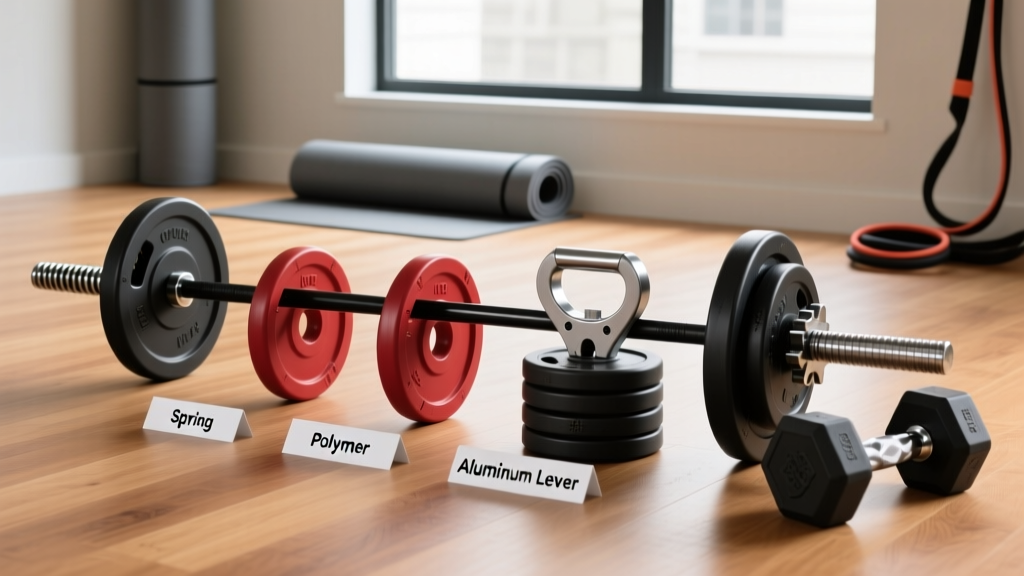
The traditional steel spring clip is the most ubiquitous collar in commercial gyms, primarily due to its low cost. Brands like CAP Barbell sell these in bulk for roughly $8 to $12 per pair. They operate via simple tensile steel coils that you compress to slide onto the sleeve.
- Pros: Extremely lightweight (under 0.2 lbs each), cheap, and fast to apply for quick weight changes.
- Cons: Lowest clamping force. Prone to metal fatigue over time.
- Failure Mode: After approximately 500 to 800 compressions, the steel loses its tensile memory. The clip becomes loose, allowing plates to slide laterally during the bench press, especially if the barbell sleeve is coated in chalk or sweat.
2. Polymer Lock-Jaw Clamps (The Commercial Workhorse)
Polymer clamps, most notably the Lock-Jaw PRO ($28–$32 per pair), dominate modern fitness floors. These utilize a dual-ridge cam-lock mechanism made from glass-reinforced nylon. They snap onto the 50mm Olympic sleeve with a satisfying, secure click.
- Pros: Excellent grip on both steel and chrome sleeves, highly durable against drops, and visually distinct (available in various colors for quick identification).
- Cons: Heavier than spring clips (approx. 0.55 lbs each) and can be stiff to remove with cold hands.
- Failure Mode: The primary failure point is the hinge pin. If a loaded barbell is dropped violently from overhead, the lateral shockwave can snap the polymer hinge, rendering the clamp useless.
3. Aluminum Lever Collars (The Premium Choice)
For serious powerlifters and Olympic weightlifters, machined aluminum lever collars are the gold standard. The Rogue Aluminum Collars ($55–$65 per pair) are CNC-machined from 6061 aircraft-grade aluminum and feature an eccentric cam lever that bites into the sleeve via a heavy-duty rubber O-ring.
- Pros: Massive clamping pressure, zero lateral plate shift, and a premium aesthetic. They add exactly 0.5 lbs per side, which is easily factored into competition math.
- Cons: Expensive, and the metal body can scratch chrome or Cerakote barbell sleeves if not aligned perfectly during application.
- Failure Mode: The rubber O-ring degrades over 2 to 3 years of heavy use, losing its elasticity. Additionally, if dropped directly onto concrete flooring, the aluminum lever arm can bend, preventing the cam from fully engaging.
4. Screw-Down / Spinlock Clamps (The Heavy-Duty Anchor)
Screw-down clamps, such as the Ivanko OB-2 ($35–$45 per pair), use a threaded steel screw that drives a brass or nylon insert directly against the barbell sleeve. This creates a friction lock that is virtually immune to lateral shifting.
- Pros: Unmatched holding power for extreme loads and highly resistant to shock from dropped barbells.
- Cons: Slowest to apply and remove. The threaded screw can cross-thread if forced.
- Failure Mode: Over years of aggressive tightening, the internal brass insert can strip out, causing the screw to spin endlessly without applying pressure to the sleeve.
Comparison Matrix: Clamping Force, Weight, and Price
| Collar Type | Material | Avg Price (Pair) | Weight (Each) | Best Application | Primary Failure Mode |
|---|---|---|---|---|---|
| Spring Clip | Tensile Steel | $8 - $12 | 0.15 lbs | Light accessory work, quick changes | Loss of tensile memory (metal fatigue) |
| Polymer Clamp | Glass-Reinforced Nylon | $28 - $32 | 0.55 lbs | General benching, commercial gyms | Hinge pin snapping from lateral shock |
| Aluminum Lever | 6061 Aluminum / Rubber | $55 - $65 | 0.50 lbs | Heavy powerlifting, Olympic lifting | O-ring degradation, bent lever arm |
| Screw-Down | Steel / Brass Insert | $35 - $45 | 0.65 lbs | Strongman, extreme heavy presses | Internal brass threading stripping |
Transitioning to Chest Workouts with Dumbbells: A Safety Contrast
While barbell collars are mandatory for securing external plates, the safety dynamics change drastically when you move to chest workouts with dumbbells. According to biomechanical analyses outlined by BarBend, dumbbell pressing requires significantly more stabilizing muscle activation and allows for a deeper range of motion (ROM) compared to the barbell bench press. However, the equipment safety profile is entirely different.
Fixed Hex Dumbbells vs. Adjustable Dumbbell Collars
When performing chest workouts with fixed rubber or urethane hex dumbbells, there are no collars to worry about; the heads are permanently cast or bolted to the handle. The primary safety concern here is the structural integrity of the weld or cast iron core.
Conversely, if your chest workouts with dumbbells utilize adjustable sets (like PowerBlock, Nuobell, or Bowflex), the 'collar' mechanism is internalized, and the failure modes are unique:
- Nuobell (Mechanical Pin-Lock): Operates similarly to a barbell sleeve lock. When the handle is docked, a steel pin retracts. If the docking tray is misaligned, the pin may only partially engage, leading to a catastrophic weight drop mid-flye.
- Bowflex (Dial System): Uses internal plastic gears and metal brackets. The primary failure mode is dropping the dumbbell. Unlike a barbell collar that absorbs shock on the steel sleeve, a dropped Bowflex dumbbell shatters the internal plastic selection dial, rendering the unit inoperable.
- PowerBlock (Selector Pin): Uses a heavy-duty steel pin with a rubber retention band. The failure mode here is the degradation of the rubber band; if it snaps, the pin can vibrate loose during heavy incline presses.
Expert Insight: When programming heavy hypertrophy blocks, many lifters alternate between barbell benching (requiring high-tension aluminum lever collars for max load safety) and dumbbell pressing (requiring meticulous inspection of adjustable dumbbell selector pins). Never assume internal dumbbell locks are as fail-proof as a properly engaged barbell lever collar.
Real-World Failure Modes: When Collars Slip
Even the best equipment fails if not maintained. Here are the non-obvious edge cases that cause collars to slip during heavy chest presses:
- Chalk Buildup on Sleeves: Gym chalk (magnesium carbonate) acts as a dry lubricant on smooth steel barbell sleeves. If you don't wipe the sleeve down with a damp cloth before applying a polymer or aluminum collar, the clamping friction is reduced by up to 40%.
- Bar Whip and Oscillation: During dynamic movements, the barbell oscillates (whips). Spring clips and loose polymer clamps cannot absorb this high-frequency vibration, causing them to inch outward toward the end of the sleeve over a set of 10 reps.
- Knurling Interference: If you load plates too close to the inner knurling, the collar may sit partially on the rough knurl rather than the smooth sleeve. This prevents the O-ring or cam from seating flush, drastically reducing holding power.
Maintenance Protocol for Maximum Clamping Force
To ensure your collars perform when you are under a 300lb barbell, implement this 60-second maintenance routine:
🛠️ The Monthly Collar Refresh:- Step 1: Wipe barbell sleeves with a microfiber cloth and a light application of 3-in-One oil to remove chalk and oxidation.
- Step 2: Inspect the rubber O-rings on aluminum lever collars. If they appear flattened or cracked, order replacement O-rings (usually $5 for a pack) rather than buying new collars.
- Step 3: Check the hinge pins on polymer clamps for micro-fractures using a bright flashlight.
Expert Verdict: Which Collar Should You Buy?
Your choice of barbell collar should be dictated by your training style, budget, and the specific movements you perform.
- For the Powerlifter / Heavy Bencher: Invest in the Rogue Aluminum Lever Collars. The $60 price tag is justified by the absolute zero-shift guarantee, which is critical when grinding out heavy singles.
- For the Commercial Gym Owner / CrossFit Box: The Lock-Jaw PRO polymer clamps offer the best balance of durability, speed, and cost. They survive drops and are easy for members to use.
- For the Home Gym on a Budget: Buy a multi-pack of CAP Spring Clips for light accessory work, but keep a pair of screw-down clamps for your heavy bench press days.
Ultimately, whether you are securing a 45lb plate on an Olympic barbell or verifying the selector pin on your adjustable dumbbells for isolated chest workouts with dumbbells, respecting the mechanical limits of your locking equipment is the first step toward a safe, injury-free training cycle.
More gear to consider
All reviews
Barbell Collar Types & Dumbbell Exercises for Back Fat
Dumbbell Rollover Guide: 2026 Storage Budget Analysis

2026 Market Trends: Dumbbell Racks for Abs Training With Dumbbells

Urethane vs Rubber: Space & Straight Leg Deadlifts with Dumbbells

Rubber vs Urethane Care: Lat Pulldown Exercise With Dumbbells Impact
