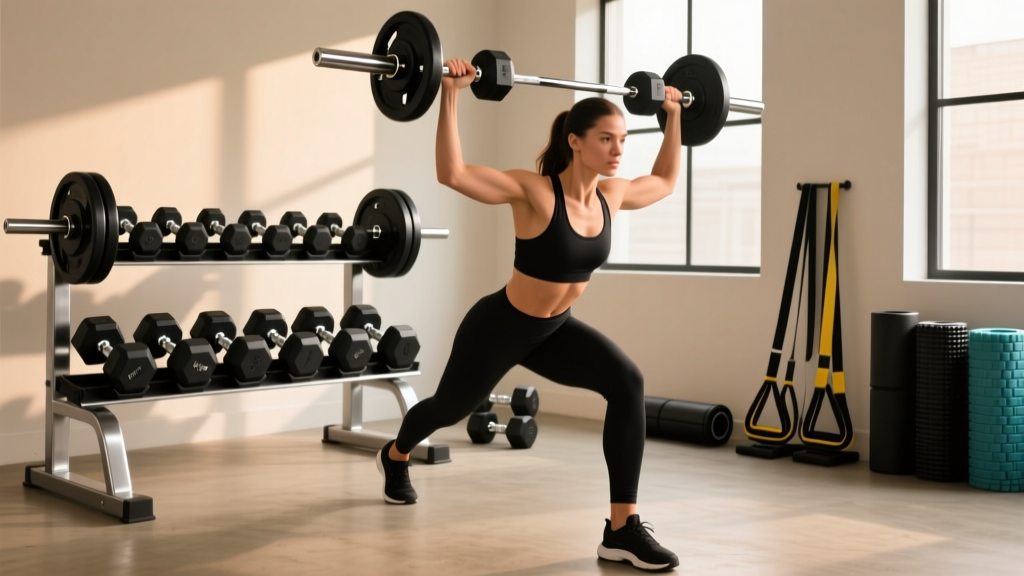
Barbell Collar Comparison & Dumbbell Pullover for Women Setup
Master your home gym setup with our barbell collar and clamp types comparison, plus a complete guide to the dumbbell pullover for women.

The Complete Free Weight Station Walkthrough: From Rack Installation to Isolation
Building a versatile home gym in 2026 requires more than just dropping a power rack onto a concrete floor. A truly optimized free weight station seamlessly transitions between heavy compound barbell lifts and targeted isolation movements. This complete setup and installation walkthrough will guide you through securing your barbell with the right collars and clamps, and then seamlessly transitioning to the dumbbell pullover for women—a critical movement for thoracic mobility and latissimus dorsi development.
Phase 1: Spatial Planning and Floor Installation
Before assembling your rack, you must establish proper clearances. The standard Olympic barbell is 7.2 feet (86.4 inches) long. For safe loading and unloading, you need a minimum of 48 inches of lateral clearance on both sides of the rack.
- Subfloor Prep: Install 3/4-inch thick vulcanized rubber horse stall mats over your concrete or plywood subfloor. This provides the necessary shock absorption for dropped bumpers and prevents the bench from sliding during the dumbbell pullover for women.
- Rack Anchoring: If you are using a 4-post power rack, bolt the front uprights to the floor or use weight storage horns on the rear uprights, loaded with at least 200 lbs of plate weight, to counter-balance heavy barbell pulls.
Phase 2: Barbell Collar and Clamp Types Comparison
When performing heavy bench presses or squats before transitioning to dumbbell work, lateral plate shift is a massive safety hazard. According to equipment safety analyses by Garage Gym Reviews, using inadequate collars can lead to asymmetric loading, causing the barbell to tip off the J-cups. Here is the definitive 2026 comparison of barbell collar and clamp types.
1. Spring Clips (The Outdated Standard)
Traditional 5-inch spring clips (e.g., Harbinger Spring Collars) cost between $5 and $10. They rely on tension steel that fatigues over time. While they are fast to apply, they offer virtually zero lateral security if the barbell is dropped. Verdict: Ban these from your gym immediately. They are a liability.
2. Clamp-Style Collars (The Home Gym Workhorse)
Clamp collars, such as the Rogue Lock-Jaw PRO or OSO Barbell Clamps, utilize a glass-reinforced nylon resin body with a steel locking cam. Priced around $28 to $35 per pair, they weigh roughly 120 grams each and take up exactly 2.5 inches of sleeve space. The nylon teeth grip the 50mm Olympic sleeve aggressively without scratching the zinc or chrome finish. Verdict: The best balance of speed, security, and price for 90% of lifters.
3. Competition Aluminum Collars (The IWF Standard)
Models like the Rogue HG 2.0 Aluminum Collars ($75 to $85 per pair) are machined from billet aluminum and feature steel roller bearings for the clamping mechanism. Crucially, they weigh exactly 2.5 kilograms each, meaning they count toward your total loaded barbell weight in sanctioned meets. They provide absolute lateral lock but take 15-20 seconds to thread and lock. Verdict: Mandatory for Olympic weightlifting; overkill for general hypertrophy training.
Quick-Release Matrix: Collar Comparison| Collar Type | Model Example | 2026 Price | Security | Transition Speed |
|---|---|---|---|---|
| Spring Clip | Harbinger 5" | $8.00 | Low | 2 Seconds |
| Nylon Clamp | Rogue Lock-Jaw PRO | $32.00 | High | 5 Seconds |
| Competition | Rogue HG 2.0 | $79.00 | Maximum | 18 Seconds |
Phase 3: Integrating the Dumbbell Pullover for Women
Why does your barbell collar choice matter for an isolation movement? Because the most effective home gym setups utilize supersets. A common and highly effective superset pairs a heavy barbell bench press with the dumbbell pullover for women to stretch the intercostals and lats while the pectorals recover. If you are using slow-threading competition collars, you will lose your heart rate zone and rest-to-work ratio while stripping the barbell. Quick-release nylon clamps allow you to strip 225 lbs off the bar in under 10 seconds, keeping the workout density high.
Biomechanics and Bench Setup
The dumbbell pullover for women is a phenomenal exercise for targeting the serratus anterior, lats, and pectoralis major sternal head. According to the biomechanical breakdown by ExRx.net, the movement relies on shoulder extension and thoracic expansion.
To set up your station for this movement correctly:
- Bench Selection: Use a flat utility bench with a high-density pad (at least 2.5 inches thick) to prevent scapular sinking. The Rogue Utility Bench 2.0 is ideal due to its 12-gauge steel frame and zero-wobble footprint.
- Positioning: You have two setup options. The traditional method is lying flat on the bench. The advanced 'cross-bench' method involves placing only your upper back and traps perpendicular across the bench, allowing your hips to drop below the bench level for a deeper lat stretch. Note: Only attempt the cross-bench setup if your bench has a wide, stable base to prevent tipping.
- Dumbbell Grip: Use a single heavy adjustable dumbbell (like the Nuobell or PowerBlock Pro) or a fixed hex dumbbell. Cup the inner plates of the dumbbell with your hands, forming a diamond shape with your thumbs and index fingers.
"When programming the dumbbell pullover for women, the limiting factor is rarely raw muscle strength, but rather shoulder joint mobility and thoracic spine extension. Forcing a heavy load through a restricted range of motion shifts the torque directly onto the anterior shoulder capsule, risking impingement."
Step-by-Step Execution Walkthrough
Once your barbell is safely collared and racked, and your bench is cleared, follow this execution protocol for the dumbbell pullover for women:
- The Descent (Eccentric): With a slight bend in your elbows (maintain this exact angle throughout the set), slowly lower the dumbbell backward over your head. Inhale deeply to expand the rib cage. Stop when you feel a maximum stretch in the lats—usually when the dumbbell is parallel to the bench. Do not force the stretch past your active mobility limit.
- The Ascent (Concentric): Exhale forcefully and pull the dumbbell back to the starting position directly over your chest. Focus on pulling with your elbows and engaging the lats, rather than pressing with the triceps.
- Rep Range & Load: For hypertrophy and thoracic mobility, aim for 3 sets of 12-15 reps. Women typically find excellent success in the 20 lb to 45 lb range for this specific isolation, as the lever arm creates significant torque at the shoulder joint even with lighter absolute loads.
Phase 4: Safety Protocols, Maintenance, and Edge Cases
A complete setup walkthrough is incomplete without addressing equipment maintenance and failure modes. Over time, the interaction between your barbell sleeves, your plates, and your collars will degrade if ignored.
Troubleshooting Collar Slippage
If your nylon clamp collars are slipping during heavy barbell lifts, the issue is rarely the collar itself. Standard Olympic sleeves are machined to 50mm. However, budget barbells often have sleeves that measure 49.2mm to 49.5mm. This 0.5mm tolerance gap prevents the cam-lock on nylon collars from achieving full surface contact. The Fix: Wrap a single layer of athletic tape around the very end of the barbell sleeve where the collar sits to shim the gap, or invest in a precision-machined barbell with true 50mm sleeves (e.g., Eleiko or American Barbell).
Plate Material Interactions
When loading the barbell, be aware of your plate materials. Virgin rubber bumper plates have a wider hub than urethane plates. If you mix steel fractional plates with rubber bumpers, the steel plates can 'float' and shift laterally, bypassing the collar's pressure. Always use steel plates on the outside of the bumpers, directly against the collar, to ensure the clamp's force is distributed evenly across the entire sleeve stack. For more insights on managing mixed plate types and collar tension, fitness equipment experts at BarBend recommend always using a steel change plate as a 'buffer' between rubber bumpers and your locking collar.
Final Walkthrough Summary
Optimizing your free weight station is about minimizing friction between exercises and maximizing safety under load. By installing proper flooring, utilizing quick-release glass-reinforced nylon clamp collars, and meticulously setting up your bench for the dumbbell pullover for women, you create an environment that supports both heavy progressive overload and precise isolation work. Respect the biomechanics, maintain your sleeve tolerances, and your 2026 training cycles will be both safe and highly effective.
More gear to consider
All reviews
Rogue Urethane Dumbbell Setup: Beyond Neoprene for Home Gyms

Rack Setup: Beyond Exercises With Dumbbells To Lose Belly Fat

Troubleshooting Adjustable Dumbbells for Dumbbells Only Workouts

Cast Iron vs Competition Care & Stomach Exercises Using Dumbbells

Bumper vs Iron Plates: 2026 Trends & Dumbbell Bulgarian Split Squats
