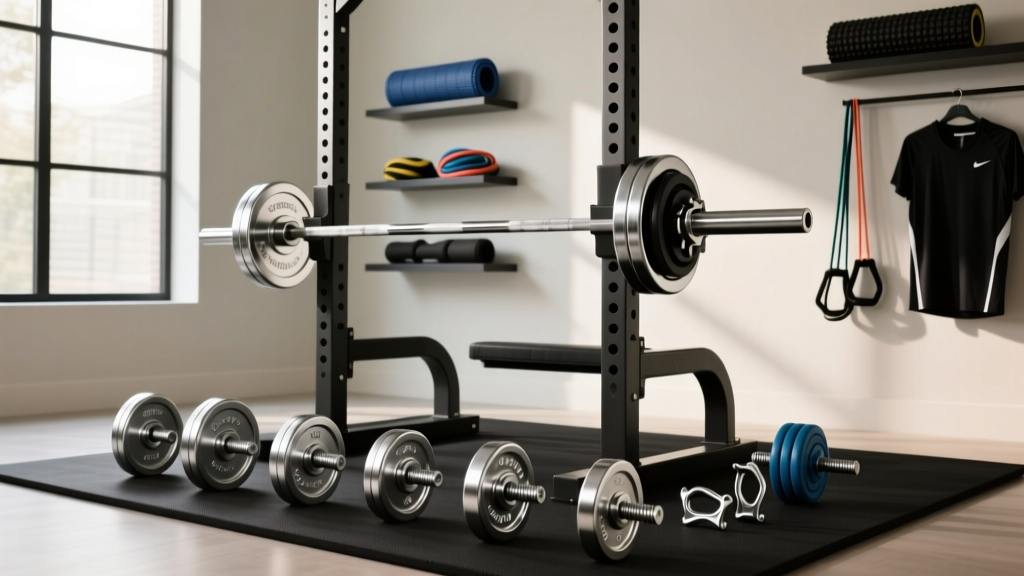
Barbell Clamps for Squats & Any Leg Workout Routine With Dumbbells
Compare spring, clamp, and competition barbell collars. Learn which lock secures heavy squats and complements your leg workout routine with dumbbells.

The Transition: From Dumbbells to the Barbell
Many lifters begin their fitness journey focusing on a leg workout routine with dumbbells. Dumbbell Bulgarian split squats, goblet squats, and Romanian deadlifts are phenomenal for building unilateral strength and correcting imbalances. However, as your strength progresses, you will inevitably hit the ceiling of commercial dumbbell racks—usually around 100 to 120 lbs. When it is time to transition to heavy barbell back squats and front squats to continue overloading the central nervous system, your safety equipment must evolve, too.
While a leg workout routine with dumbbells offers inherent safety (you can simply drop the weights to your sides during failure), a loaded barbell resting on your cervical spine or clavicles requires strict mechanical security. This is where barbell collars and clamps become non-negotiable. A failing collar during a heavy squat does not just risk plates sliding off; it alters the barbell's whip and center of gravity mid-rep, leading to catastrophic spinal torsion.
⚠️ The Physics of Plate Shift
According to biomechanical analyses of Olympic barbells, a standard 20kg power bar is engineered to flex (whip) predictably under loads exceeding 300 lbs. If your plates shift outward by just 4 millimeters on one sleeve due to a weak spring collar, the moment arm changes. This creates an asymmetric oscillation during the concentric phase of a squat, forcing your erector spinae and obliques to compensate for unpredictable lateral torque. Securing the sleeves is a matter of physics, not just tidiness.
Comprehensive Barbell Collar Comparison Matrix
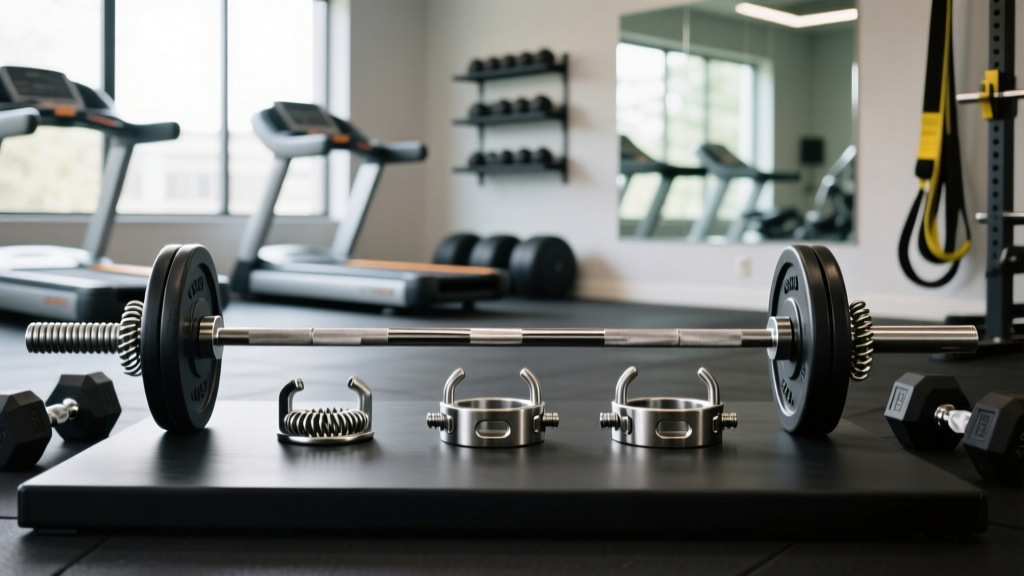
Not all collars are created equal. The market in 2026 is saturated with cheap plastic imitations and high-end aerospace aluminum clamps. Below is a data-driven comparison of the four primary collar types used in home and commercial gyms.
| Collar Type | Holding Force (Axial) | Weight per Collar | Material / Build | Price Range (2026) |
|---|---|---|---|---|
| Spring Clips | ~40 lbs | 0.15 lbs | Zinc-plated spring steel | $5 - $12 (pair) |
| Nylon Clamp (e.g., Lock-Jaw) | ~150 lbs | 0.55 lbs | Glass-filled nylon resin | $25 - $35 (pair) |
| Aluminum Screw Clamp | ~300+ lbs | 1.20 lbs | Extruded 6061 Aluminum | $40 - $65 (pair) |
| IWF Competition Collar | ~500+ lbs | 5.51 lbs (2.5 kg) | Forged steel / Machined aluminum | $120 - $180 (pair) |
Deep Dive: Mechanics, Failure Modes, and Top Models
1. The Spring Clip: A Budget Trap
Standard spring clips rely on the tension of bent steel to grip the 50mm Olympic sleeve. Failure Mode: After approximately 400 to 600 loading cycles, the steel suffers from metal fatigue, losing up to 40% of its axial holding force. Furthermore, they are notoriously difficult to remove with chalky hands or when wearing lifting gloves. We do not recommend spring clips for any heavy compound lifting.
2. Glass-Filled Nylon Clamps (The Home Gym Standard)
Models like the Lock-Jaw Pro utilize a cam-lever mechanism that bites into the steel sleeve. The use of glass-filled nylon provides high tensile strength while keeping the collar lightweight. Edge Case Warning: If your home gym is an uninsulated garage in a northern climate, be aware that nylon resins become brittle at temperatures below 35°F (1.6°C). Dropping a cold nylon clamp on a concrete floor can cause micro-fractures in the hinge mechanism, leading to sudden failure under load.
3. Extruded Aluminum Screw Clamps
For powerlifters and heavy squatters, aluminum clamps (such as the Rogue Fitness Monster Clamps or similar machined variants) are the gold standard. They use a threaded steel bolt that presses a high-durometer rubber pad against the sleeve. Why they excel: The mechanical advantage of the screw thread provides immense clamping force that will not degrade over time. They are impervious to temperature changes and will easily survive being dropped from shoulder height.
4. IWF-Certified Competition Collars
According to the International Weightlifting Federation (IWF) Technical Rules, competition collars must weigh exactly 2.5 kilograms each. These are massive, forged-steel locking mechanisms designed to hold bumper plates secure during explosive Olympic lifts like the clean and jerk. Unless you are an Olympic weightlifter dropping 400+ lbs from overhead, these are overkill and unnecessarily heavy for standard squatting or bodybuilding routines.
Bridging the Gap: Dumbbell Stability vs. Barbell Security
When executing a leg workout routine with dumbbells, the weight is distributed independently in each hand. If your right arm fatigues during a walking lunge, you simply lower the right dumbbell. The left side remains entirely unaffected.
'A barbell couples your limbs into a single kinetic chain. Any shift in the load on the barbell sleeve instantly transfers asymmetric force to your hips and spine. Collars are the mechanical bridge that ensures the barbell behaves as a single, unified mass.' — Biomechanics of Resistance Training
By using high-quality aluminum or nylon clamps, you artificially recreate the 'fixed' stability of a dumbbell. The plates cannot slide, meaning the only variable your central nervous system has to manage is the vertical force vector of the lift, not lateral stabilization of shifting iron.
The 2026 Purchasing Decision Framework
Use this step-by-step framework to select the exact collar for your training style:
- Step 1: Assess Your Max Load. If your working sets for squats or deadlifts are under 225 lbs, and you primarily use cast iron plates, a premium nylon clamp (Lock-Jaw) is sufficient and cost-effective.
- Step 2: Evaluate Your Plate Type. If you use thick rubber bumper plates for deadlifts or drop your barbell after heavy sets, the repeated shockwaves will slowly back out the threads on cheap screw clamps. Invest in machined aluminum clamps with nylon-insert locknuts (Nyloc nuts) to prevent vibration loosening.
- Step 3: Consider Sleeve Real Estate. If you are loading 600+ lbs, you need every millimeter of the 16.3-inch Olympic sleeve. Low-profile aluminum clamps take up only 1.5 inches of sleeve space, whereas bulky competition collars consume over 3 inches, potentially preventing you from loading that final 45-lb plate.
Frequently Asked Questions (FAQ)
Do standard Olympic collars fit hex (trap) bars?
Most hex bars feature standard 50mm Olympic sleeves, meaning standard clamps and collars will fit perfectly. However, some budget hex bars have shorter sleeves (under 10 inches). If you use thick bumper plates on a trap bar, you may find that bulky clamp collars do not have enough physical space to lock onto the sleeve securely. Always measure your sleeve length before buying.
Can I use collars for dumbbell handles?
No. Standard Olympic collars are engineered for 50mm (1.97-inch) barbell sleeves. As noted by exercise databases like ExRx.net, standard spin-lock dumbbell handles are typically 1-inch (25.4mm) or 2-inch (50.8mm) in diameter, and their threading requires specific star-nuts, not friction-based clamps. Attempting to use a barbell clamp on a smooth dumbbell handle is highly dangerous.
How do I clean chalk buildup from my clamp hinges?
Gym chalk (magnesium carbonate) absorbs moisture and turns into a cement-like paste inside the cam-lever hinges of nylon clamps. Every 3 months, use a stiff nylon brush and a blast of compressed air to clear the hinge. Apply a single drop of dry PTFE (Teflon) lubricant to the pivot pin. Avoid wet oils like WD-40, as they will attract more chalk dust and accelerate wear.
More gear to consider
All reviews
Cast Iron vs Competition Kettlebells & Dumbbell Exercises for Rounded Shoulders

Best Neoprene Dumbbells for Side Lunges: 2026 Home Guide
2026 Dumbbell Rack Trends: Storage for Pepin Fast Dumbbells & More
Neoprene Dumbbells & the Dumbbell Hang Clean to Overhead Guide
Barbell Buying Guide: Weight, Knurling & Underhand Dumbbell Fly