
Home Gym in Apartment: Electrical Safety Mistakes & Fixes
Avoid costly and dangerous electrical mistakes when building a home gym in apartment spaces. Learn circuit load limits, GFCI troubleshooting, and safety tips.

Building a home gym in apartment spaces presents a unique set of structural and logistical challenges, but the most overlooked hazard is entirely invisible: electrical overload. Unlike suburban garages or basements where homeowners can easily hire an electrician to run a dedicated 20-amp or 240-volt line, apartment dwellers are bound by existing 15-amp branch circuits, shared neutral wires, and strict lease agreements. When you introduce high-draw motorized fitness equipment into a bedroom or living room circuit already burdened by window AC units and space heaters, the result ranges from nuisance breaker trips to catastrophic electrical fires.
This troubleshooting guide breaks down the most common electrical mistakes made when setting up a home gym in apartment environments and provides actionable, code-compliant solutions to keep your equipment—and your security deposit—safe.
⚠️ Critical Safety Warning: According to the Consumer Product Safety Commission (CPSC), electrical distribution and lighting equipment are leading causes of home structure fires. Never bypass a tripped breaker by replacing it with a higher-amp fuse or breaker; this removes the safety mechanism and guarantees wire melting inside your apartment walls.Mistake #1: Ignoring the NEC 80% Continuous Load Rule
The most frequent mistake apartment gym builders make is assuming a 15-amp circuit can safely deliver 15 amps of continuous power. Under the National Electrical Code (NEC) Article 210.20(A), a circuit breaker should only be loaded to 80% of its maximum rating for continuous loads (defined as running for 3 hours or more, which applies to long endurance treadmill sessions or smart gym classes).
On a standard 15-amp apartment circuit (120 volts), the absolute maximum wattage is 1,800W. However, the safe continuous limit is just 1,440W (12 amps). If your treadmill draws 12 amps and your apartment's window AC unit kicks on (drawing another 5 to 8 amps), the combined 17+ amp draw will instantly trip the breaker.
Appliance Amperage Draw & Circuit Impact Matrix
| Equipment Type | Typical Wattage | Amp Draw (120V) | Circuit Impact on 15A Line |
|---|---|---|---|
| Motorized Treadmill (e.g., NordicTrack 1750) | 1,400W - 1,800W | 11.6A - 15A | Maxes out circuit; requires dedicated line |
| Smart Strength Rig (e.g., Tonal) | 1,200W (Peak) | 10A | High draw; requires dedicated 20A circuit |
| Smart Bike (e.g., Peloton Bike+) | 240W | 2A | Low draw; safe to share with lighting/TV |
| Window AC Unit (10,000 BTU) | 900W - 1,200W | 7.5A - 10A | Severe trip hazard if sharing gym circuit |
| Ceramic Space Heater (High) | 1,500W | 12.5A | Will instantly trip if used with treadmill |
The Fix: Map your apartment’s circuits (see the audit framework below). Motorized treadmills and smart strength systems like Tonal strictly require a dedicated circuit. If your apartment lacks one, consult your landlord about having a licensed electrician install a dedicated 20-amp line. Expect to pay between $150 and $350 for this upgrade, a minor cost compared to replacing a fried $3,000 treadmill motor.
Mistake #2: The Extension Cord Daisy-Chain Death Trap
When designing a home gym in apartment layouts, outlet placement is rarely ideal. This leads to the dangerous reliance on extension cords. The Electrical Safety Foundation International (ESFI) warns that improper extension cord use causes thousands of fires annually due to voltage drop and thermal overload.
Treadmills utilize high-torque DC motors that require a massive initial surge of current (inrush current) to start the belt. If you use a standard, thin 16 AWG (American Wire Gauge) household extension cord, the wire acts as a resistor. This creates a voltage drop that starves the motor, causing it to overheat, degrade the control board, and potentially melt the cord's insulation.
- 16 AWG Cords: Rated for ~10 amps. Never use for motorized fitness equipment.
- 14 AWG Cords: Rated for ~15 amps. Acceptable for smart bikes or rowers, but not heavy treadmills.
- 12 AWG Cords: Rated for ~20 amps. The only acceptable gauge for motorized treadmills if a dedicated wall outlet is unreachable.
Troubleshooting GFCI Nuisance Tripping on Motorized Equipment
Many modern apartments feature GFCI (Ground Fault Circuit Interrupter) outlets in bedrooms or living areas near balconies or wet bars. A common and highly frustrating issue when setting up a home gym in apartment spaces is the treadmill repeatedly tripping the GFCI outlet mid-workout.
Why Does This Happen?
- Motor Brush Dust: Over time, the carbon brushes inside the treadmill’s DC motor wear down, creating conductive dust that can cause micro-leakages to the ground wire, tricking the GFCI into detecting a fault.
- Static Electricity Buildup: The friction of the treadmill belt generates static voltage. Without proper grounding, this static discharges into the control board and leaks to the ground, tripping sensitive GFCI sensors.
- Back-EMF (Electromotive Force): When you step off a moving treadmill belt, the motor acts as a generator, sending a reverse voltage spike back into the circuit.
How to Fix It
Do not replace the GFCI outlet with a standard outlet; this violates electrical code and removes life-saving shock protection. Instead, troubleshoot the equipment:
- Lubricate and Clean: Apply 100% silicone treadmill lubricant to the deck to reduce friction and static. Vacuum the motor hood (while unplugged) to remove conductive carbon dust.
- Use an Anti-Static Mat: Place a high-density PVC equipment mat under the machine and ensure the user wears moisture-wicking socks to ground the static charge.
- Check the Grounding Prong: Ensure the treadmill’s 3-prong plug is not damaged and that the apartment outlet actually has a functional ground wire (test with a $15 receptacle tester).
Mistake #3: Skipping Surge Protection for Smart Fitness Tech
In 2026, fitness equipment is essentially heavy machinery married to high-end computing. Smart treadmills, interactive rowers, and AI-driven strength rigs feature sensitive LCD/OLED touchscreens and complex logic boards. Plugging a $3,500 smart treadmill directly into a wall outlet leaves it vulnerable to grid surges and the aforementioned Back-EMF spikes.
A standard $15 power strip offers zero surge protection; it merely provides extra outlets. You need a UL-listed surge protector with a high Joule rating and EMI/RFI noise filtering to protect the console's logic board from voltage spikes and dirty power.
Recommended Spec: Look for a surge protector rated for at least 2,000 Joules with a clamping voltage of 330V or lower. Models like the Tripp Lite ISOBAR6ULTRA (approx. $65) or the APC Performance SurgeArrest series provide the necessary isolated filter banks to separate the motor's noise from the console's delicate power supply.
Step-by-Step Apartment Circuit Audit Framework
Before plugging in your new equipment, perform this 15-minute audit to map your apartment’s electrical layout and avoid overloading shared circuits.
- Locate the Panel: Find your apartment's breaker box. If it's in a shared utility closet, get permission from maintenance to access it.
- The 'Flip and Map' Test: With all lights and appliances on, flip one breaker to OFF. Walk through the apartment and note every dead outlet, light, and appliance. Label the breaker in the panel (e.g., 'Master Bed / West Wall').
- Identify Shared Loads: Plug a lamp into the outlet where your treadmill will go. Turn on the room's window AC unit and a space heater. If the breaker trips before you even start the treadmill, that circuit is already at capacity.
- Verify Dedicated Lines: Check if major appliances (microwave, fridge, AC) share the same breaker as your planned gym wall. If they do, you must relocate your gym equipment to a different wall on a lighting-only circuit.
Summary: Prioritize Power Infrastructure
Designing a home gym in apartment spaces requires looking past the aesthetics of mirrors and rubber flooring to address the critical power infrastructure. By respecting the 80% continuous load rule, utilizing 12 AWG cords, actively troubleshooting GFCI static leaks, and deploying high-joule surge protection, you ensure your workouts are interrupted only by your own fatigue—not by a tripped breaker or a fried console board.
More gear to consider
All reviews
Beginner Starter Kit for Your Marcy Home Gym Routine
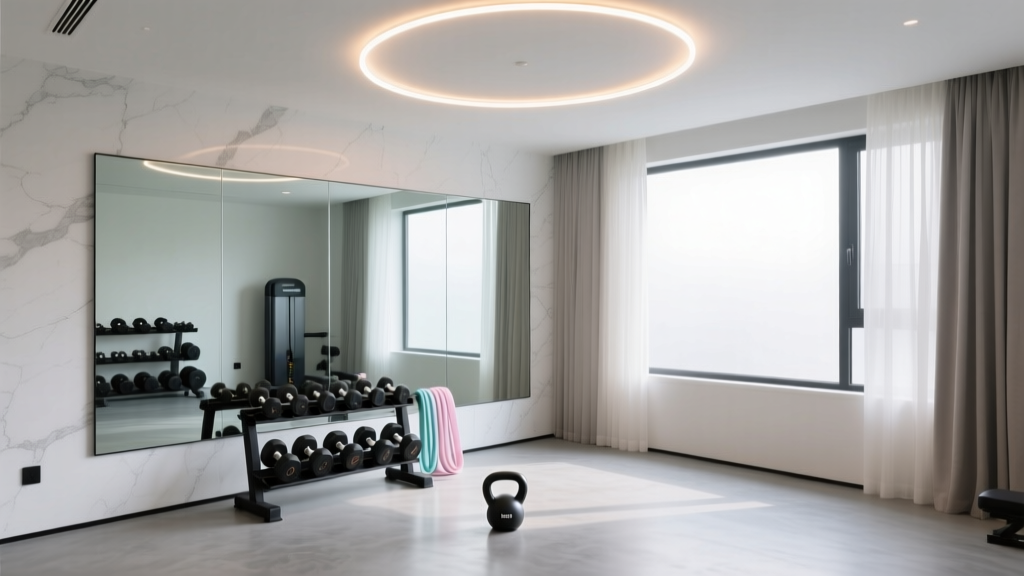
Minimalist Home Gym Design Trends 2026: Mirror & Lighting Showdown

How Much Weight Is a Leg Press Machine? Layout & Floor Guide

Compact Luxury Home Gym Trends 2026: Mirror & Lighting Budget Guide

Weatherproof Outdoor Gym Setup & Home Gym Workout Plan PDF
