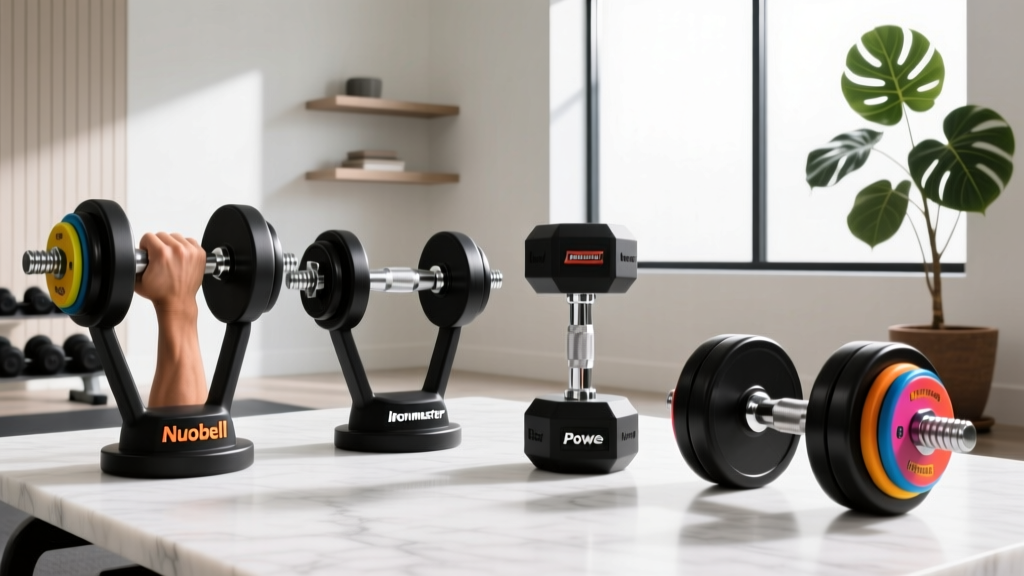
Best Adjustable Dumbbells for the Narrow Dumbbell Press: 2026 Review
Discover which adjustable dumbbells survive the narrow dumbbell press. We compare Nuobell, Bowflex, Ironmaster, and PowerBlock for plate clash and ergonomics.

The Biomechanical Problem with Adjustable Dumbbells
The narrow dumbbell press—often referred to as the dumbbell squeeze press or close-grip dumbbell press—is a staple movement for targeting the sternal head of the pectoralis major and the anterior deltoids. By pressing the medial (inner) edges of the dumbbells together and maintaining an isometric squeeze throughout the range of motion, you create continuous adduction tension that standard presses cannot replicate. According to biomechanical analyses of chest movements, this constant adduction forces the pectoral fibers to remain under peak tension even at the top of the concentric phase.
However, if you are using adjustable dumbbells, this exercise quickly exposes a major design flaw in many popular models: medial plate collision. When the inner weight plates or selector housings are too wide or blocky, the dumbbells collide before your hands can get close enough to achieve a true narrow grip. Furthermore, excessively wide handles force the wrists into severe ulnar deviation, placing dangerous torque on the radiocarpal joint. In this 2026 head-to-head review, we test the top adjustable dumbbells specifically for their viability during the narrow dumbbell press.
The Squeeze Press Collision Point
For a proper narrow dumbbell press, the handles must be able to approach within 2 to 4 inches of each other. If the dumbbell's medial profile exceeds this threshold, the weights will clang together at the top of the movement, ruining the isometric tension and potentially chipping the floor or your equipment.
Head-to-Head Comparison Matrix
Below is our benchmark data for the four most popular adjustable dumbbell systems on the market, evaluated strictly on their geometry, handle ergonomics, and suitability for close-grip pressing.
| Model (2026) | Overall Length | Medial Profile | Handle Knurling | Narrow Press Rating | Current Price |
|---|---|---|---|---|---|
| Nuobell 552 | 15.7 inches | Tapered / Flush | Moderate | 9.5 / 10 | $429 |
| Ironmaster Quick-Lock | 14.5 inches | Traditional Round | Aggressive | 9.0 / 10 | $359 |
| PowerBlock Elite USA | 12.0 inches | Enclosed Cage | Smooth / Knurled | 6.5 / 10 | $329 |
| Bowflex SelectTech 552 | 16.9 inches | Wide Flat Block | Light | 3.0 / 10 | $399 |
Nuobell 552: The Ergonomic Champion
The Nuobell 552 has rapidly become the gold standard for home gym enthusiasts who prioritize traditional dumbbell geometry. Unlike dial-based systems, Nuobell uses a twist-lock handle mechanism that allows the weight plates to sit remarkably flush with the handle.
Why it Wins for the Narrow Press
When executing the narrow dumbbell press, the Nuobell's medial plates taper inward. This allows you to bring the handles within 3 inches of each other at the peak of the concentric squeeze. The handle length is a standard 5.5 inches, meaning your wrists remain in a neutral, stacked position without the ulnar deviation required by wider adjustable models. The knurling is present but not abrasive, which is ideal since the squeeze press causes significant grip fatigue due to the constant isometric adduction.
- Pros: Traditional shape, zero plate clash, excellent wrist neutrality, rapid weight changes.
- Cons: Higher price point ($429), twist mechanism requires two hands to adjust safely.
Ironmaster Quick-Lock: The Heavy-Duty Contender
Ironmaster dumbbells are essentially indestructible, machined from solid steel and iron. They utilize a screw-lock pin mechanism that, while slower to adjust, guarantees zero mechanical failure.
Performance on the Squeeze Press
Because Ironmaster uses traditional circular weight plates rather than rectangular blocks, the medial profile is naturally rounded. You can press the dumbbells together until your knuckles are nearly touching. The aggressive knurling is a double-edged sword: it ensures the dumbbell won't slip from your hands during a heavy 80-lb squeeze press, but it will tear up your calluses over high-rep sets. Furthermore, the overall length of the 75-lb base set is a compact 14.5 inches, keeping the center of gravity tight and manageable over the sternum.
Expert Insight: When performing heavy narrow presses, grip strength is often the limiting factor before pectoral failure. The Ironmaster's deep knurling allows you to rely on friction rather than pure crushing grip strength, saving your forearms for the actual pressing movement.
Bowflex SelectTech 552: The Collision Culprit
The Bowflex 552 is arguably the most recognizable adjustable dumbbell in the world, but it is fundamentally incompatible with the narrow dumbbell press.
The Failure Mode
The Bowflex utilizes a wide, flat medial plate housing to accommodate its internal selector dial mechanism. The overall length of the dumbbell is a massive 16.9 inches. When you attempt to bring the dumbbells together for a squeeze press, the wide plastic and iron housings collide when your hands are still 7 to 8 inches apart. This completely defeats the purpose of the exercise, as you cannot achieve the peak adduction required to stimulate the inner sternal fibers. Additionally, the 6-inch handle length forces the wrists outward, creating painful joint angles when the weights are pressed together. If the narrow dumbbell press is a staple in your programming, avoid the Bowflex 552.
PowerBlock Elite USA: The Unconventional Squeeze
PowerBlock's cubic, cage-like design is incredibly space-efficient, but it presents a unique hazard for close-grip movements.
Knuckle Clearance Issues
With PowerBlock, your hand sits inside the weight cage. When you attempt a narrow dumbbell press, the medial cages collide. While the compact 12-inch length means the weights can get physically close, the steel support bars of the cage will scrape directly against your knuckles and fingers as you squeeze them together. You can mitigate this by wearing weightlifting gloves or wrapping the medial bars in athletic tape, but out of the box, it is a painful and frustrating experience for high-volume hypertrophy work.
Execution Guide: Perfecting the Narrow Dumbbell Press
To maximize the hypertrophic benefits of the narrow dumbbell press, proper setup and execution are non-negotiable. The National Strength and Conditioning Association (NSCA) notes that grip width drastically alters the moment arm and muscle recruitment patterns of the pressing musculature.
- The Setup: Set an adjustable bench to a 15-degree or 30-degree incline. A flat bench works, but a slight incline better aligns the resistance vector with the clavicular and upper sternal fibers.
- The Grip: Use a neutral grip (palms facing each other). Select a weight that is roughly 40-50% of your standard dumbbell press working weight. The isometric squeeze will fatigue you faster than the concentric press.
- The Descent: Lower the dumbbells toward your lower sternum, keeping the medial edges in light contact. Flare the elbows slightly, but keep them tucked at roughly a 45-degree angle to protect the rotator cuff.
- The Squeeze and Press: Drive the weights up while actively trying to crush the dumbbells together. As detailed in ExRx's anatomical breakdown of the pectoralis major, horizontal adduction is the primary function of the chest; the squeeze ensures this function is active through the entire lockout.
- The Lockout: Stop just short of elbow lockout to maintain continuous tension on the chest and prevent the triceps from taking over the load.
Final Verdict & Buying Framework
Not all adjustable dumbbells are created equal, and specialty movements like the narrow dumbbell press expose the geometric limitations of space-saving designs.
The 2026 Buyer's Decision Tree
- Choose Nuobell 552 if: You want the closest experience to traditional commercial dumbbells, prioritize wrist ergonomics, and have the budget for premium engineering.
- Choose Ironmaster Quick-Lock if: You lift heavy, drop your weights occasionally, and want a traditional round-plate profile that allows for deep adduction without mechanical fragility.
- Avoid Bowflex 552 if: You frequently program squeeze presses, close-grip flyes, or any movement requiring the dumbbells to touch.
For more foundational movement patterns, refer to the ACE Fitness Exercise Library to ensure your standard pressing mechanics remain sound before introducing complex adduction variations.
Ultimately, the narrow dumbbell press is an invaluable tool for chest development, but it demands equipment that respects human biomechanics. By selecting a dumbbell with a tapered or traditional medial profile, you ensure that the only thing failing during your set is your pectoral muscle—not your equipment's geometry.
More gear to consider
All reviews
Collar Clamp Types Compared: Barbells vs. Dumbbell Power Cleans

Olympic Barbell Knurling Guide & Alternating Dumbbell Press

Bumper vs Iron Plates: Budgeting for the Dumbbell Power Clean

EZ vs Straight Bar Maintenance & Dumbbell Bench Press Care
Barbell Collar Setup & Grip Prep for Dumbbell Curls for Forearms
