
Where to Donate Fitness Equipment: Nonprofit Pickup Services Near You
A comprehensive guide to donating used fitness equipment. Covers national nonprofits with free pickup services, tax deduction rules, equipment preparation, and local donation options.

The easiest way to donate used fitness equipment is through national nonprofits that offer free pickup services — Goodwill, The Salvation Army, and Habitat for Humanity ReStore all accept gym equipment and will schedule a home pickup in most metropolitan areas. Equipment must be in working condition, and donors can claim tax deductions based on fair market value (IRS Publication 561). This guide covers every major donation channel, how to prepare your equipment, and how to maximize your tax write-off.
Why Donate Instead of Selling or Disposing?
Used fitness equipment has a short resale window. Treadmills lose 50-70% of their value within the first year (Consumer Reports, 2024), and the used market is flooded with post-pandemic home gym equipment. Selling takes time, effort, and often results in lowball offers from buyers who expect steep discounts.
Donation offers three advantages: free pickup (no heavy lifting on your part), immediate tax deductions (typically $50-$500 per item depending on condition), and the satisfaction of supporting community programs. Habitat for Humanity ReStores specifically use fitness equipment sales to fund homebuilding projects in underserved communities.
National Organizations with Free Pickup Services
| Organization | Equipment Accepted | Pickup Area | Scheduling | Tax Receipt |
|---|---|---|---|---|
| Goodwill Industries | Small-to-medium equipment (dumbbells, bands, yoga mats, light cardio) | Most US metro areas | Online or phone, 3-7 day window | Yes (itemized) |
| The Salvation Army | Most equipment including treadmills, bikes, weight sets | Most US metro areas | Online, 5-10 day window | Yes (itemized) |
| Habitat for Humanity ReStore | All equipment including heavy machines (racks, benches, multi-gyms) | 1,000+ US locations | Phone, 7-14 day window | Yes (itemized with values) |
| Planet Aid (Yellow Bins) | Small items only (bands, mats, accessories) | Mid-Atlantic and Northeast US | Drop-off at yellow bins | Yes (weight-based) |
| Veterans of Foreign Wars (VFW) | Varies by local post | Local only | Contact local post | Yes |
| Local YMCAs / Community Centers | All types, especially commercial-grade | Local delivery usually required | Direct contact | Yes |
Goodwill Industries
Goodwill accepts smaller fitness equipment — dumbbells, kettlebells, resistance bands, yoga mats, foam rollers, stability balls, and light cardio machines (under 100 lbs). Large equipment like treadmills and power racks are typically declined due to transport logistics. Schedule pickup at goodwill.org or call your regional Goodwill directly.
Goodwill provides a blank tax receipt at pickup. You must fill in item descriptions and values yourself. Keep photos of donated items as supporting documentation for IRS purposes.
The Salvation Army
The Salvation Army has broader acceptance criteria than Goodwill and will pick up treadmills, ellipticals, stationary bikes, and weight benches in most markets. Their scheduling system at satruck.org lets you select a date and describe your items online. Pickup is free and drivers handle all loading.
Condition requirement: equipment must be functional and not recalled. Cosmetic wear is acceptable. The Salvation Army sells donated fitness equipment at their Family Stores, with proceeds funding adult rehabilitation programs.
Habitat for Humanity ReStore
Habitat ReStores are the best option for heavy or bulky equipment. They accept power racks, Smith machines, cable machines, commercial treadmills, and full weight sets. Many ReStore locations have box trucks and loading crews specifically equipped for heavy items.
ReStores price donated equipment at 50-80% below retail, making fitness gear accessible to low-income families. Your tax receipt from Habitat includes estimated values for each item, which simplifies tax documentation. Find your nearest ReStore at habitat.org/restore.
Preparing Equipment for Donation
Proper preparation ensures your equipment is accepted and maximizes its useful life for the next owner.
Step-by-Step Preparation Checklist
- Deep clean all surfaces: Use a disinfectant cleaner on handles, seats, and touchpoints. For cardio machines, wipe down the console, handrails, and belt. Remove sweat residue and any visible dirt.
- Test all functions: Run the treadmill for 5 minutes, check all resistance levels on a bike, verify that weight stack pins engage properly. Note any malfunctions.
- Lubricate moving parts: Apply silicone lubricant to treadmill belts, oil pivot points on weight machines, and grease any squeaky joints. A well-maintained machine is more likely to be accepted.
- Include all accessories: Safety keys, power cords, remote controls, assembly manuals, and any original attachments. Missing parts reduce the equipment's value and may cause rejection.
- Take photographs: Photograph each item from multiple angles in good lighting. These photos serve dual purposes: they document condition for your tax records and can be shared with the receiving organization.
- Measure and weigh: Record dimensions and approximate weight. Large items need truck space planning, and accurate measurements help the pickup team prepare appropriately.
- Clear the path: Ensure a clear path from the equipment's location to your front door or garage. Remove obstacles, open gates, and if possible, move the equipment to the ground floor.
Tax Deductions: How to Value Your Donation
The IRS allows you to deduct the fair market value (FMV) of donated property. FMV is defined as "the price a willing buyer would pay a willing seller" for the item in its current condition (IRS Publication 561). For used fitness equipment, FMV is typically 20-40% of the original retail price for items in good condition.
Fair Market Value Reference Table
| Equipment Type | Original Price Range | FMV (Good Condition) | FMV (Fair Condition) |
|---|---|---|---|
| Treadmill (mid-range) | $800-$2,000 | $200-$600 | $100-$300 |
| Elliptical machine | $500-$1,500 | $150-$400 | $75-$200 |
| Stationary bike | $300-$1,200 | $100-$350 | $50-$150 |
| Power rack | $300-$800 | $100-$300 | $50-$150 |
| Adjustable dumbbell set | $200-$600 | $80-$200 | $40-$100 |
| Weight bench | $100-$400 | $40-$120 | $20-$60 |
| Kettlebell set | $50-$200 | $20-$80 | $10-$40 |
| Resistance band set | $15-$50 | $5-$20 | $3-$10 |
Documentation Requirements by Deduction Amount
| Total Deduction | Documentation Required |
|---|---|
| Under $250 | Receipt from organization (name, date, description of items) |
| $250-$500 | Written acknowledgment from organization + your records (photos, values) |
| $500-$5,000 | All above + Form 8283 (Section A) filed with tax return |
| Over $5,000 | All above + qualified appraisal + Form 8283 (Section B) |
Important: You must itemize deductions on Schedule A to claim charitable donations. If you take the standard deduction, you cannot claim donated equipment. In 2025, the standard deduction is $15,000 (single) or $30,000 (married filing jointly). Itemizing only makes sense if your total deductions exceed these amounts.
Local Donation Options Beyond National Chains
National organizations are convenient, but local recipients often put your equipment to more direct use:
- Schools and universities: High school athletic departments and college rec centers often accept used equipment. Contact the athletic director or facilities manager directly.
- Community centers and YMCAs: Local Y branches frequently need replacement equipment and may arrange their own pickup for large items.
- Women's shelters and rehabilitation centers: Many shelters operate fitness programs for residents. Donating directly provides immediate community impact.
- Fire stations and police departments: Many first responder stations maintain small fitness areas and welcome donated equipment.
- Senior living facilities: Assisted living communities often need low-impact equipment like recumbent bikes and resistance bands for resident exercise programs.
- Churches and religious organizations: Many churches run community fitness programs and accept equipment donations.
When Equipment Cannot Be Donated
Organizations will reject equipment that is non-functional, recalled, or poses safety hazards. If your equipment falls into these categories:
- Recycling: Most municipal recycling centers accept metal fitness equipment. Treadmills and bikes contain significant steel and aluminum. Some scrap metal dealers will pick up heavy equipment for free and pay you for the metal value.
- Manufacturer take-back: Some brands (Peloton, NordicTrack) offer trade-in or recycling programs for their own equipment. Check the manufacturer's website for current programs.
- Junk removal services: 1-800-GOT-JUNK and similar services will remove any equipment for a flat fee ($100-$300 depending on size). This is the fastest option for non-donatable equipment.
- Parts harvesting: Before disposing, remove reusable components — weight plates, resistance bands, cables, and electronic consoles can often be donated separately even if the main frame cannot.
Frequently Asked Questions
Can I donate a treadmill that needs minor repairs?
It depends on the organization. Habitat for Humanity ReStores sometimes accept equipment needing minor repairs if the fix is straightforward (belt replacement, lubrication). The Salvation Army and Goodwill generally require fully functional equipment. Call ahead and describe the issue — some organizations have volunteer repair teams.
How do I get a tax receipt for fitness equipment donation?
All major organizations provide tax receipts at pickup or drop-off. For donations over $250, you need a written acknowledgment that includes the organization's name, date of donation, and description of items. Habitat ReStore provides the most detailed receipts with estimated values.
Will the pickup team disassemble my equipment?
Mostly no. Goodwill and Salvation Army drivers typically expect equipment to be accessible and movable as-is. Habitat ReStore crews are more likely to help with basic disassembly (removing treadmill handles, detaching weight stacks). If equipment is on an upper floor, consider moving it to the garage or ground level before pickup day.
Can I donate fitness equipment to international charities?
Most domestic nonprofits do not ship equipment internationally. However, organizations like Kids in Need Foundation and Project Hope sometimes accept bulk fitness equipment for international programs. Contact them directly to inquire about current needs.
Is there a limit on how much I can deduct for equipment donations?
You can deduct up to 60% of your adjusted gross income (AGI) for charitable donations to public charities in 2025. Amounts exceeding this limit can be carried forward for up to 5 years. For most individual donors, this limit is never reached.
More gear to consider
All reviews
Installing a Dumbbell Rack 5 75 lb Set & Kettlebell Storage

Titan Fitness Dumbbell Rack & Barbell Storage: Horizontal vs Vertical

Best Dumbbell Weight Holder Racks: 2026 Comparison
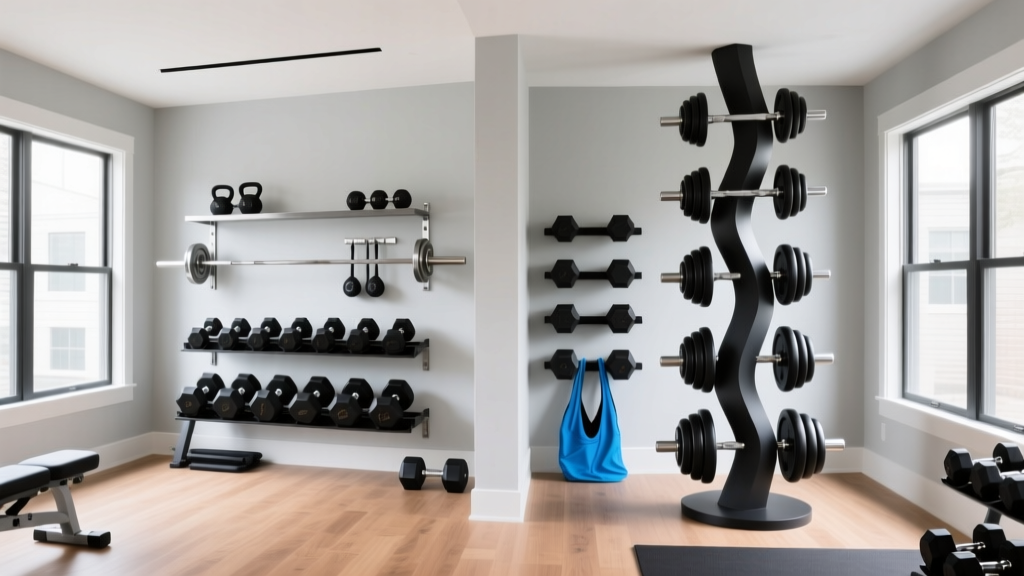
Wall Storage vs a Dumbbell Tree with Weights: Space Layout Guide

Cap Barbell A-Frame Dumbbell Rack vs Kettlebell Racks: 2026 Guide
