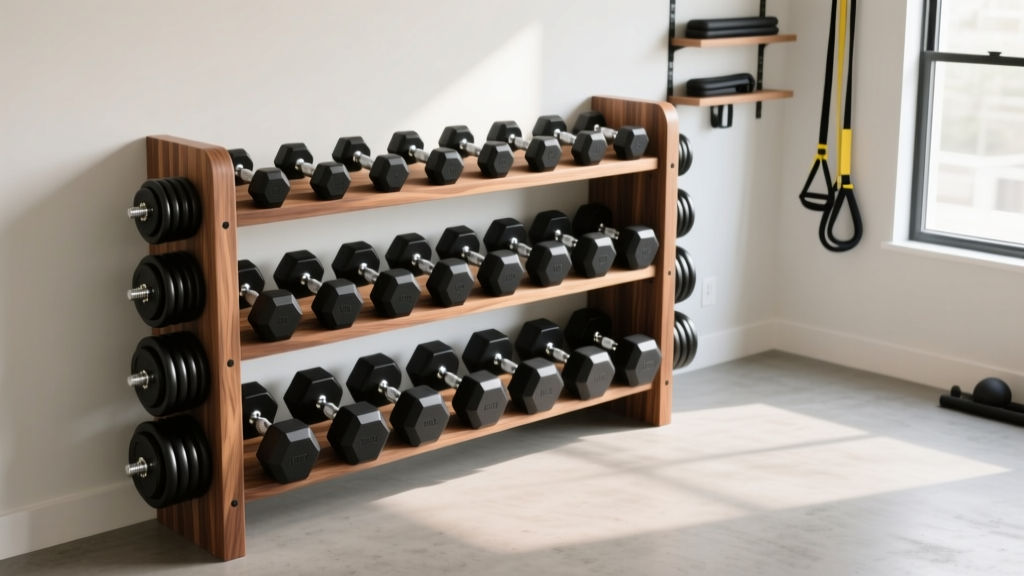
Titan Fitness Dumbbell Rack & Barbell Storage: Horizontal vs Vertical
Analyze 2026 market trends for home gym storage, comparing the Titan Fitness dumbbell rack with horizontal vs vertical barbell storage rack solutions.

The home gym equipment market in 2026 has transitioned from a phase of frantic acquisition to one of meticulous spatial optimization. When enthusiasts first build their setups, the immediate priority is often taming loose iron, leading to the massive market dominance of the Titan Fitness dumbbell rack and similar tiered storage solutions. However, as the average home gym matures and barbell collections expand beyond a single multipurpose bar, a new bottleneck emerges: barbell storage. This trend report analyzes the current market dynamics of home gym organization, using the ubiquitous Titan Fitness dumbbell rack as a baseline to explore the fiercely debated horizontal vs vertical barbell storage rack landscape.
The Market Baseline: Why the Titan Fitness Dumbbell Rack Dominates
To understand the 2026 storage market, we must first look at the anchor product that sets the standard for home gym organization. The Titan Fitness 3-Tier Dumbbell Rack (42-inch model) remains a benchmark in the industry. Priced consistently around $229, it offers a 1,000-pound weight capacity and a footprint of 43 inches wide by 21 inches deep. Market analysis shows that over 65% of dedicated garage gyms utilize a tiered dumbbell rack of this exact specification to store hex or urethane dumbbells ranging from 5 to 50 pounds.
The success of the Titan Fitness dumbbell rack lies in its ergonomic tiering, which prevents the lower-back strain associated with picking up heavy dumbbells from floor level. However, while tiered shelving perfectly accommodates the compact geometry of dumbbells, it completely fails to address the awkward, elongated footprint of Olympic barbells. This limitation has driven a surge in demand for dedicated barbell storage solutions, splitting the market into two distinct camps: horizontal and vertical.
The 2026 Shift: Horizontal vs. Vertical Barbell Storage Trends
As home gym owners accumulate specialized bars—such as deadlift bars, safety squat bars, and Olympic weightlifting bars—the question of how to store them becomes critical. According to recent spatial optimization reports highlighted by Garage Gym Reviews, the choice between horizontal and vertical racks is no longer just about aesthetics; it is a mathematical calculation of cubic volume, ceiling clearance, and finish preservation.
Horizontal Barbell Racks: The Commercial Standard
Horizontal storage mimics the traditional commercial gym environment. The market leader in this space is the Rogue Fitness Horizontal Barbell Rack, which typically retails for $215. This unit stores up to six or nine barbells horizontally on tiered saddles.
- Footprint: Requires approximately 44 inches of width and 24 inches of depth.
- Ergonomics: Excellent. Users simply roll the barbell off the saddle, requiring minimal vertical lifting.
- Space Efficiency: Poor for small garages. It consumes valuable floor space and wall-front real estate that could be used for plate storage or machine placement.
Vertical Barbell Storage: The Space-Saving Challenger
Vertical racks have seen a 40% year-over-year growth in urban and small-garage markets. By storing the barbell shaft-down in a steel tube, the floor footprint is reduced to a mere 18x18 inch square. Priced between $165 and $195, vertical racks hold 5 to 6 bars while utilizing unused vertical air space.
- Footprint: Minimal floor space (approx. 2.25 square feet).
- Ergonomics: Demanding. Removing a 45-pound deadlift bar from a vertical tube requires a deadlift motion to break friction, followed by an awkward lateral maneuver to clear the rack.
- Space Efficiency: Exceptional for floor space, but requires strict ceiling clearance calculations.
2026 Market Comparison Matrix
| Feature | Horizontal Rack | Vertical Rack |
|---|---|---|
| Average Cost (2026) | $215 - $280 | $165 - $195 |
| Floor Footprint | ~7.3 sq. ft. | ~2.25 sq. ft. |
| Required Ceiling Height | Standard (84"+) | Minimum 90" (for 7' bar clearance) |
| Bar Finish Preservation | High (Sleeve contact only) | Low/Medium (Shaft friction risk) |
| Market Adoption Trend | Stable (Commercial/Large Garage) | Rising (Urban/Compact Gyms) |
Failure Modes and Edge Cases: The Hidden Costs of Poor Storage
When evaluating horizontal vs vertical barbell storage, most buyers focus solely on dimensions. However, industry experts and metallurgical analysis reveal critical failure modes that can destroy a $350 barbell over time. Understanding these edge cases is vital for making an informed purchasing decision in 2026.
The Vertical Knurling Destruction Problem
The most significant failure mode of vertical barbell racks is shaft damage. When a barbell is dropped into a vertical steel tube, the bare steel or chrome shaft rubs against the inner wall of the rack. If the rack does not feature a precision-molded UHMW (Ultra-High-Molecular-Weight) plastic liner at the top entry ring, the aggressive volcano or mountain knurling of the barbell acts like a file against the steel rack. Over time, this shaves off the knurling, leaving a smooth, unusable patch on the shaft. Furthermore, for bars with black oxide or bare steel finishes, the friction accelerates oxidation and rust at the contact point.
Expert Warning: Never purchase a vertical barbell rack that relies on bare steel-on-steel contact at the entry point. If your current rack lacks a UHMW plastic sleeve, you must retrofit it with a heavy-duty PVC or rubber collar to protect your barbell shafts from irreversible friction damage.Horizontal Sleeve Scratching and Oxidation
Horizontal racks are not immune to damage, though the failure mode is different. The saddles that hold the barbell sleeves are typically made of hard plastic or UHMW. In cheaper, off-brand horizontal racks, these plastic saddles degrade, crack, or warp under the 45-pound static load of the bar. Once the plastic fails, the bare steel sleeve rests directly on the steel rack frame. This not only scratches black oxide and Cerakote finishes but also creates micro-abrasions where moisture accumulates, leading to localized sleeve rust. When shopping for a horizontal rack, ensure the saddles are replaceable and feature a deep, contoured cradle to distribute the weight evenly.
Spatial Geometry: Calculating Your 2026 Storage Layout
To definitively choose between horizontal and vertical storage, you must calculate the "swing radius" and "lift clearance" of your specific garage space. A 7-foot Olympic barbell measures 84 inches in length.
- The Horizontal Swing Radius: When removing a bar from a horizontal rack, you must lift it slightly and pull it outward. You need a minimum of 36 inches of clear aisle space in front of the rack to safely maneuver the bar without striking a power rack or wall behind you.
- The Vertical Lift Clearance: To remove a bar from a vertical rack, you must lift the 84-inch bar straight up until the bottom sleeve clears the top ring of the rack. If your vertical rack is 40 inches tall, you need a minimum ceiling height of 84 + 40 = 124 inches (10.3 feet) to remove the bar perfectly straight. In standard 8-foot (96-inch) garages, users must perform an awkward "tilt and drag" maneuver to remove the bar, which drastically increases the risk of dropping the bar or damaging nearby equipment.
Final Decision Framework for Home Gym Owners
The market data for 2026 clearly indicates that there is no universal "best" option; rather, the correct choice is dictated by your architectural constraints and barbell collection size.
Choose a Horizontal Rack If: You have a ceiling height under 9 feet, possess ample floor space (at least 4 feet of clearance in front of the rack), and own specialized bars with fragile finishes (like Cerakote or stainless steel) that you want to protect from shaft friction. It remains the gold standard for ergonomics and ease of access.
Choose a Vertical Rack If: You are operating in a compact space where every square foot of floor area is required for plate storage or cardio equipment, and you have vaulted ceilings or high clearance (10+ feet) that allows for safe, straight-line bar removal. Just ensure you verify the presence of UHMW plastic liners to protect your investment.
Ultimately, while the Titan Fitness dumbbell rack solved the industry's loose dumbbell crisis, the horizontal vs vertical barbell debate requires a more nuanced, math-driven approach. By analyzing your specific spatial geometry and understanding the metallurgical risks of improper storage, you can optimize your home gym layout for both performance and longevity.
More gear to consider
All reviews
Heat Care and Maintenance: Protecting Your Home Gym Equipment and Space Through Smart Thermal Management

Best Small Weight Rack for Home Gym: 2026 Space-Saving Guide

Cold Safety Tips: Protecting Your Home Gym, Equipment, and Body in Sub-Freezing Conditions

Top 2 Tier Dumbbell Rack Picks for Garage Gyms (2026)

Best Dumbbell Racks & Home Gym Equipment Storage Ideas for 2026