
Small Home Gym Layout: Dual-Purpose Office Setup Walkthrough
Transform your workspace with our step-by-step small home gym layout guide. Discover dual-purpose office setups, space-saving gear, and installation tips.

The permanent shift toward remote work has forced a massive evolution in how we utilize our living spaces. For fitness enthusiasts operating out of apartments or modest homes, dedicating an entire room to a gym is rarely feasible. The solution? A dual-purpose home office and workout space. However, merging a high-tech workspace with a high-sweat environment requires meticulous planning to avoid ruining your electronics or compromising your ergonomics.
In this complete setup and installation walkthrough, we will break down exactly how to design a small home gym layout that seamlessly transitions from a morning productivity hub to an afternoon training zone. We will cover spatial zoning, flooring installation, climate control, and the exact gear you need to make this hybrid room function flawlessly in 2026.
Room Assessment & The Sweat-Tech Divide
The most common failure mode in dual-purpose rooms is environmental cross-contamination. Treadmills and kettlebells generate humidity, airborne dust, and vibration, all of which are lethal to PC towers, monitors, and ergonomic desk chairs. Before buying a single piece of equipment, you must establish the "Sweat-Tech Divide."
Minimum Spatial Requirements
To safely execute a dual-purpose layout, your room must meet these baseline dimensions:
- Total Room Size: Minimum 10x12 feet (120 sq ft).
- Workspace Zone: 4x6 feet for desk, chair clearance, and filing.
- Workout Zone: 6x8 feet of unobstructed clearance (per American Council on Exercise guidelines for free-range movements).
- Buffer Zone: At least 24 inches of separation between your heaviest equipment and your electronics.
The Ideal Small Home Gym Layout Blueprint
When mapping your small home gym layout, orientation is everything. Never place your desk directly in the line of fire of your workout zone. If you are doing dumbbell lunges or kettlebell swings, a stray weight can easily shatter a $1,500 ultrawide monitor.
Zone A: The Ergonomic Workspace
Position your desk near a window for natural light, which regulates circadian rhythms for both work and training. According to Cornell University Ergonomics guidelines, your monitor should be an arm's length away, with the top of the screen at or slightly below eye level. Use a desk with lockable casters or a folding wall-mounted desk (like the Haotian FWT18-W, approx. $110) to instantly reclaim 15 square feet of floor space when it is time to train.
Zone B: The High-Yield Workout Area
Place your gym zone closest to the HVAC vent or a window. This ensures that airborne sweat and humidity are immediately pulled into the return air system or ventilated outside, rather than settling onto your keyboard and motherboard.
Equipment Selection: Gear That Works Overtime
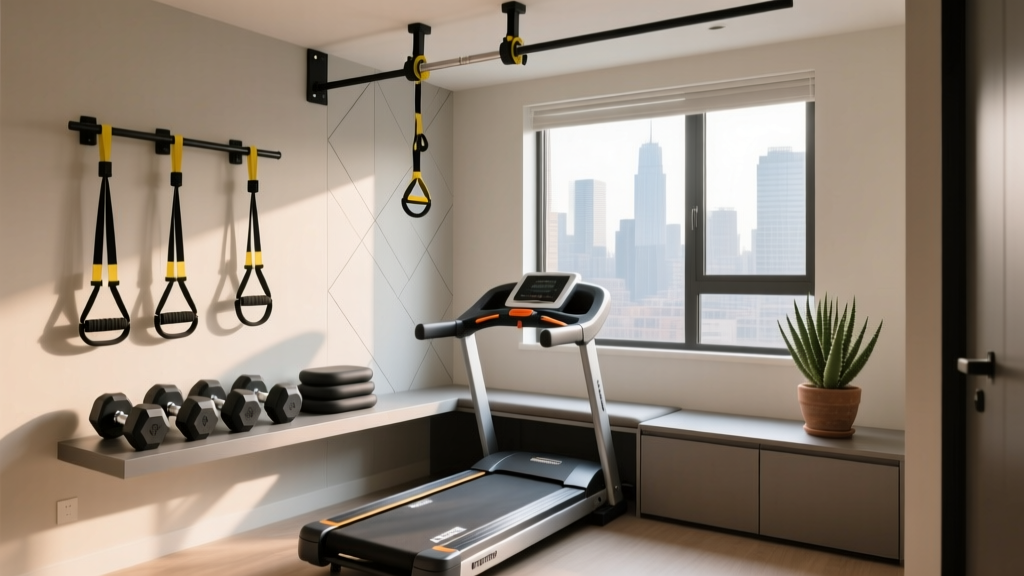
In a dual-purpose room, footprint is the ultimate currency. You cannot fit a standard power rack and a commercial treadmill without making the room claustrophobic and unusable for deep work. Here is a comparison of dedicated gear versus dual-purpose optimized gear for a 2026 small space setup.
| Equipment Type | Traditional Choice | Small Space Optimized Choice | Footprint Saved |
|---|---|---|---|
| Cardio | Sole F63 Treadmill (30 sq ft) | WalkingPad R2 Foldable ($499) | ~26 sq ft |
| Strength | Full Dumbbell Rack (20 sq ft) | Bowflex SelectTech 552 ($429/pair) | ~18 sq ft |
| Resistance | Cable Crossover Machine (35 sq ft) | TRX Home2 System ($169) + Door Anchor | ~34 sq ft |
By utilizing the WalkingPad R2, which folds down to a mere 10 inches thick and can slide under a bed or stand vertically against a wall, you preserve the visual calm required for focused office work. Similarly, the TRX Home2 system can be anchored to a heavy door or a ceiling joist, providing hundreds of resistance exercises without a permanent footprint.
Step-by-Step Flooring Installation Walkthrough
Do not make the beginner mistake of laying cheap interlocking EVA foam tiles in a dual-purpose room. EVA foam compresses permanently under the concentrated weight of office chair casters, and it absorbs sweat, leading to bacterial growth and odors. Instead, follow this professional-grade installation sequence to protect your subfloor and dampen sound.
- Step 1: The Vapor Barrier. Lay down a 6-mil polyethylene plastic sheeting over your existing hardwood or laminate. This is non-negotiable. Sweat and spilled water bottles will eventually find their way to the floor; the vapor barrier prevents warping and mold on the subfloor.
- Step 2: Acoustic Underlayment (For Upstairs Rooms). If your office is on a second floor or in an apartment, lay down 1/4-inch thick cork underlayment. Cork is dense enough to resist compression from desk chairs but excellent at dampening the low-frequency impact noise of dropped dumbbells.
- Step 3: The Wear Layer. Purchase 3/4-inch thick vulcanized rubber horse stall mats (typically $55 each from agricultural suppliers). Cut them to fit your 6x8 workout zone using a utility knife and a straight edge. Leave a 1/4-inch gap around the perimeter for expansion.
- Step 4: Transition Strips. Use a rubber or aluminum transition strip where the gym mats meet the bare floor or carpet of the office zone to prevent tripping during transitions between desk and workout.
Climate Control: The Hidden Cognitive Killer
Here is a fact most home gym builders ignore: exercising in a closed, small room drastically alters the indoor air quality, which directly impacts your subsequent work performance.
The CO2 Problem: During a 45-minute high-intensity interval training (HIIT) session in a closed 10x12 room, CO2 levels can easily spike past 2,500 ppm. According to the EPA's guidelines on indoor air quality, elevated CO2 and poor ventilation lead to immediate cognitive fatigue, headaches, and reduced decision-making capabilities—exactly what you don't want when jumping back onto a post-workout strategy call.
The Fix: Install a smart HVAC vent booster (like the AC Infinity CLOUDLINE T6) to actively pull fresh air into the room during workouts. Alternatively, keep a HEPA air purifier with an activated carbon filter running on max speed during your session to scrub VOCs and odors from the air before they settle into your office upholstery.
Cable Management for Hybrid Spaces
Floor cable runners are a massive tripping hazard during dynamic movements like burpees or lunges. In a dual-purpose room, all tech cables must be routed vertically. Use adhesive-backed cable raceways along the baseboards or, better yet, mount a wire mesh cable tray directly to the underside of your desk. For your gym equipment, use Velcro straps to secure power cords to the equipment's frame so they do not snake across your transition zones.
Summary: Your Daily Transition Protocol
A successful dual-purpose room relies on a frictionless transition protocol. Keep a dedicated "gym bin" (a simple $15 fabric storage cube) under your desk to toss your keyboard, mouse, and notebooks into before your workout. Keep a microfiber towel and a bottle of 70% isopropyl alcohol solution on your desk to quickly wipe down your adjustable dumbbells and TRX handles before putting them away, preventing rust and keeping your tech zone sanitary.
By respecting the spatial, environmental, and structural boundaries between your office and your gym, your small home gym layout will serve as a high-performance engine for both your career and your physical health.
More gear to consider
All reviews
Best Equipment for Building Back Strength on a Budget: Smart, Space-Saving, and Effective Choices

Breaking Down the True Home Gym Renovation Cost by Feature
Smart Small Space Small Home Gym Ideas: Budget & Maintenance

Beginner vs. Plunge Cold Plunge Tubs: A Practical, Budget-Savvy Comparison for Home Gym Owners

Beginner vs. Athlete Home Gym Setups: Space, Budget, and Equipment Realities
