How Much Weight You Need: Space Layouts & G7 Home Gym Guide
Discover exactly how much weight you need for your setup. We analyze spatial footprints, storage layouts, and G7 home gym space optimization strategies.

Designing a home gym is an exercise in spatial geometry, and no variable disrupts a carefully planned floor layout quite like free weights. When evaluating how much weight you need, most lifters focus solely on their one-rep max (1RM) and future strength gains. However, from a space optimization perspective, weight selection is equally about density, storage footprint, and loading clearances. A 600-pound plate collection requires a radically different floor plan than a 250-pound starter kit.
In this guide, we break down the exact mathematics of weight selection, compare the spatial footprints of different plate materials, and explore how integrated systems—like the highly efficient G7 home gym ecosystem—can reclaim valuable square footage in tight garages and spare rooms.
The Mathematics of Iron: Calculating Your True Weight Requirements
Before measuring your floor space, you must establish your baseline weight requirements. According to strength and conditioning principles outlined by the American Council on Exercise (ACE), progressive overload requires incremental weight jumps, typically in 2.5 to 5-pound increments for upper body and 5 to 10-pound increments for lower body movements.
The Core Plate Inventory
To avoid the "plate math bottleneck"—where you lack the specific combination of plates to hit your target weight—your layout must accommodate a complete pairing set. Here is the exact inventory required for three distinct lifter tiers:
- The Starter Kit (Max Load: 255 lbs): 2x45s, 2x25s, 2x10s, 2x5s, 2x2.5s. (Total: 170 lbs of plates + 45 lb bar). Footprint: Minimal, easily stored on a wall-mounted rack.
- The Intermediate Standard (Max Load: 405 lbs): 4x45s, 2x25s, 2x10s, 2x5s, 2x2.5s. (Total: 290 lbs of plates). Footprint: Requires a dedicated 6-peg weight tree or integrated rack storage.
- The Advanced Load (Max Load: 600+ lbs): 8x45s, 2x25s, 2x10s, 4x5s, 2x2.5s. (Total: 470+ lbs of plates). Footprint: Demands heavy-duty floor stands or high-capacity dual-side rack storage.
Spatial Footprint: Bumper vs. Urethane vs. Cast Iron
Not all weight is created equal when it comes to spatial volume. If you are designing a layout for a compact 10x10 foot spare bedroom or a narrow single-car garage, the thickness of your plates dictates your storage footprint and the length of the barbell sleeve you must purchase.
| Plate Material | Thickness (per 45lb pair) | Approx. 2026 Cost / lb | Space Efficiency & Layout Impact |
|---|---|---|---|
| Cast Iron | ~3.0 inches | $1.50 - $2.20 | Highest density. Takes up minimal sleeve space and storage tree width. Prone to rust if garage is unclimate-controlled. |
| Urethane | ~4.5 inches | $4.50 - $6.50 | Excellent durability and odor-free. Moderate footprint. Ideal for indoor home gyms where noise and floor protection matter. |
| Crumb Rubber Bumper | ~7.0 inches | $2.50 - $3.50 | Lowest density. Consumes massive amounts of barbell sleeve space and requires deep, wide weight trees. Often smells in enclosed rooms. |
Expert Insight: If your layout forces you to store plates on a vertical A-frame tree, crumb rubber bumpers are a failure point. Their width creates a massive lever arm that can bend standard 1-inch tree pegs over time. For A-frame storage in tight spaces, cast iron or competition-style steel-hub bumpers are mandatory.
Layout Case Study: Space Optimization with a G7 Home Gym
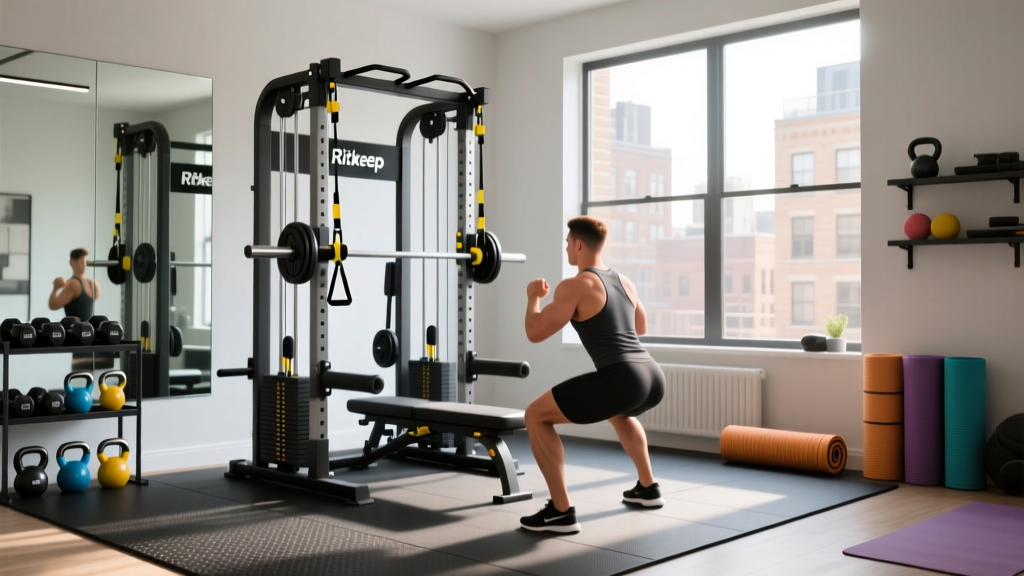
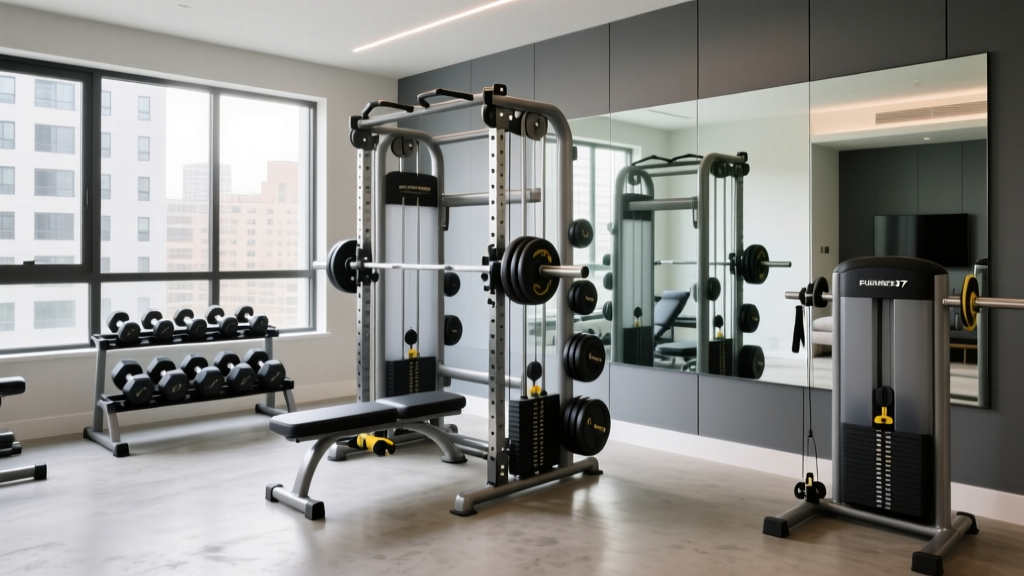
When mapping out a floor plan, the traditional approach involves a power rack, a separate weight tree, and potentially a cable stack machine. This "siloed" equipment approach creates dead space and requires multiple loading aisles. This is where an all-in-one functional trainer, such as the G7 home gym by Force USA, revolutionizes space optimization.
Traditional Layout vs. Integrated Layout
Let us compare the functional square footage required for a standard 400-lb plate setup:
- Traditional Setup: A standard 4x2 power rack (approx. 16 sq ft) + a standalone 10-peg weight tree (approx. 4 sq ft) + 36-inch clearance aisles for loading plates onto the tree and the bar. Total functional footprint: ~45 square feet.
- Integrated G7 Setup: The G7 home gym integrates the power rack, dual 200-lb cable stacks, and built-in plate storage horns directly onto the unit's frame. Dimensions sit at roughly 53" W x 53" D (approx. 19.5 sq ft). Because the plates store directly on the rack's exterior horns, you eliminate the standalone tree and its dedicated aisle. Total functional footprint: ~28 square feet.
By consolidating storage into the rig's vertical profile, you reclaim nearly 17 square feet of floor space. In a 2-car garage, this reclaimed space is often the difference between fitting a dedicated deadlift platform and having to deadlift inside the rack.
⚠️ Structural Warning: Second-Floor Joist Limits
If you are building your gym in a second-story bedroom or bonus room, weight selection is governed by structural engineering, not just your squat max. According to the American Wood Council (AWC), standard residential floor joists are typically designed for a 40 PSF (pounds per square foot) live load. A concentrated 600-pound weight stack or a dropped 400-pound barbell can exceed local shear limits. Always distribute heavy plate storage along load-bearing exterior walls, never in the center of the room span.
Strategic Floor Planning and Safety Clearances
Knowing how much weight you need is only half the battle; knowing where to put it is the other. When drafting your layout, apply the 36-Inch Loading Rule. You must maintain a minimum 36-inch clearance between your weight storage zone (whether on a tree, wall rack, or the G7's built-in horns) and the barbell sleeve.
"The most common layout failure I see in home gyms isn't a lack of space for the equipment itself, but a lack of space for the human body to move while loading and unloading plates. If you have to twist your spine in a 15-inch gap to slide a 45-pound plate onto the bar, your layout is a liability."
— Ergonomic Fitness Space Design Principles
Wall-Mounted vs. Floor Storage
If you opt for a minimalist rack without built-in storage (unlike the G7 home gym), wall-mounted plate racks are the ultimate space-saving hack. By mounting a plate rack at waist height (approx. 36 inches from the floor), you utilize "dead wall space" and keep the floor entirely clear for stretching, kettlebell work, or dumbbell lunges. Ensure you use lag bolts driven directly into wall studs; a 300-pound plate load will easily rip drywall anchors out of the wall.
The Phased Acquisition Framework
You do not need to buy 500 pounds of iron on day one. In 2026, with freight shipping costs for cast iron remaining high (often adding $150-$250 to pallet orders), a phased approach protects both your wallet and your initial floor plan. Follow this spatial expansion roadmap:
- Phase 1: The Foundation (Months 1-6)
Purchase the Starter Kit (170 lbs of plates). Store these on wall-mounted pegs or the base of your rack. This allows you to finalize your gym's traffic flow without tripping over excess iron. - Phase 2: The Intermediate Jump (Months 6-18)
Add two additional pairs of 45s and a pair of 35s. At this stage, transition to a dedicated weight tree or utilize the integrated storage horns if you are using a system like the G7 home gym. - Phase 3: The Advanced Plateau (Year 2+)
Add fractional plates (1.25s, 0.5s) and extra 25s for micro-loading. By now, your layout is permanent, and you can invest in premium urethane or calibrated steel plates that match your exact spatial tolerances.
Final Thoughts on Weight and Space
Ultimately, calculating how much weight you need is a balancing act between your physiological goals and the physical realities of your room. By prioritizing high-density plates, respecting loading clearances, and leveraging space-saving integrated rigs like the G7 home gym, you can build a world-class training environment that feels expansive, safe, and meticulously organized.
More gear to consider
All reviews
Bowflex Revolution Home Gym: Apartment Setup & Maintenance Guide

Inspire M3 Home Gym Weight Guide: How Much Resistance Do You Need?

Build a Home Gym Chuck Norris Style: Budget Setup Under $500

Making the Planet Fitness Change: Home Gym Strength Setup & Care

The Ultimate Force Home Gym Floor Plan & Setup Guide