
Outdoor Home Gyms for Renters: No-Damage Setup Mistakes
Avoid lease violations. Our troubleshooting guide covers common mistakes when building outdoor home gyms in rental apartments and no-damage fixes.

Building outdoor home gyms in a rental apartment—whether on a private balcony, a shared patio, or, or a rooftop terrace—presents a unique set of engineering and legal challenges. While fresh air and natural light make outdoor training incredibly appealing, renters frequently make critical errors that result in property damage, forfeited security deposits, or even eviction. In 2026, with composite decking and strict HOA regulations becoming the norm, the margin for error is smaller than ever.
This troubleshooting guide dissects the most common mistakes renters make when setting up an outdoor fitness space and provides actionable, no-damage solutions to keep your landlord happy and your training uninterrupted.
Mistake #1: Ignoring Balcony Load Limits and Point-Force Physics
The most dangerous mistake in apartment outdoor home gyms is assuming a balcony can handle the same dynamic weight as a ground-floor garage. According to the International Building Code (IBC), residential balconies are generally designed for a uniform live load of 50 to 60 pounds per square foot (psf) and a concentrated load of 200 pounds at any single point (source: Family Handyman).
⚠️ The Point-Force Failure Mode:A 4x8 foot balcony (32 sq ft) has a theoretical uniform capacity of 1,920 lbs. However, if you load a barbell to 225 lbs and drop it, the dynamic impact force can easily exceed 600 lbs concentrated on the two square inches of the barbell sleeve. This will punch straight through standard wooden deck boards or crack composite fascia.
The Troubleshooting Fix: Force Distribution
You must spread dynamic loads across a wider surface area. Do not lift directly on the deck. Instead, build a 'floating force plate' using a 4x6 foot sheet of 3/4-inch CDX plywood. Place high-density EVA foam puzzle mats underneath the plywood to act as a shock-absorbing buffer. This disperses the impact of a dropped dumbbell or kettlebell across 24 square feet rather than a few inches, keeping you well within the 50 psf uniform safety threshold.
Mistake #2: Trapping Moisture with Solid Rubber Mats
In traditional garage gyms, 3/4-inch vulcanized rubber horse stall mats are the gold standard. In an outdoor apartment setting, they are a disaster waiting to happen.
When solid rubber mats are laid directly over wooden or composite decking, they trap rainwater, morning dew, and condensation against the surface. Within a single season, this trapped moisture will cause wooden deck boards to rot and composite boards to warp or grow black mold. If your landlord discovers rot caused by your gym flooring, you will be billed for the entire deck replacement—a cost that can easily exceed $3,000.
The Troubleshooting Fix: Raised Airflow Flooring
Swap solid rubber for interlocking PVC deck tiles with a raised grid base. Products like the NewTechWood UltraShield Naturale tiles (approx. $6.50 per sq ft) snap together and elevate the walking surface by 5/8 of an inch. This allows water to drain freely and air to circulate, protecting the rental property's underlying deck while providing a stable, slip-resistant surface for your outdoor home gym.
Mistake #3: Drilling into Rental Concrete
Many ground-floor apartment patios feature concrete slabs. To stabilize a power rack or squat stand, lifters often drill Tapcon masonry screws into the concrete. Under most standard lease agreements, altering the structural concrete is a direct violation of your contract (source: Nolo Legal Encyclopedia). When you move out, the landlord will charge you for professional concrete patching and resurfacing.
The Troubleshooting Fix: The Sand-Ballasted Base
Instead of anchoring into the concrete, build a ballasted platform.
- Construct a shallow 4x4 foot wooden frame using 2x6 lumber.
- Line the inside with a heavy-duty contractor trash bag or pond liner.
- Fill the frame with 200 to 300 lbs of play sand (approx. $5 per 50lb bag at local hardware stores).
- Cap it with a 3/4-inch plywood sheet, and bolt your squat stands (like the Rogue SML-1 Monster Lite) directly into the plywood cap.
Mistake #4: Choosing the Wrong Weather-Resistant Gear
Standard cast-iron plates and chrome-plated barbells will develop surface rust within 48 hours when exposed to outdoor humidity. Worse, 'rust jacking' can occur where expanding rust flakes wedge into the knurling of a barbell or the moving parts of an adjustable dumbbell, permanently seizing the equipment.
| Equipment Category | Mistake (Avoid) | Troubleshooting Swap (Buy) | Est. Cost | -10px;'>Mistake (Avoid) | Troubleshooting Swap (Buy) | Est. Cost |
|---|---|---|---|---|---|---|
| Dumbbells | Standard Hex Iron | Nuobell 552 (Urethane coated) | $349/pair | |||
| Plates | Cast Iron / Steel | Crumb Rubber Bumper Plates | $1.80/lb | |||
| Barbells | Chrome / Bare Steel | Cerakote or Stainless Steel Shaft | $295 - $450 | |||
| Racks | Standard Powder Coat | Rogue Monster Lite (Outdoor rated) | $525+ |
Troubleshooting Neighbor Noise Complaints
In multi-family apartments, the number one reason outdoor home gyms get shut down by property management is noise transmission. Dropping weights on a balcony creates low-frequency structural vibrations that travel through the building's steel or concrete framework, amplifying in the units below you.
"If your downstairs neighbor can hear your heart rate monitor beep, they can definitely hear your kettlebell swings. Treat impact noise as your primary constraint when designing an apartment gym."
The Fix: Decoupling and Dampening
To stop structure-borne noise, you must decouple your equipment from the building.
- Layer 1 (Base): 1/2-inch thick Sorbothane vibration isolation pads placed at the corners of your plywood platform.
- Layer 2 (Core): The 3/4-inch plywood force distribution board.
- Layer 3 (Top): 2-inch thick high-density crash pads or layered EVA foam for the actual lifting surface.
Frequently Asked Questions
Can I use a wall-mounted folding rack on my apartment balcony?
No. Wall-mounted racks (like the PRx Profile ONE) require lag bolting into wall studs or masonry. This causes structural damage, violates almost all residential lease agreements, and compromises the building's weather barrier. Always use freestanding squat stands or a ballasted half-rack for rental outdoor home gyms.
How do I protect my gear from sudden rainstorms?
Invest in heavy-duty, UV-resistant furniture covers with drawstring hems. For smaller items like adjustable dumbbells and resistance bands, use a waterproof deck storage bench (e.g., the Keter Eden 70-Gallon Bench, approx. $140). Never leave electronic fitness trackers or heart rate monitors outside, as sudden temperature drops will destroy the lithium-ion batteries.
Are resistance bands safe to anchor to balcony railings?
Absolutely not. Balcony railings are designed to resist outward lateral pressure (leaning), not the repetitive, high-tension cyclical pulling of resistance bands. Over time, this can loosen the railing anchors, creating a severe fall hazard and a massive liability issue. Use a freestanding door-anchor-style tension pole or a heavy sandbag anchor instead.
More gear to consider
All reviews
2026 Home Gym Renovation Costs: Are Home Gym Cabinets Worth It?
How Much Weight You Need: Space Layouts & G7 Home Gym Guide

Build Home Gym: Best Mirrors & Lighting Compared (2026)
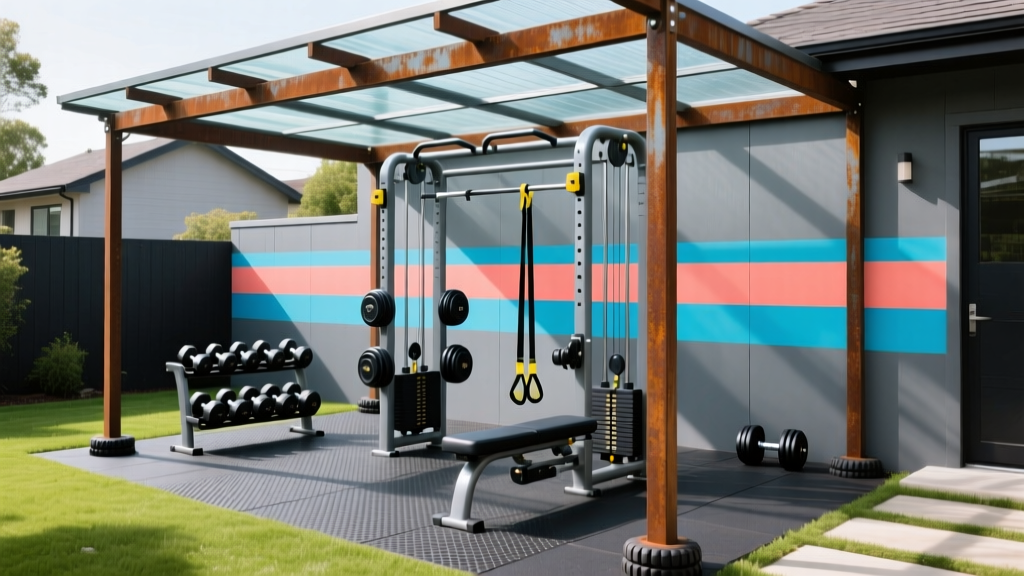
Outdoor Setup: Weatherproofing & Home Gym Paint Schemes

Belt Squat Home Gym Setup: Flooring & Ventilation Mistakes
