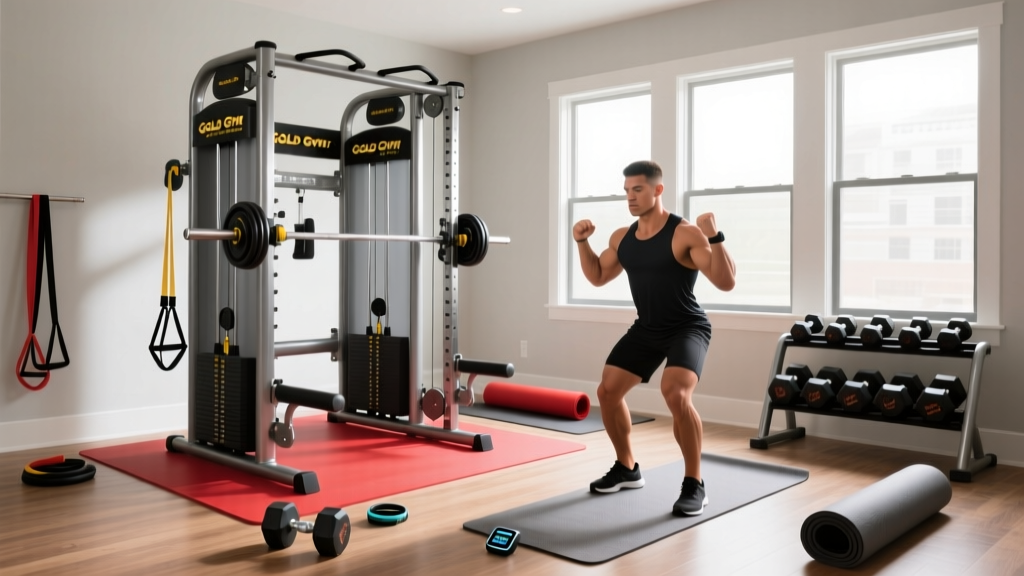
Building a Gold Gym Home Gym Setup Under $500: Value Analysis
Is a Gold Gym home gym the best choice for a $500 budget? We break down the costs, value, and muscle stimulus of all-in-one machines vs. free weights.

The $500 Home Gym Dilemma in 2026
Building a functional home gym on a strict budget requires ruthless prioritization. In 2026, supply chain stabilization has somewhat eased the extreme price gouging of previous years, but inflation has permanently reset the baseline cost of fitness equipment. When you have exactly $500 to spend, every dollar must contribute directly to your progressive overload and training consistency. For many beginners and intermediate lifters, the search inevitably leads to the gold gym home gym product line—specifically the licensed all-in-one cable and stack machines that dominate big-box retail stores. But is an all-in-one machine truly the best allocation of a $500 budget, or does a modular free-weight setup offer superior long-term value?
The 2026 Inflation Reality Check
A $500 budget today holds the purchasing power of roughly $410 in 2020. This means entry-level power racks and premium adjustable dumbbells are largely priced out of this bracket. To maximize value, we must compare the popular all-in-one cable route against a carefully curated, bare-bones free-weight setup.
Route A: The Gold Gym Home Gym All-in-One Machine
When consumers search for a gold gym home gym, they are typically looking at models like the Gold's Gym XRS 50 or similar entry-level cable/stack systems. These machines promise a complete full-body workout in a single, compact footprint. Let us break down the actual costs and biomechanical realities of this route.
Equipment Breakdown and Costs
- Gold's Gym XRS 50 (or equivalent 2026 model): $279.00 (Includes 112 lb vinyl weight stack, high/low pulleys, and leg developer).
- 3/4-inch Horse Stall Mat (4x6 ft): $55.00 (Essential for protecting your floor and stabilizing the machine's base).
- Set of Loop Resistance Bands (Heavy/Light): $35.00 (To supplement the limited 112 lb max stack for heavy compound movements).
- Machine Anchoring Straps & Hardware: $20.00 (Budget machines often require aftermarket ratchet straps to prevent tipping during heavy lat pulldowns).
- Total Route A Cost: $389.00 (Leaves $111 for future accessories or shipping fees).
Failure Modes and Edge Cases
While the convenience of a cable machine is undeniable, budget all-in-one gyms suffer from specific mechanical failure modes. According to equipment durability analyses by Consumer Reports, entry-level home gyms frequently experience pulley friction and cable fraying within the first 18 months of heavy use. Furthermore, the 112-pound weight stack limit is a severe bottleneck. Once you can lat pulldown or chest press 112 pounds for 12 reps, the machine becomes obsolete for hypertrophy unless you employ advanced tempo techniques or supplement heavily with resistance bands. The plastic bushings used in the pivot points of the leg developer and press arm also tend to warp under sustained heavy loads, creating a gritty, uneven resistance profile.
Route B: The Modular Free-Weight Alternative
The alternative to the all-in-one machine is building a modular free-weight setup. This route sacrifices the convenience of quick weight-stack changes but offers vastly superior axial loading, stabilizer muscle engagement, and infinite progressive overload potential.
Sourcing the Iron: A Strategic Allocation
To stay under $500, we must avoid premium brands like Rogue or Eleiko and focus on high-value, budget-friendly manufacturers like Titan Fitness, REP Fitness, and Amazon Basics cast iron.
| Item | Specific Model / Spec | Est. Cost |
|---|---|---|
| Olympic Barbell | Titan Fitness Classic 7ft Olympic Bar (28.5mm shaft) | $130.00 |
| Weight Plates | 160 lbs Cast Iron Olympic Plates (Used/Local Marketplace) | $120.00 |
| Weight Bench | REP Fitness FB-5000 Flat Bench (1000 lb capacity) | $110.00 |
| Flooring | Two 4x6 ft Horse Stall Mats (3/4-inch thick) | $110.00 |
| Collars | Pair of Lock-Jaw Spring Collars | $20.00 |
| Total Route B Cost | $490.00 | |
Note: Sourcing cast iron plates locally via Facebook Marketplace or Craigslist is critical to this budget. Buying new iron online will incur freight shipping fees that will instantly destroy a $500 budget.
Biomechanical Value: Stimulus vs. Dollar
From a pure hypertrophy and strength perspective, Route B (Free Weights) offers a significantly higher return on investment. The Mayo Clinic emphasizes that progressive overload—gradually increasing the stress placed on the musculoskeletal system—is the primary driver of muscle growth and bone density improvements.
'Resistance training increases muscle strength by making your muscles work against a weight or force. For optimal results, you need to progressively increase the resistance as your muscles adapt. Free weights provide a more natural movement pattern and require greater stabilizer muscle activation compared to fixed-path machines.'
— Adapted from Mayo Clinic Strength Training Guidelines
With the Gold Gym Home Gym route, your progressive overload hits a hard ceiling at 112 pounds. With the modular barbell route, your ceiling is limited only by how much iron you can acquire over time. Furthermore, barbell squats, deadlifts, and bench presses recruit significantly more core and stabilizer musculature than seated cable presses and leg extensions. The free-weight setup builds functional, real-world strength that translates better to daily activities and athletic performance.
Hidden Costs: Space, Maintenance, and Noise
A true value analysis must account for the environment in which the equipment lives.
The Spatial Footprint
All-in-one cable machines require a dedicated, permanent footprint. The Gold's Gym XRS 50 measures roughly 70 inches tall, 40 inches wide, and 55 inches deep. You cannot easily fold it away or move it. Conversely, a barbell, plates, and a flat bench can be disassembled and pushed into a corner or stored in a closet, making Route B vastly superior for apartment dwellers or those converting a multi-purpose guest room into a gym.
Maintenance and Noise
Cable machines require periodic maintenance. The vinyl-coated cables must be inspected for fraying, and the pulley wheels need occasional silicone lubrication to prevent squeaking and jerky resistance. Free weights, on the other hand, are virtually indestructible. Cast iron plates will last multiple lifetimes. The only maintenance required is wiping down the barbell shaft with a nylon brush and applying a light coat of 3-in-One oil to prevent rust. However, dropping a barbell generates significantly more low-frequency impact noise than the clinking of a weight stack. If you live in a shared building or have a bedroom directly above your garage gym, the horse stall mats are non-negotiable to dampen acoustic transfer.
Frequently Asked Questions
Can I upgrade the weight stack on a budget cable machine later?
Generally, no. Budget all-in-one gyms use proprietary cable lengths and pulley ratios. Adding aftermarket weight plates to the guide rods often exceeds the structural rating of the base frame and the tensile strength of the factory-installed vinyl cables, creating a severe safety hazard.
Is a power rack possible under $500?
In 2026, a brand-new, safe, and stable power rack will consume at least $250 to $350 of your budget, leaving insufficient funds for a quality barbell and plates. If you absolutely need a rack for heavy squats, look for used half-racks locally, but prioritize the barbell and plates first to ensure you have the implements necessary to actually train.
What about adjustable dumbbells instead of a barbell?
Adjustable dumbbells (like the Bowflex SelectTech or PowerBlock) are excellent space-savers, but a pair of 5-50 lb adjustable dumbbells will cost between $300 and $400 in 2026. This leaves almost no room for a bench or flooring. A standard Olympic barbell and cast iron plates offer a much higher weight ceiling (up to 300+ lbs) for a fraction of the cost.
Final Verdict: Which Setup Wins the $500 Challenge?
If your primary goal is general fitness, circuit training, and you have a dedicated, permanent space in a garage or basement, the gold gym home gym all-in-one machine offers undeniable convenience. It allows for quick transitions between exercises and keeps your workout contained to a single station.
However, from a strict value analysis and long-term progressive overload perspective, Route B (The Modular Free-Weight Setup) is the undisputed winner. By sourcing a quality Olympic barbell, a heavy-duty flat bench, and local cast iron plates, you build a foundation that will never artificially cap your strength gains. The $500 free-weight gym requires more effort to set up and tear down, but the biomechanical stimulus and infinite scalability make it the smartest financial investment for any serious lifter on a budget.
More gear to consider
All reviews
How Much Weight You Need: Space Layouts & G7 Home Gym Guide

How to Create a Home Gym in Small Spaces: Maintenance Guide

Budgeting Mirrors & Lighting: Vital Fitness Equipment for Home Workout

Smart Gifts for Home Gym: Mirror & Lighting Budget Guide

Bowflex Xtreme 2 SE Home Gym: Complete Setup & Installation Guide
