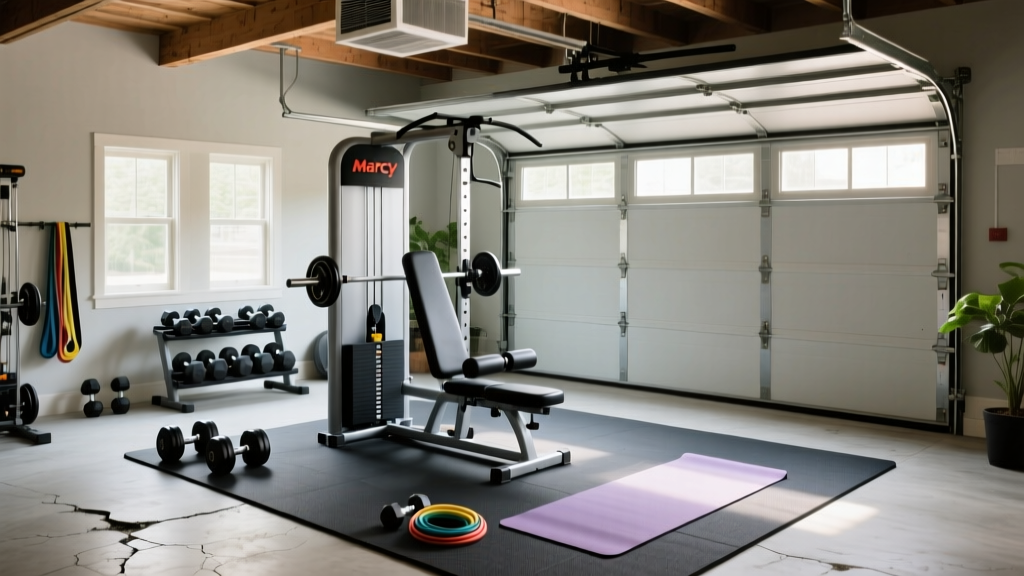
Marcy Home Gym MWM-989 Garage Setup: Flooring & Ventilation Mistakes
Avoid common garage gym mistakes with your Marcy Home Gym MWM-989. Learn expert troubleshooting for flooring compression, humidity, and pulley maintenance.

The Garage Environment: Why Your Marcy MWM-989 is at Risk
Setting up the Marcy Home Gym MWM-989 in a garage remains one of the most popular home fitness configurations in 2026. The machine offers incredible versatility, combining a lat pulldown, low row, and chest press into a single footprint. However, the uncontrolled environment of a typical residential garage introduces severe mechanical and structural risks to multi-station cable machines. The MWM-989 is a robust piece of engineering, featuring a 150-pound weight stack and a heavy-duty steel frame that weighs roughly 330 pounds unboxed. When loaded with a user performing heavy lat pulldowns, the static point-load on the front stabilizers can easily exceed 500 pounds.
WARNING: The Point-Load TrapMany garage gym owners focus on the total square footage of their flooring but ignore compressive strength. If the flooring beneath the MWM-989's front stabilizers compresses more than the rear stabilizers, the entire machine tilts. This misalignment causes the 150-pound weight stack to bind against the chrome guide rods, leading to premature cable fraying and a frustrating, jerky user experience.
Flooring Mistakes Under Heavy Multi-Gyms
The 'Interlocking Foam Tile' Failure Mode
The most frequent and costly mistake garage gym builders make is placing a heavy cable machine like the MWM-989 on high-density EVA foam interlocking tiles. While EVA foam (typically 3/8-inch to 1/2-inch thick) is excellent for dropping dumbbells or doing floor work, it has a low compressive strength—often failing at pressures above 15 psi. Under the concentrated weight of the MWM-989's front stabilizers, EVA foam will permanently compress by up to 1/4 inch within the first two weeks of use. This creates a 2-to-3-degree forward tilt, instantly voiding your warranty and ruining the machine's biomechanics.
Correcting the Base: Horse Stall Mats vs. Poured Rubber
To properly support the Marcy MWM-989, you need flooring with high compressive resilience. The gold standard for garage gyms in 2026 is 3/4-inch vulcanized horse stall mats (often sourced from agricultural suppliers for about $50 to $65 per 4x6 foot mat). These mats are designed to support 1,200-pound animals and will not compress under a 500-pound point-load. If your garage concrete is heavily sloped or pitted, you must first lay down a 3/4-inch tongue-and-groove plywood subfloor, shim the low spots, and then place the rubber matting on top.
| Material Type | Thickness | Approx. Cost (per sq ft) | Compressive Resilience | Verdict for MWM-989 |
|---|---|---|---|---|
| EVA Foam Tiles | 1/2 inch | $1.00 - $1.50 | Poor (Permanent denting) | AVOID (Causes binding) |
| Standard Rolled Rubber | 3/8 inch | $2.00 - $2.50 | Fair (Requires flat concrete) | Acceptable (If floor is level) |
| Vulcanized Stall Mats | 3/4 inch | $1.75 - $2.25 | Excellent (Zero point-load crush) | HIGHLY RECOMMENDED |
| Plywood + Rubber Sandwich | 1.5 inches | $3.50 - $4.50 | Superior (Corrects slopes) | Required for uneven garages |
Ventilation and Climate Control Troubleshooting
Rust and Pulley Seizure: The Silent Killers
Garages are notorious for massive fluctuations in temperature and relative humidity (RH). When the RH in your garage regularly exceeds 60%, moisture condenses on the cold steel components of your gym equipment. The Marcy MWM-989 utilizes nylon pulleys that house steel ball bearings. High humidity causes micro-rust to form inside these bearings, leading to the dreaded 'pulley squeak' and increased rotational friction. Over time, this friction causes the aircraft-grade cables to fray at the pulley contact points.
'Proper ventilation and moisture control in attached and detached garages are critical not just for air quality, but for preventing the accelerated degradation of stored mechanical equipment and vehicles.' — U.S. Environmental Protection Agency (EPA)
Active vs. Passive Ventilation Strategies
To protect your investment, you must stabilize the garage environment. According to the U.S. Department of Energy, relying solely on passive ventilation (like cracking a window or using standard soffit vents) is insufficient for moisture removal in humid climates. You need a targeted approach:
- Active Dehumidification: Install a 50-pint commercial-grade dehumidifier (such as the Midea or Yaufey 50-pint models, priced around $250-$300) equipped with a continuous drain hose routed to a garage utility sink or floor drain. Set the target RH to 45%.
- Targeted Airflow: Mount a 16-inch high-velocity wall-mounted fan directed specifically at the MWM-989's weight stack and pulley towers to prevent stagnant, moisture-heavy air from settling on the steel.
- Desiccant Packs: For enclosed cable housings, zip-tie large silica gel desiccant packs near the upper pulley brackets to absorb trapped ambient moisture.
Troubleshooting MWM-989 Specific Garage Issues
Even with proper flooring and ventilation, the harsh garage environment can cause specific mechanical hiccups. Here is how to troubleshoot the most common MWM-989 issues related to its environment.
Issue 1: Weight Stack Scraping and Guide Rod Binding
Symptom: The 150-pound weight stack drops smoothly when lifted, but stutters, scrapes, or gets stuck on the descent.
Root Cause: The machine is not perfectly plumb, usually due to subtle concrete sloping beneath the garage floor or uneven flooring compression. The guide rods are binding against the inner nylon bushings of the weight plates.
The Fix:
- Remove all weight from the machine.
- Place a 48-inch machinist level against the main vertical uprights (both front-to-back and side-to-side).
- If the bubble is off-center, use composite (plastic) horseshoe shims under the rear or side stabilizer pads. Never use wooden shims, as they will compress and rot from garage moisture.
- Once perfectly plumb, wipe the chrome guide rods with a microfiber cloth and apply a light coat of 100% silicone spray lubricant. Avoid WD-40, which attracts garage dust and creates an abrasive paste.
Issue 2: Pulley Grinding and Cable Fraying
Symptom: A metallic grinding noise from the upper lat pulldown station, followed by visible 'whiskers' of steel poking out of the braided cable.
Root Cause: Humidity-induced bearing corrosion inside the nylon pulley wheels, causing the pulley to drag rather than spin freely.
The Fix: Immediately stop using the lat pulldown. Use a socket wrench to remove the pulley bolt. Clean the bolt and the inner bearing race with a degreaser, then pack it with white lithium grease (which resists moisture better than standard oil). If the cable has already frayed, you must replace it. Order a replacement 3/16-inch 7x19 aircraft cable with swaged fittings (approx. $35-$50 online) to restore the MWM-989 to factory safety standards.
Final Checklist for a Bulletproof Garage Gym
Before you load up the Marcy Home Gym MWM-989 for your first heavy workout, run through this final environmental and structural checklist:
- [ ] Subfloor Check: Confirmed 3/4-inch vulcanized rubber or plywood sandwich is in place under all four stabilizers.
- [ ] Plumb Verification: Checked vertical uprights with a 48-inch level; composite shims applied where necessary.
- [ ] Humidity Baseline: Installed a digital hygrometer near the machine; confirmed ambient RH stays below 55%.
- [ ] Lubrication Protocol: Applied silicone spray to guide rods and white lithium grease to all pulley axles.
- [ ] Cable Tension: Checked the turnbuckles at the base of the weight stack to ensure cables are taut but not overtightened, preventing premature stretching in temperature swings.
By treating your garage not just as a storage space, but as a controlled mechanical environment, your Marcy MWM-989 will deliver smooth, friction-free resistance for years to come. Ignoring the interplay between heavy point-loads and ambient moisture is the fastest way to turn a premium home gym investment into a frustrating, squeaky paperweight.
More gear to consider
All reviews
Complete Home Gym Setup & Floor Plans: Best Home Gym Shelf Picks

Marcy Club Home Gym: Strength Setup & Longevity Tips

Renter-Friendly Home Gym Painting: Mistakes & Fixes
2026 Garage Gym Trends: Flooring, Ventilation & Bowflex Home Gym Models

What Do I Need for a Home Gym? 2026 Compact Foldable Guide
