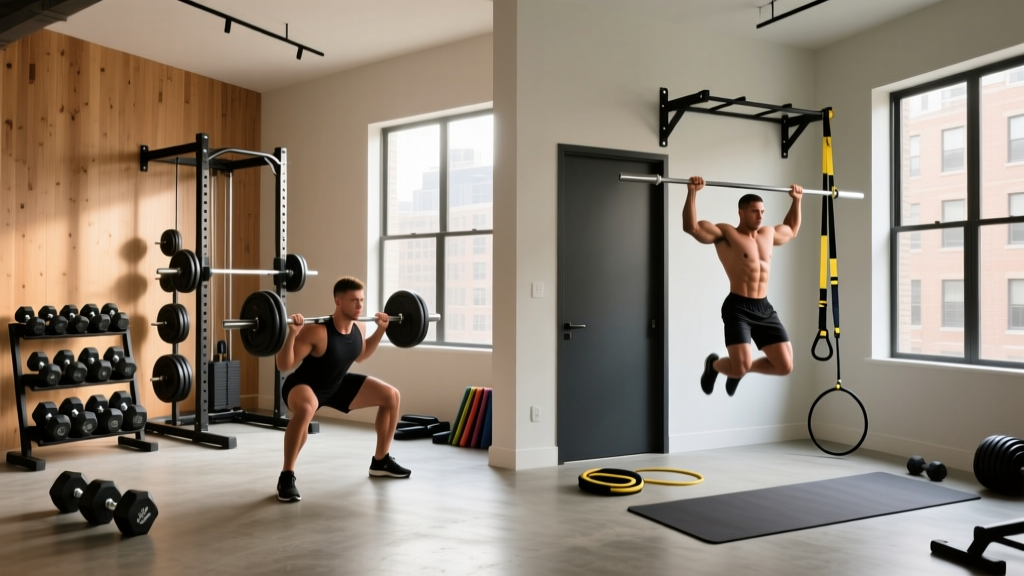
Huge Home Gym Results on a $500 Budget: 2026 Gear Showdown
Compare two $500 budget home gym setups for 2026. We test free weights vs. calisthenics gear to build the foundation of a huge home gym.

The $500 "Huge Home Gym" Foundation Philosophy
Most fitness enthusiasts assume that achieving huge home gym results requires a massive upfront investment in commercial-grade racks and cable machines. However, building a world-class training space is a marathon, not a sprint. The secret to laying the groundwork for a huge home gym on a strict $500 budget is avoiding "starter kits" that end up in landfills. Instead, you must purchase foundational gear that scales with your strength and integrates seamlessly into future expansions.
According to the Centers for Disease Control and Prevention (CDC), adults need muscle-strengthening activities of moderate or greater intensity that involve all major muscle groups on two or more days a week. To meet this with progressive overload on a budget, we are pitting two distinct $500 loadouts against each other: The Iron & Gravity Route versus The Calisthenics & Tension Route. Let us break down the exact 2026 pricing, biomechanical advantages, and failure modes of each.
Loadout A: The Iron & Gravity Route (Free Weights)
This loadout prioritizes traditional hypertrophy and absolute strength. It relies on adjustable dumbbells, a heavy kettlebell, and a high-quality bench, anchored by commercial-grade flooring that will never need replacing.
Core Components & Exact 2026 Pricing
- Yes4All Adjustable Dumbbells (5-25 lbs each): $79.00. Unlike expensive dial-systems, these use a classic spin-lock collar. They are virtually indestructible.
- CAP Barbell Cast Iron Kettlebell (35 lb): $48.00. Essential for unilateral lower-body work, swings, and goblet squats.
- Fitness Reality 1000 Super Max Adjustable Bench: $129.00. Offers a 1000 lb capacity and 12 backrest adjustments, crucial for incline and decline pressing.
- Titan Fitness 4x6 FT 3/4" Thick Rubber Mat: $185.00. This is non-negotiable. Thin foam tiles will compress and tear under heavy iron.
- Total Investment: $441.00
Scalability & Edge Cases
The primary advantage of Loadout A is infinite scalability. When you eventually upgrade to a power rack and barbell, the adjustable dumbbells become perfect accessory tools, and the 3/4" rubber mat becomes the permanent floor of your huge home gym. The edge case here is the 25 lb dumbbell ceiling; advanced lifters will outgrow the 25 lb limit for chest presses within 6 to 8 months, requiring a future purchase of heavier fixed dumbbells or a barbell setup.
Loadout B: The Calisthenics & Tension Route
This loadout focuses on relative strength, core stability, and joint-friendly tension. It is ideal for apartments or spaces where dropping heavy iron is prohibited.
Core Components & Exact 2026 Pricing
- Sportsroyals Power Tower Dip Pull-Up Station: $139.00. A freestanding unit with a backrest, eliminating the need for doorframe bars.
- WODFitters Heavy Duty Resistance Bands (Set of 5): $45.00. Ranging from 2 lbs to 120 lbs of resistance, allowing for variable tension on presses and rows.
- Yes4All Suspension Training Kit: $38.00. A TRX-style alternative for deep core and stabilizer work.
- Flybird Adjustable Weight Bench: $119.00. A compact, foldable bench that pairs well with resistance bands for seated rows and flyes.
- ProSource Fit Puzzle Exercise Mats (3/4" EVA Foam): $45.00. Provides joint cushioning for floor work without the heavy weight of rubber.
- Total Investment: $386.00
Scalability & Edge Cases
Loadout B excels at building functional, gymnastics-style strength. The Mayo Clinic notes that resistance training improves bone density and joint health, and bands provide accommodating resistance that spares the joints at the weakest points of a movement. However, the failure mode is band degradation; polyurethane bands will oxidize and snap after 12-18 months of heavy use, requiring recurring replacement costs. Furthermore, the EVA foam mats will permanently compress if you ever decide to add a heavy squat rack later.
Head-to-Head Comparison Matrix
| Feature | Loadout A (Iron & Gravity) | Loadout B (Calisthenics & Tension) |
|---|---|---|
| Hypertrophy Potential | High (Easy to track exact micro-loading) | Moderate (Hard to quantify exact band tension) |
| Footprint | 30 sq ft (Bench + Mat) | 16 sq ft (Tower folds/shifts, bench folds) |
| Joint Impact | Moderate to High (Constant external load) | Low (Variable resistance curves) |
| Future Integration | Seamless (Gear becomes accessory work) | Friction (Bands/tower often get replaced) |
| Noise Level | High (Clanking iron, dropping weights) | Very Low (Silent tension and bodyweight) |
Critical Failure Modes to Avoid in 2026
Warning: The Dial-Adjustable Dumbbell TrapMany budget guides recommend cheap, $99 dial-adjustable dumbbells from unknown Amazon brands. Do not buy these. The internal plastic ratchets are notorious for jamming when placed on the bench at an incline. If you want adjustable dumbbells under $100, stick to traditional cast-iron spin-lock plates like the Yes4All models. They take 15 seconds longer to load, but they will last a lifetime.
Warning: Doorframe Pull-Up Bar DamageTelescoping doorframe pull-up bars rely on friction and outward pressure. In 2026, with many modern homes using lightweight MDF trim rather than solid wood, these bars routinely crush architraves and slip mid-set. The freestanding Sportsroyals tower in Loadout B eliminates this structural risk entirely.
Space Assessment for Future Expansion
When planning your initial $500 setup, you must measure your space for the future huge home gym you intend to build. If you plan to add a power rack within the next two years, verify your ceiling height immediately. A standard power rack is 84 to 90 inches tall. Add 6 inches for a barbell sleeve and overhead clearance, and you need a minimum ceiling height of 8.5 feet. If your basement ceiling is only 7.5 feet, you will be forced to buy a specialized "short" rack (like the Rogue SML-2C 90" Monster Lite) which costs significantly more, altering your future budget.
Additionally, map out your electrical outlets. If you plan to add a smart bike or a motorized treadmill later, ensure your 15-amp circuit is not already overloaded by a space heater or dehumidifier, which is a common issue in basement gym setups.
"The biggest mistake beginners make is buying equipment that solves their current weakness but creates a bottleneck for their future strength. Buy the floor and the bench first; buy the toys later." — FitGearPulse Editorial Team
Expert Verdict: Which Loadout Scales Better?
If your ultimate goal is to build a huge home gym capable of handling powerlifting, heavy bodybuilding, and athletic conditioning, Loadout A (The Iron & Gravity Route) is the undisputed winner. The 3/4" Titan rubber mat alone is a permanent fixture that will protect your subfloor when you eventually drop 300 lb deadlifts. The adjustable dumbbells and bench will seamlessly transition into your accessory work once a barbell is introduced.
However, if your "huge home gym" vision is actually a dedicated functional fitness and mobility studio, or if you are constrained by apartment noise rules and low ceilings, Loadout B provides a superior, joint-friendly foundation. Just be prepared to budget $45 every 18 months to replace oxidized resistance bands.
Ultimately, a strict $500 budget is not a limitation; it is a filter. It forces you to strip away gimmicks and invest in the raw, foundational tools that have driven human physical culture for over a century.
More gear to consider
All reviews
Best Equip Wearables for Home Gym Fixes: Smart Gear That Prevents Injury and Optimizes Form
Weider 8530 Home Gym vs Bowflex PR1000: Remodel Guide

Weight Guide: Pacific Fitness Zuma Home Gym & Compact Space Layouts

Build Home Gym: Best Mirrors & Lighting Compared (2026)

Home Gym in Shed: How Much Weight Do You Actually Need?
