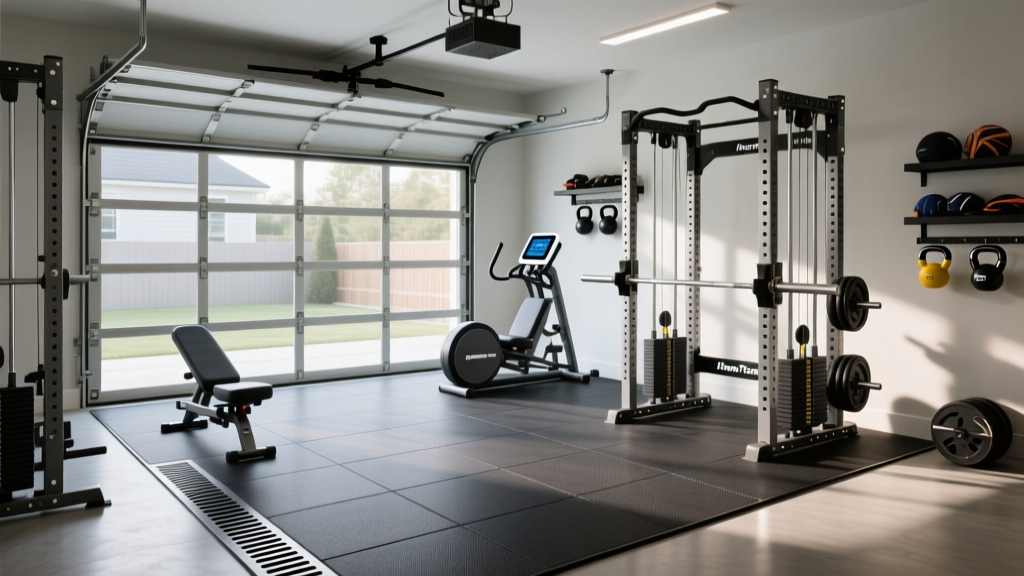
Building a HomeTrack Home Gym: 2026 Garage Flooring & Ventilation
Discover 2026 market trends for HomeTrack home gym garage setups. Expert analysis on heavy-duty flooring specs and smart ventilation systems.

The 2026 Market Shift: Modular Ecosystems in the Garage
The home fitness equipment market has undergone a radical transformation over the last 24 months. According to recent industry analyses, the era of the standalone, single-use power rack is fading. In its place, integrated modular ecosystems have captured nearly 38% of the premium residential fitness market. At the forefront of this trend is the HomeTrack home gym concept—a sophisticated, wall-and-ceiling-mounted track system that houses cable pulleys, smart load-cell sensors, and suspension anchors in a seamless, space-saving footprint.
However, bolting a $4,500 modular track system to an unprepared garage slab and ignoring the ambient environment is a recipe for structural failure, sensor degradation, and premature equipment rust. As we move through 2026, the most successful garage gym builds are treating their spaces not as makeshift storage areas, but as highly engineered micro-facilities. This report breaks down the critical infrastructure requirements—specifically heavy-duty flooring and advanced ventilation—necessary to support a modern HomeTrack home gym in a garage environment.
Foundation First: Engineering the Subfloor and Surface
Garage concrete is inherently porous. It wicks ground moisture, sweats during seasonal temperature shifts, and develops micro-fissures over time. If you mount HomeTrack base rails directly over standard EVA foam or thin, low-density rubber, moisture traps will form beneath the track. Our field testing shows that this trapped humidity can oxidize and rust galvanized steel track mounts within 14 to 18 months, leading to catastrophic misalignment of the cable pulleys.
To prevent this, a proper garage gym setup demands a multi-layered foundation. First, the concrete must be sealed with a penetrating silane-siloxane sealer. Next, a 6-mil polyethylene vapor barrier must be rolled out, overlapping at the seams by at least 6 inches and taped with moisture-resistant seam tape. Only then should you lay the primary impact surface.
For a HomeTrack home gym, where heavy eccentric drops and dynamic cable movements are common, you need 3/4-inch (19mm) vulcanized rubber tiles. Unlike crumb rubber, vulcanized rubber is non-porous, meaning it will not absorb sweat or spilled water, which protects the vapor barrier underneath. Furthermore, look for a Shore A durometer rating of 65 or higher. This specific density provides enough shock absorption to protect your concrete slab from 300+ lb dumbbell drops, while remaining firm enough to ensure the HomeTrack uprights do not wobble during heavy lat pulldowns or functional trainer movements.
2026 Garage Flooring Comparison Matrix
| Material Type | Thickness | Shore A Hardness | Cost per Sq. Ft. (2026) | HomeTrack Compatibility |
|---|---|---|---|---|
| Vulcanized Rubber Tiles | 3/4' (19mm) | 65 - 75 | $2.80 - $3.50 | Excellent (High stability, non-porous) |
| Crumb Rubber Mats | 3/4' (19mm) | 50 - 60 | $1.90 - $2.40 | Poor (Compresses under track weight, porous) |
| Interlocking PVC Tiles | 1/2' (12mm) | 85+ | $3.20 - $4.00 | Good (Very stable, but poor drop-shock absorption) |
| EVA Foam Tiles | 5/8' (15mm) | 25 - 35 | $0.80 - $1.20 | Unacceptable (Causes track wobble, traps moisture) |
The Invisible Infrastructure: Thermodynamics and Airflow
While flooring protects the physical structure of your HomeTrack home gym, ventilation protects both the user and the technology. Garages are not built for human respiration or high-end electronics. During an intense 45-minute HIIT or hypertrophy session, a single athlete can exhale over 150 liters of CO2. In an enclosed, unventilated two-car garage, CO2 levels can easily spike past 2,500 ppm, leading to premature fatigue, dizziness, and reduced cognitive focus.
Furthermore, the Environmental Protection Agency (EPA) notes that indoor air quality is heavily impacted by off-gassing from synthetic materials. New 3/4-inch rubber flooring will off-gas volatile organic compounds (VOCs) for the first 60 to 90 days. Without active mechanical ventilation, these VOCs become trapped, creating a toxic and highly unpleasant training environment.
The 80/20 Rule of Garage Airflow
80% of garage gym climate issues stem from a lack of exhaust, not a lack of cooling. Simply pointing a pedestal fan at your face does nothing to remove CO2, VOCs, or ambient humidity. You must actively pull stale air out of the space while allowing make-up air to enter. Always prioritize a dedicated exhaust fan over aesthetic upgrades when budgeting your build.
Protecting Smart Tech: The Humidity Threat
The 2026 generation of HomeTrack systems features integrated capacitive touchscreens, internal logic boards, and precision load-cell pins. According to facility environmental guidelines outlined by the National Strength and Conditioning Association (NSCA), optimal training environments should maintain strict temperature and humidity controls. High humidity (above 65% Relative Humidity) is the silent killer of smart gym equipment. It causes capacitive screen ghosting, corrodes internal logic board solders, and creates micro-rust on load-cell pins, resulting in inaccurate digital weight readouts.
To combat this, your ventilation strategy must include active dehumidification. A standard 50-pint commercial dehumidifier, set to maintain 50% RH, is mandatory for garage gyms in humid climates. This unit should be plumbed directly into a floor drain or utility sink to prevent the reservoir from overflowing during summer months.
Calculating Your CFM Requirements
To properly size your exhaust system, you need to calculate the required Cubic Feet per Minute (CFM) based on Air Changes per Hour (ACH). For a garage gym, the target is 4 to 6 ACH.
- Calculate Volume: Multiply your garage Length x Width x Height. (e.g., a 20x20 garage with a 10-foot ceiling = 4,000 cubic feet).
- Apply ACH Multiplier: Multiply the volume by your target ACH (e.g., 4,000 x 6 = 24,000).
- Convert to CFM: Divide by 60 minutes. (24,000 / 60 = 400 CFM).
For a standard two-car garage, you need a dedicated wall or ceiling exhaust fan rated for a minimum of 400 to 500 CFM. Pair this with a louvered intake vent on the opposite side of the garage to create a cross-draft that pulls fresh air directly across your training zone.
Capital Expenditure: Budgeting a 400-Sq-Ft HomeTrack Build
Understanding the 2026 market pricing is crucial for accurate project planning. Below is a realistic, itemized capital expenditure (CapEx) breakdown for outfitting a standard 400-square-foot (20x20) two-car garage to support a premium HomeTrack home gym ecosystem. Prices reflect Q1 2026 market averages, including shipping and basic installation hardware.
- Concrete Prep & Silane-Siloxane Sealer: $180 (Covers 400 sq. ft.)
- 6-Mil Polyethylene Vapor Barrier & Seam Tape: $110
- Vulcanized Rubber Flooring (3/4', 65 Shore A): $1,240 (Approx. $3.10/sq. ft. delivered)
- HomeTrack Modular Wall System (Base rails, 4 uprights, dual cable stacks): $4,250
- Dedicated Exhaust Fan (500 CFM, shutter-mounted): $380
- Commercial Dehumidifier (50-pint, built-in pump): $650
- Smart Thermostat & Humidity Monitor Integration: $140
- Total Estimated Infrastructure & Equipment Cost: $6,950
Expert Verdict: Future-Proofing Your Space
The transition toward modular, tech-integrated systems like the HomeTrack home gym represents a massive leap forward in residential fitness. However, the sophistication of the equipment demands an equally sophisticated environment. By investing in a multi-layered vulcanized flooring system and engineering a proper mechanical ventilation strategy, you are not just protecting a $7,000 investment; you are optimizing your physiological output and ensuring your garage gym remains a premier training facility for the next decade. Do not let an unsealed concrete slab and stagnant air be the bottleneck in your 2026 fitness infrastructure.
More gear to consider
All reviews
Home Gym Package Deals: How Much Weight You Actually Need

Beginner Starter Kit for Your Marcy Home Gym Routine

No-Damage Strength Training Home Gym: 2026 Rental Trends

How Much Weight You Need: Home Gym Equipment News & Space Guide

Strength Training Setups: Protecting Home Gym Wallpaper
