Bowflex Sport Home Gym vs Modern Budget Setups 2026
Is a used Bowflex Sport home gym still the best sub-$500 fitness investment in 2026? We compare it head-to-head against modern modular budget setups.

The Sub-$500 Home Gym Dilemma in 2026
Building a comprehensive home gym on a strict budget has become increasingly complex. With inflation and supply chain shifts pushing the retail price of entry-level all-in-one cable machines well past the $700 mark, fitness enthusiasts are forced to get creative. If your hard cap is $500, you generally have two distinct paths: hunting the secondary market for a legacy all-in-one machine, or piecing together a modern modular free-weight setup. Today, we are putting a legendary secondary-market find—the Bowflex Sport home gym—head-to-head against a meticulously curated 2026 modular budget build to determine which approach delivers the highest return on investment for your sweat equity.
Editor's Note: The Bowflex Sport is no longer manufactured. To keep this comparison strictly under $500, our pricing for the Bowflex unit reflects current 2026 secondary market averages (Facebook Marketplace, Craigslist, and refurbished fitness outlets), while the modular setup reflects current primary market retail prices.Contender 1: The Used Bowflex Sport Home Gym
The Bowflex Sport was designed as an accessible, space-efficient alternative to the flagship Xtreme series. It relies on polymeric Power Rod technology rather than traditional weight stacks. On the secondary market, a well-maintained Bowflex Sport home gym typically sells between $150 and $250, leaving you with extra budget for a mat and maintenance.
Specifications and Real-World Footprint
- Dimensions: 53' L x 46' W x 82' H
- Machine Weight: 145 lbs
- Standard Resistance: 210 lbs (upgradeable to 310 lbs)
- Exercise Capacity: Over 60 distinct movements via lat tower and lower pulley
The Failure Mode: Power Rod Degradation
While the initial cost is incredibly low, the Power Rods present a specific longevity challenge. According to equipment longevity analyses by Consumer Reports, polymeric resistance rods are highly susceptible to environmental fatigue. If you plan to install this gym in an unclimate-controlled garage where temperatures regularly exceed 90°F, or where UV light hits the rods through a window, the elastomer will dry out and lose its tensile memory. A replacement set of 210-lb rods costs roughly $130 in 2026, which can instantly break your $500 budget if you buy a used unit with fatigued rods.
Contender 2: The 2026 Modular Budget Build
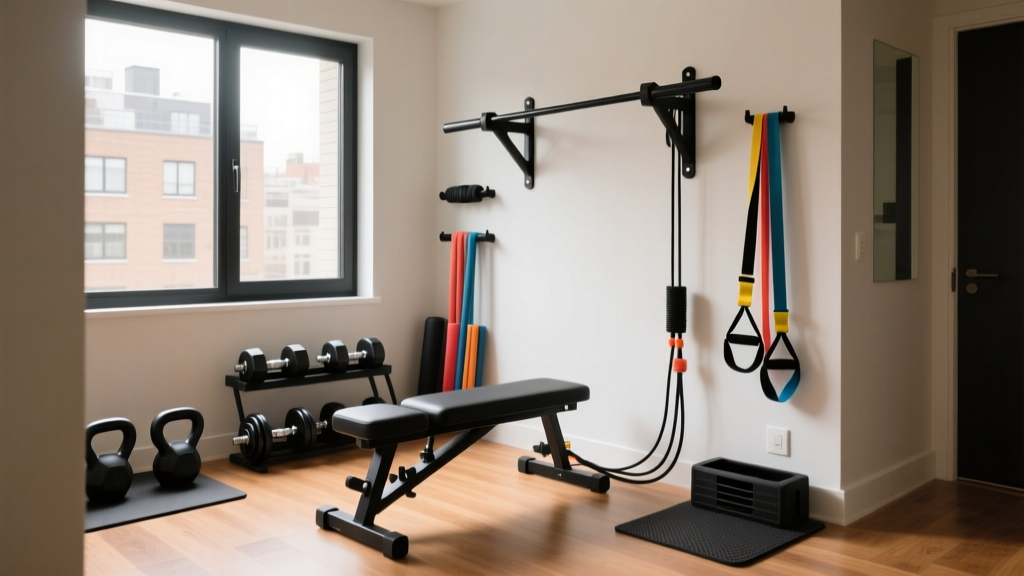
The alternative to a legacy all-in-one machine is a modular setup that prioritizes free weights and bodyweight leverage. This approach requires purchasing three distinct pieces of equipment that together mimic the versatility of a cable machine while offering superior stabilizer muscle engagement.
The $460 Shopping List
- Flybird Adjustable Dumbbells (5-52.5 lbs): $260. These utilize a dial-turn mechanism to replace 15 sets of traditional dumbbells.
- Stamina 1690 Power Tower: $140. A heavy-duty steel frame for pull-ups, dips, and knee raises.
- WODFitters Heavy-Duty Loop Bands (Set of 4): $40. Used to simulate cable pushdowns, face pulls, and assisted pull-ups.
Free weights demand continuous stabilization from secondary muscle groups. The Mayo Clinic notes that engaging these stabilizer muscles not only improves functional daily strength but also significantly enhances joint integrity over time compared to fixed-path machines.
Head-to-Head Comparison Matrix
| Feature | Used Bowflex Sport | Modular Budget Build |
|---|---|---|
| Total Cost (2026) | $150 - $250 (Used) | $440 (New) |
| Resistance Curve | Variable (heavier at peak contraction) | Constant (gravitational) |
| Footprint | 17 sq. ft. (Fixed) | 8 sq. ft. (Modular/Scattered) |
| Setup Time | 4-6 Hours (Complex assembly) | 45 Minutes (Minimal assembly) |
| Maintenance | High (Rod replacement, cable lubrication) | Low (Dumbbell dial care, bolt tightening) |
| Resale Value | Poor (Depreciates heavily) | Good (Dumbbells hold 60% value) |
Biomechanics: Variable vs. Constant Resistance
Understanding the biomechanical differences between these two setups is critical for your programming. The National Strength and Conditioning Association (NSCA) frequently highlights the impact of resistance curves on hypertrophy.
The Bowflex Sport utilizes Power Rods that bend as you pull. This creates a variable resistance curve. During a chest press, the resistance is lightest when your hands are near your chest (where your pectorals are mechanically weakest) and heaviest at full extension (where you are strongest). This is excellent for joint safety and isolating the peak contraction. However, it falls short for movements like deadlifts or heavy rows, where the initial pull off the floor requires maximum force.
Conversely, the modular dumbbell setup provides constant gravitational resistance. A 50-lb dumbbell is 50 lbs at the bottom of the movement and 50 lbs at the top. This is superior for raw strength building and central nervous system adaptation, but it requires stricter form to avoid injury at the mechanical weak points of a lift.
Space Assessment and Environmental Factors
Where you build your gym dictates which option wins. The Bowflex Sport requires a dedicated 5x5 foot footprint, plus an additional 2 feet of clearance on all sides for the lat bar and leg extension attachments. It is a monolith; once assembled, you are not moving it. If you are setting up in a dedicated spare bedroom or a finished basement, the Bowflex is a fantastic, quiet option that won't damage floors if a weight slips.
The modular setup, however, is the undisputed king of the multi-use space. The Stamina Power Tower can be tucked into a corner, and the adjustable dumbbells can be slid under a bed or into a closet when not in use. If you are building an apartment home gym or a garage gym where you also need to park your car, the modular build's collapsible footprint is mandatory.
Warning: Adjustable Dumbbell Fragility
Crucial Edge Case: Never drop adjustable dial dumbbells. The internal plastic gearing mechanisms that lock the weight plates are highly sensitive to impact. Dropping a Flybird or Bowflex SelectTech dumbbell from shoulder height will likely shatter the dial housing, rendering the $260 investment useless. The Bowflex Sport cables, by contrast, are virtually drop-proof.Frequently Asked Questions
Can I upgrade the Bowflex Sport resistance later?
Yes. The Bowflex Sport can be upgraded from 210 lbs to 310 lbs of resistance by purchasing the official rod upgrade kit. However, this kit costs approximately $150. If you buy the machine for $250 and immediately upgrade it, you will hit your $500 budget ceiling, negating the financial advantage of buying used.
Which setup is better for a beginner?
The Bowflex Sport is generally safer for absolute beginners. The fixed movement paths and variable resistance curve reduce the sheer force on connective tissues and lower the risk of dropping a weight on yourself. The modular setup requires a foundational understanding of free-weight form, particularly for exercises like dumbbell Romanian deadlifts and overhead presses.
The Final Verdict
If you have a dedicated, climate-controlled room and prioritize joint-friendly, high-volume isolation work, hunting down a well-maintained Bowflex Sport home gym on the secondary market remains an unbeatable sub-$300 value in 2026. It provides a premium, all-in-one experience that new budget brands simply cannot match at this price point.
However, if you value raw strength progression, space flexibility, and equipment longevity, the $440 Modular Budget Build is the superior investment. Adjustable dumbbells and a power tower will easily survive a decade of heavy use, require zero proprietary replacement parts, and offer a biomechanical stimulus that polymeric rods simply cannot replicate. Choose the path that aligns with your spatial constraints and your long-term training philosophy.
More gear to consider
All reviews
How Much Does It Cost to Build a Home Gym? Mirrors & Lighting Costs

Pink Home Gym Ideas: Strength Training Setup Walkthrough

Gold's Gym Home Gym Equipment: Complete Strength Setup Walkthrough

Top Home Gym Paint Ideas for Layout and Design Optimization

Best Flooring for Home Gym in Basement Apartments & Small Spaces