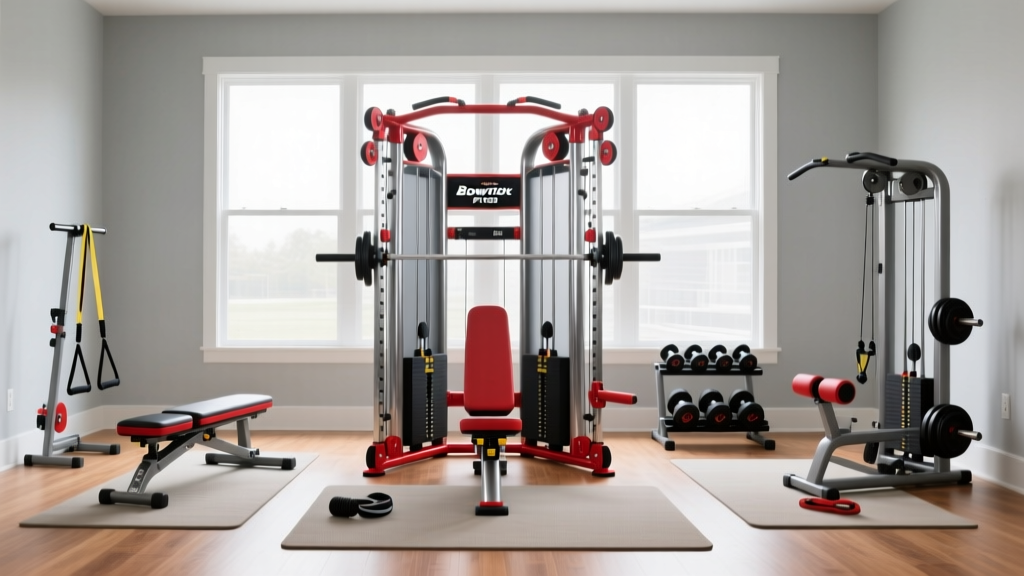
Bowflex PR1000 Home Gym Review vs Budget Alternatives Under $500
Read our in-depth Bowflex PR1000 home gym review and compare it against top budget setups under $500. Find the best space-saving fitness gear for 2026.

The $500 Home Gym Dilemma in 2026
Building a comprehensive home gym on a strict budget requires navigating a minefield of overhyped gadgets and flimsy equipment. When your hard ceiling is $500, the margin for error is zero. You need gear that delivers progressive overload, durability, and versatility without eating up your entire living room. According to the Centers for Disease Control and Prevention (CDC), adults need at least two days of muscle-strengthening activities per week, meaning your budget setup must accommodate full-body resistance training.
In this head-to-head comparison, we are putting a legendary all-in-one machine under the microscope with our comprehensive Bowflex PR1000 home gym review, pitting it against the two most effective modular budget setups available in 2026: a heavy-duty power tower with adjustable dumbbells, and a premium variable resistance band ecosystem. Let us break down the exact costs, spatial requirements, and real-world failure modes to determine which sub-$500 setup deserves your floor space.
Bowflex PR1000 Home Gym Review: The All-in-One Contender
The Bowflex PR1000 has been a staple in the budget fitness space for years, and in 2026, it remains one of the only multi-station cable machines that frequently dips below the $500 mark during seasonal sales or via certified refurbished channels. It utilizes Bowflex’s proprietary Power Rod technology, offering up to 210 lbs of resistance via flexible polymer rods rather than traditional cast-iron weight stacks.
Specifications and Spatial Footprint
- Dimensions: 93" H x 38" W x 64" D
- Weight: 148 lbs
- Max Resistance: 210 lbs (Upgradable to 310 lbs, though the upgrade kit pushes the total cost over our $500 budget)
- Required Clearance: 72" W x 84" D (including user movement zone)
Expert Warning: Environmental Failure Modes
The Power Rods are constructed from polyhexamethylene adipamide (a specialized nylon). These rods are highly susceptible to hygroscopic degradation and UV damage. If you plan to place the PR1000 in an uninsulated garage or a sunroom with direct UV exposure, the rods will lose tensile strength, warp, and eventually splinter within 18 to 24 months. This machine is strictly for climate-controlled indoor environments.
Pros and Cons of the PR1000
The primary advantage of the PR1000 is joint health. The Mayo Clinic notes that smooth, continuous tension is highly beneficial for joint rehabilitation and older adults. The Power Rods provide a linear variable resistance that is incredibly smooth, eliminating the momentum-based joint shock of free weights. Furthermore, the folding design allows you to roll the machine into a closet, a massive win for apartment dwellers.
However, the eccentric (lowering) phase of the lift feels notably weaker than the concentric phase, which Harvard Health identifies as a critical component for maximum muscle hypertrophy. Additionally, the seat pad features only 1.5 inches of high-density foam; users over 180 lbs will experience sit-bone fatigue during extended leg extension or lat pulldown sessions.
Challenger 1: Power Tower & Adjustable Dumbbell Matrix
If you want raw, unadulterated progressive overload, modular free weights and bodyweight stations are the gold standard. For 2026, the most cost-effective heavy-duty combination is the Sportsroyals Power Tower paired with a set of Yes4All 5-52.5 lb Adjustable Dumbbells.
The Cost Breakdown
- Sportsroyals Power Tower: ~$140 (Features a 330 lb weight capacity, heavy-duty steel frame, and integrated push-up/dip stations)
- Yes4All Adjustable Dumbbells (Pair): ~$180 (Replaces 15 sets of traditional dumbbells)
- 3/8" Rubber Floor Mats (4-pack): ~$60
- Total Investment: ~$380
This setup leaves you with $120 in breathing room for accessories like a kettlebell or a yoga mat. The Sportsroyals tower occupies a compact 35" x 26" footprint but requires 84" of vertical clearance. The primary drawback here is assembly and floor loading. The tower's base is relatively narrow, meaning aggressive kipping pull-ups or heavy weighted dips can cause lateral tipping if the unit is not anchored or loaded with sandbags at the base.
Challenger 2: Premium Variable Resistance Band Ecosystem
For ultra-small spaces (like dorms or studio apartments) or those prioritizing travel, a high-end tube band system is the ultimate budget hack. The Serious Steel Assisted Pull-Up & Resistance Band Set (4-Band) combined with a heavy-duty door anchor and a tension-based suspension trainer provides a complete gym in a shoebox.
The Cost Breakdown
- Serious Steel 4-Band Set: ~$85 (Provides up to 230 lbs of combined tension)
- Heavy-Duty Door Anchor & Handles: ~$25
- Doorway Pull-Up Bar: ~$35
- Total Investment: ~$145
While the price is unbeatable, the biomechanical limitations are significant. Resistance bands offer ascending tension—meaning the exercise is easiest at the start of the movement (where you are weakest) and hardest at the end (where you are strongest). This is excellent for joint warm-ups and finishers, but suboptimal for building raw starting strength. Furthermore, the latex and TPE materials degrade with sweat and friction, requiring a full replacement every 12 to 18 months.
Head-to-Head Comparison Matrix
| Feature | Bowflex PR1000 | Tower + Dumbbells | Premium Band Ecosystem |
|---|---|---|---|
| Average 2026 Cost | $499 (Sale/Refurb) | $380 | $145 |
| Footprint (In Use) | 72" x 84" | 60" x 60" (Clearance) | 36" x 36" |
| Resistance Profile | Linear Variable (Smooth) | Constant (Gravity-based) | Ascending (Elastic) |
| Setup / Teardown Time | 2 mins (Fold/Unfold) | 0 mins (Always ready) | 3 mins (Anchor/Swap) |
| Primary Failure Risk | UV/Moisture rod degradation | Tower lateral tipping | Latex snapping/fraying |
Space, Flooring, and Environmental Constraints
When building a budget gym, the equipment cost is only half the equation; protecting your home is the other. The Bowflex PR1000 weighs 148 lbs and distributes its weight across four small plastic feet. If placed on luxury vinyl plank (LVP) or hardwood, it will dent the flooring during heavy leg presses. You must use a 1/2" interlocking EVA foam mat puzzle ($30) to disperse the point-load.
Conversely, the Power Tower and adjustable dumbbell setup requires impact protection. Dropping a 50 lb dumbbell on EVA foam will instantly crack the foam and damage the subfloor. For the free-weight setup, you must invest in 3/4" thick vulcanized rubber horse stall mats (typically $50 per 4x6 ft section at local farm supply stores). While this eats into your budget, it is a non-negotiable requirement for shock absorption and noise dampening in multi-story homes.
Final Verdict: Choosing Your Sub-$500 Setup
So, which budget setup takes the crown in 2026? The answer depends entirely on your biomechanical goals and spatial constraints.
The Apartment Dweller & Rehab User
If you live in a climate-controlled apartment, prioritize quiet operation, and need a joint-friendly circuit for general fitness or physical therapy, the Bowflex PR1000 is the undisputed winner. Its folding capability and smooth Power Rod resistance offer a premium commercial-gym feel that free weights cannot replicate in a small bedroom.
The Hypertrophy & Strength Seeker
If your primary goal is building raw muscle mass, increasing bone density, and mastering functional bodyweight movements, skip the Bowflex. The Power Tower and Adjustable Dumbbell Matrix provides true progressive overload, eccentric control, and infinite scalability. It is the superior investment for long-term strength gains, provided you have the garage or basement space to accommodate rubber matting and vertical clearance.
Ultimately, a $500 budget in 2026 is more than enough to build a highly effective home gym, provided you match the equipment's resistance profile to your specific physiological goals and respect the environmental limitations of the materials involved.
More gear to consider
All reviews
Outdoor CBUM Home Gym: Weatherproofing & Maintenance Tips

Apartment Home Gym Size Dimensions: Avoid These No-Damage Mistakes

How to Design a Home Made Gym: Step-by-Step Layout Guide

Shared Gym Setup: Using Bowflex Home Gym Older Models for Couples
Weatherproofing Your MCore Home Gym: Outdoor Setup
