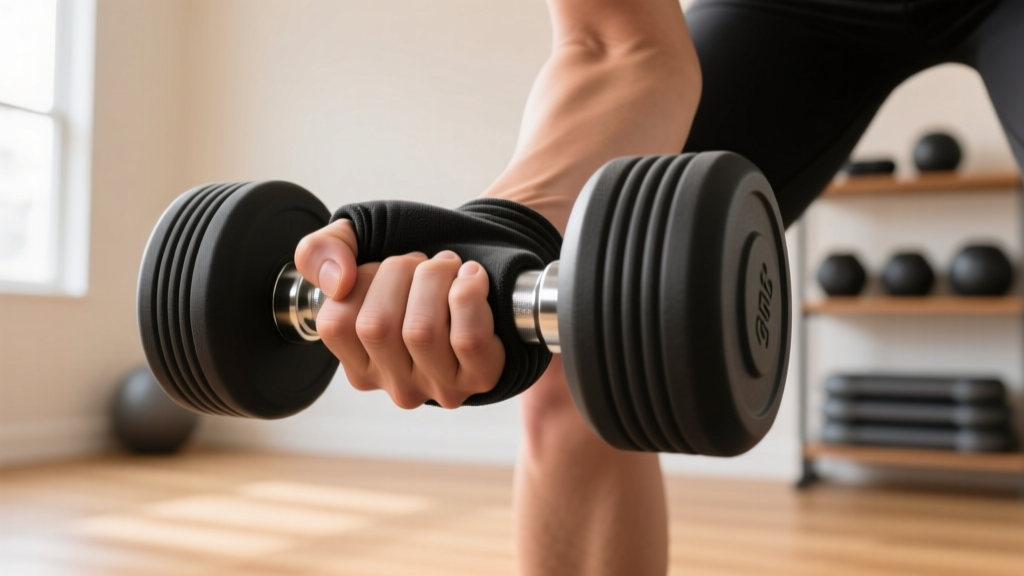
Wrist Exercises With Dumbbells: Neoprene Grip Mistakes & Fixes
Fix common form and grip mistakes when doing wrist exercises with dumbbells. Learn how to properly use neoprene-coated weights for home wrist rehab.

The Hidden Biomechanical Flaws of Neoprene Dumbbells
Walk into any home gym built in the last five years, and you will inevitably find a rack of hex-shaped, neoprene-coated dumbbells. Brands like Yes4All and Amazon Basics dominate this space, offering floor-friendly, budget-oriented weight sets typically ranging from $15 to $30 per pair. While these dumbbells are excellent for high-repetition metabolic conditioning and general fitness, they present unique, often overlooked challenges when used for targeted isolation work—specifically wrist exercises with dumbbells.
Wrist and forearm rehabilitation requires precise biomechanical alignment and strict load management. According to the Cleveland Clinic, wrist tendonitis and repetitive strain injuries often stem from improper load distribution and poor joint mechanics during flexion and extension. When you introduce the thick, rubberized grip of a neoprene dumbbell into the equation, the mechanics of your wrist curls and extensions change drastically. If you are using these home weights for wrist rehab or forearm hypertrophy and experiencing stalled progress or joint pain, you are likely falling victim to equipment-specific form errors.
4 Critical Mistakes When Using Neoprene Dumbbells for Wrists
Mistake 1: Ignoring the Handle Diameter Shift
A standard Olympic or cast-iron dumbbell handle measures approximately 28mm in diameter. Neoprene coatings, however, add anywhere from 4mm to 6mm of synthetic rubber, bringing the total grip diameter to 32mm–34mm. This seemingly minor increase forces your fingers into a wider splay, shifting the primary point of fatigue away from the wrist flexors (flexor carpi radialis and palmaris longus) and onto the finger flexors (flexor digitorum superficialis).
The Fix: If your fingers are burning out before your wrist achieves full fatigue, your grip is failing first. Choke up slightly on the handle, placing the weight closer to the base of your palm rather than your fingertips. This reduces the lever arm on your fingers and forces the wrist joint to bear the rotational load, which is the exact stimulus required for proper wrist curl execution.
Mistake 2: Compressing the TFCC on Hard Benches
The most common setup for wrist exercises with dumbbells involves resting the forearm on a flat bench with the hand hanging off the edge. However, many home gym owners rest their forearm directly on the bony prominence on the pinky-side of the wrist, known as the ulnar styloid process. When holding a 10lb or 15lb neoprene dumbbell, this compresses the Triangular Fibrocartilage Complex (TFCC)—a critical stabilizing structure in the wrist—against the hard bench pad.
The Fix: Rotate your forearm slightly inward (pronate about 15 degrees) so the meat of the forearm flexors rests on the bench, elevating the ulnar styloid just millimeters off the pad. Alternatively, roll up a microfiber towel and place it under the distal third of your forearm to create a soft, anatomical cradle.
Mistake 3: The "Short-Stroke" Rep and Tendon Starvation
Because neoprene dumbbells are often lightweight (typically capping out at 15 or 20 lbs per hand in home sets), users compensate by performing rapid, half-rep wrist flicks. Tendons and ligaments do not respond well to partial-range, momentum-driven reps. To stimulate collagen synthesis in the wrist tendons, you must utilize a full range of motion and an eccentric-focused tempo.
The Fix: Adopt a 3-1-2-0 tempo. Lower the dumbbell into a deep stretch (allowing the wrist to extend fully) for 3 seconds, pause for 1 second at the bottom to eliminate the stretch reflex, curl the weight up for 2 seconds, and hold for 0 seconds at the top. This time-under-tension protocol is vastly superior for tendon health than pumping out 30 rapid, partial reps.
Mistake 4: Neglecting the Extensors (The Imbalance Trap)
Home gym users heavily favor wrist flexion (curls) because the flexor muscles are naturally larger and more visible. Neglecting wrist extensions with your neoprene dumbbells creates a severe strength imbalance. The American Academy of Orthopaedic Surgeons notes that weakness in the extensor carpi radialis brevis is a primary contributor to lateral epicondylalgia, commonly known as tennis elbow. If you only curl the weight, you are leaving the lateral elbow vulnerable to injury.
The Fix: Enforce a strict 2:1 ratio of extension to flexion in your programming. For every set of wrist curls you perform with your neoprene dumbbells, perform two sets of wrist extensions to ensure the posterior forearm chain remains robust and balanced.
Troubleshooting Matrix: Symptoms & Equipment Fixes
Use the following diagnostic table to identify what your pain or fatigue is telling you about your form and equipment setup.
| Symptom / Failure Point | Probable Cause | The Fix |
|---|---|---|
| Fingers go numb or burn out first | Handle diameter too thick (33mm+); grip placed too far down the fingers. | Choke grip toward the palm; wrap a thin cotton towel around the handle to improve friction without adding bulk. |
| Sharp pain on the pinky-side of wrist | Ulnar styloid compressing the TFCC against the bench pad. | Place a rolled towel under the forearm; slightly pronate the arm to lift the bony landmark off the bench. |
| Aching on the outside of the elbow | Extensor weakness; over-reliance on wrist flexion exercises. | Implement 2:1 extension-to-flexion ratio; use lighter 3lb-5lb neoprene weights for strict extensor isolation. |
| Dumbbell slipping during the eccentric phase | Neoprene degradation from sweat and sebum buildup. | Wash handles with mild dish soap weekly; chalk hands lightly before isolation sets. |
| Wrist joint clicking or popping at the top | Hyper-flexion; curling the wrist past its natural anatomical limit. | Stop the concentric phase when the back of the hand is parallel to the floor; do not force an extra "squeeze". |
Progressive Overload: Escaping the 15lb Neoprene Trap
The most significant limitation of neoprene dumbbells for home use is the lack of micro-progression. Wrist tendons adapt slowly, and jumping from a 10lb to a 15lb dumbbell represents a massive 50% increase in load—a guaranteed recipe for tendonitis. When you max out your 10lb or 15lb neoprene hex sets, do not simply buy the next heaviest fixed dumbbell. Instead, use these progression methods:
- The Ankle Weight Hack: Strap a 2.5lb or 5lb neoprene ankle weight directly over your wrist joint while holding your 10lb dumbbell. This allows for precise 2.5lb micro-loading without altering the grip dynamics of your primary dumbbell.
- Eccentric Overloads: Use your non-working hand to assist in lifting a 20lb or 25lb neoprene dumbbell into the flexed position, then let go and use the working wrist to resist the weight on the 3-second eccentric descent. This builds tendon tensile strength without requiring a lighter grip on the way up.
- Transition to Adjustable Steel: Once you consistently require loads over 20lbs for 12-rep sets, it is time to retire the neoprene for wrist work and invest in a pair of adjustable steel dumbbells (like the Bowflex 552 or Nuobell), which offer standard 28mm knurled handles and 5lb or 2.5lb micro-increments.
Equipment Care: Sweat and Neoprene Degradation
Finally, a troubleshooting note on the material itself. Neoprene is a closed-cell synthetic rubber that is highly susceptible to degradation from the acids, salts, and sebum found in human sweat. Over time, the handles of heavily used home dumbbells develop a slick, almost oily film. During heavy wrist extensions, where gravity is actively trying to pry your fingers open, a degraded neoprene handle will slip, forcing your finger flexors to panic-grip and potentially straining the medial epicondyle.
Do not use harsh, alcohol-based gym wipes or bleach solutions on your neoprene dumbbells; these dry out the rubber, causing it to crack and peel. Instead, wipe them down weekly with a microfiber cloth dampened with warm water and a drop of mild dish soap. This preserves the tactile friction of the coating, ensuring that when you perform wrist exercises with dumbbells, your grip remains secure and the tension stays exactly where it belongs: on the wrist and forearm musculature.
More gear to consider
All reviews
Olympic vs Standard Plates: Setup Guide & Dumbbell Pic Layouts
Maintain Loadable Dumbbells for Chest Exercises Without a Bench

Racks vs Stands: Fixing the Seated Dumbbell Rear Lateral Raise

Olympic vs Standard Plates: Sourcing Dumbbells in Spanish Markets

Home Gym Setup Walkthrough: Integrating a 45 lb Dumbbell Pair
