
Wing Exercises Dumbbells Guide: Top Adjustable Picks Reviewed (2026)
Master wing exercises with dumbbells using our step-by-step beginner guide. Plus, compare the best adjustable dumbbells for back training in 2026.

Building a wider, stronger back—commonly referred to as developing your "wings"—is a primary goal for many beginners entering the home gym space. The latissimus dorsi (lats) are the largest muscles in your upper body, and targeting them effectively requires specific pulling mechanics. Many beginners searching for wing exercises dumbbells routines quickly realize that free weights offer superior range of motion compared to machines. However, when outfitting a home gym, space and budget constraints make adjustable dumbbells the undisputed champion.
But not all adjustable dumbbells are created equal, especially when it comes to back training. The bulky collars, handle lengths, and weight distribution of different models can drastically alter your biomechanics during pulling movements. In this comprehensive 2026 guide, we will walk you through a step-by-step beginner routine for lat development, followed by an in-depth, expert review of the top adjustable dumbbells specifically evaluated for back and "wing" training.
The Anatomy of the "Wings" and Dumbbell Biomechanics
Before picking up a weight, it is crucial to understand what you are training. The "wings" primarily refer to the latissimus dorsi, a broad, flat muscle covering the lower and mid-back. Its primary functions are shoulder extension (pulling the arm down and back) and shoulder adduction (pulling the arm toward the midline).
Expert Insight: According to electromyographic (EMG) studies on back muscle activation, dumbbell rows and pullovers elicit some of the highest latissimus dorsi activation levels because they allow for a natural, unconstrained path of motion, enabling the scapula to retract and protract freely—something fixed barbells cannot replicate.Step-by-Step: 3 Essential Wing Exercises With Dumbbells
As a beginner, mastering the mind-muscle connection is more important than moving maximum load. Follow this step-by-step protocol to ensure your lats, not your biceps, are doing the heavy lifting.
1. The Single-Arm Dumbbell Row (The Foundation)
This is the ultimate mass-builder for the mid-back and lats.
- The Setup: Place your left knee and left hand on a flat bench. Keep your right foot planted firmly on the floor. Your torso should be nearly parallel to the ground, spine neutral.
- The Grip: Grab the dumbbell with a neutral grip (palm facing your torso). Let the weight hang straight down, feeling a deep stretch in your lat.
- The Pull: Initiate the movement by driving your elbow up and back toward the ceiling, not by pulling with your hand. Imagine you are trying to elbow someone standing behind you.
- The Squeeze & Lower: Pause at the top for one second, squeezing your shoulder blade toward your spine. Lower the weight under control for a full 2-second negative.
Beginner Mistake to Avoid: Rotating the torso to heave the weight up. If your shoulders twist, the weight is too heavy.
2. The Dumbbell Pullover (The Lat Stretcher)
The pullover targets the lats in their fully lengthened position, which is highly stimulative for muscle hypertrophy.
- The Setup: Lie with your upper back perpendicular across a bench, hips dropped slightly to create a stable arch.
- The Grip: Hold a single dumbbell with both hands cupping the inside top plate (diamond grip).
- The Descent: Keeping a slight bend in your elbows, slowly lower the weight backward over your head until you feel a deep stretch in your armpits/lats.
- The Return: Pull the dumbbell back over your chest using only your lats, stopping before the weight goes directly over your face to maintain constant tension.
3. Chest-Supported Reverse Fly (The Wing Detailer)
While rows hit the lats, reverse flies target the rhomboids and rear deltoids, giving the upper back that 3D "winged" look.
- The Setup: Set an adjustable bench to a 30-degree incline. Lie face down with a light dumbbell in each hand, arms hanging straight down.
- The Arc: With a slight bend in the elbows, raise the weights out to the sides in a wide arc.
- The Peak: Squeeze your shoulder blades together at the top, then slowly lower.
The Hidden Challenge: Adjustable Dumbbell Ergonomics for Pulling
When performing back exercises, the physical dimensions of your adjustable dumbbells matter immensely. Unlike pressing movements where the weight rests in your palms, pulling movements require the dumbbell to travel close to your torso. If an adjustable dumbbell is too long, the bulky weight plates or dial mechanisms will collide with your ribs or bench, artificially cutting off your range of motion and ruining lat activation.
Furthermore, handle thickness (diameter) impacts grip fatigue. During heavy single-arm rows, your grip will fail before your lats do if the handle is uncomfortably thick or lacks proper knurling. Below, we evaluate the top 2026 models specifically through the lens of back training.
2026 Adjustable Dumbbell Comparison Matrix
| Feature | Nuobell 552 (Authentic) | Bowflex SelectTech 552 | PowerBlock Elite (US) |
|---|---|---|---|
| Overall Length | 14.5 inches | 15.75 inches | 12 inches (Cage) |
| Handle Type | Traditional Steel / Knurled | Smooth Rubber / Contoured | Caged / Straight Bar |
| Lat Exercise Rating | ⭐⭐⭐⭐⭐ | ⭐⭐⭐ | ⭐⭐⭐⭐ |
| Approx. Price (Pair) | $429 | $349 | $369 |
In-Depth Reviews: Best Picks for Lat Training
1. Nuobell 552: The Undisputed Champion for Back Day
The Nuobell 552 (ensure you are buying the authentic version, not a cheap knockoff) is the closest an adjustable dumbbell gets to the feel of a traditional commercial gym dumbbell. The twist-handle adjustment mechanism means there are no bulky dials on the ends of the dumbbell. At 14.5 inches in length, it clears the torso easily during single-arm rows and bench pullovers. The knurled steel handle provides the exact grip security needed when your hands get sweaty during heavy lat work.
- Pros: Traditional profile, excellent knurling, no end-caps to bump together.
- Cons: Highest price point; the internal mechanism requires careful handling (never drop them).
2. Bowflex SelectTech 552: The Budget-Friendly Compromise
The Bowflex 552 is the most recognizable adjustable dumbbell on the market, utilizing a dial system that is incredibly intuitive. However, for wing exercises, it has a distinct flaw: the 15.75-inch length and wide dial collars. When performing close-grip rows or deep pullovers, the plastic dials can clack against each other or dig into your ribs. Furthermore, the smooth rubber handle lacks aggressive knurling, making grip fatigue a real issue on high-rep back sets.
- Pros: Excellent price-to-weight ratio, highly durable for the price, easy micro-loading.
- Cons: Bulky ends restrict range of motion on pulling exercises; handle lacks grip texture.
3. PowerBlock Elite: The Ergonomic Wildcard
PowerBlock’s cage design is polarizing. For back training, the compact 12-inch block shape is actually a massive advantage for rows, as it keeps the center of mass incredibly close to your hand, reducing torque on the wrist. The neutral grip enforced by the cage is also the exact grip recommended for lat isolation. The downside? The cage restricts wrist supination, meaning you cannot rotate your wrist at the top of a row for an extra squeeze, and it feels highly unnatural for pullovers.
- Pros: Most compact footprint, indestructible build quality, perfect for heavy neutral-grip rows.
- Cons: Cage limits wrist rotation; terrible for pullovers and reverse flies.
Beginner's 4-Week Progression Framework
To maximize hypertrophy in the latissimus dorsi, consistent progressive overload is required. Follow this beginner-friendly 4-week framework, performing this routine twice a week with at least 48 hours of rest between sessions.
- Week 1 (Form & Activation): 3 sets of 10-12 reps per exercise. Focus entirely on the 2-second negative. Rest 90 seconds between sets. Choose a weight where the last 2 reps are challenging but form remains perfect.
- Week 2 (Volume Increase): 3 sets of 12-15 reps. Keep the weight the same as Week 1. The increased volume will induce metabolic stress, a key driver of muscle growth.
- Week 3 (Intensity & Load): 4 sets of 8-10 reps. Increase the weight by 5 lbs (using the adjustable mechanism). Rest 2 minutes between sets to allow for ATP replenishment.
- Week 4 (Deload & Refine): 2 sets of 10 reps at 70% of your Week 3 weight. Focus on the mind-muscle connection and deep stretching of the lats.
Frequently Asked Questions (FAQ)
Can I build big "wings" using only adjustable dumbbells?
Yes. The lats do not know what type of iron they are pulling; they only respond to mechanical tension and stretch. Adjustable dumbbells actually offer a superior range of motion compared to barbells, allowing for deeper lat stretches during pullovers and single-arm rows.
Why do I feel my biceps more than my back during rows?
This is the most common beginner mistake. You are likely initiating the pull with your elbow flexors (biceps) rather than your shoulder extensors (lats). Use the "thumbless grip" (wrapping your thumb over the top of the handle alongside your fingers) to reduce bicep engagement and force the back to pull the load.
Are adjustable dumbbells safe for heavy single-arm rows?
Yes, provided you purchase a reputable brand (like Nuobell, Bowflex, or PowerBlock) and adhere to the manufacturer's weight limits. Never drop the dumbbell at the bottom of a rep; control the descent to protect the internal adjustment mechanisms from shattering.
More gear to consider
All reviews
How Dumbbell Workout Photos Drive 2026 Rack Trends
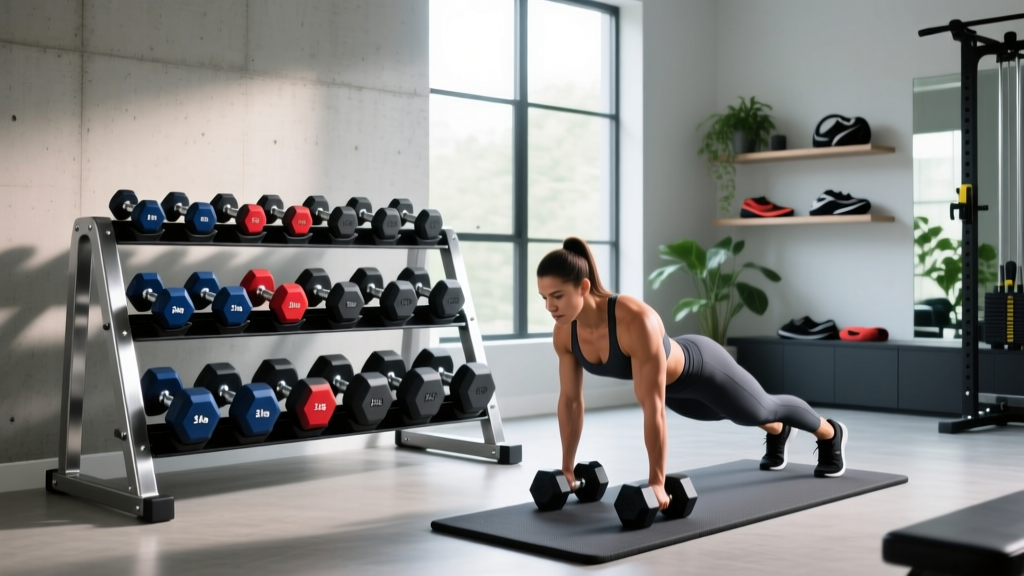
2026 Rack Trends: Dumbbell Pillover Workouts & Storage
Cast Iron vs Competition Kettlebells & Chest Training with Dumbbells

EZ vs Straight Bar Care & The Best Tricep Exercises with Dumbbells
Power Rack Setup: Olympic Barbell Knurling & 40lbs Dumbbell Storage
