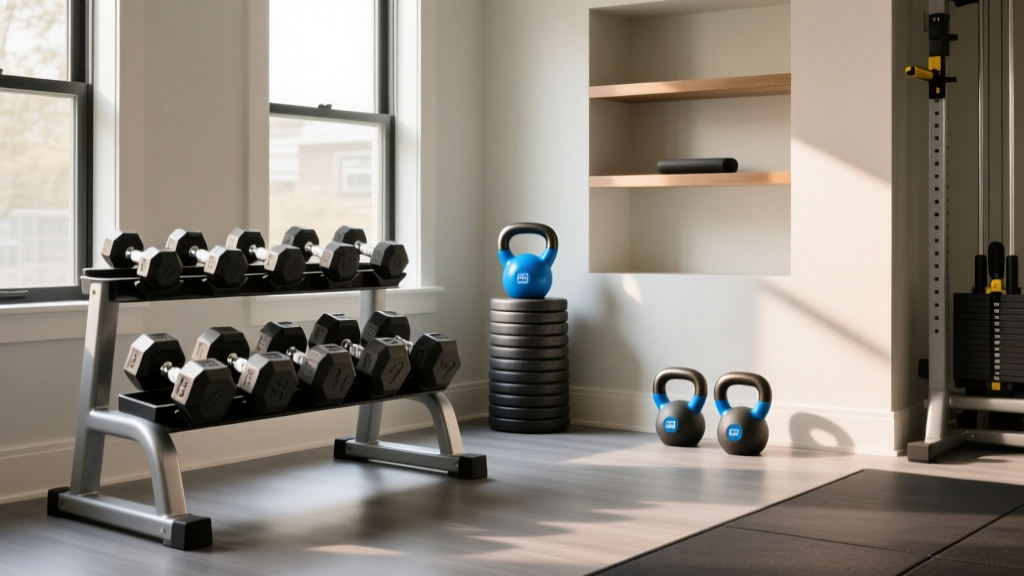
Gym Layouts: Upper Chest Workout with Dumbbells & Kettlebell Guide
Optimize your home gym layout. Compare cast iron vs competition kettlebells for space efficiency, racking, and complementing your dumbbell routines.

The Micro-Gym Paradigm: Balancing Isolation and Ballistics
As residential real estate trends shift and home gyms shrink into 50-to-80-square-foot micro-spaces, spatial economy has become the defining metric of equipment selection in 2026. When mapping out a compact garage or spare bedroom gym, you must carefully balance hypertrophy-focused isolation movements with functional, full-body conditioning. For example, you might dedicate your adjustable bench and power rack to a targeted upper chest workout with dumbbells, utilizing incline presses and flyes to build the clavicular head of the pectoralis major. Dumbbells excel here due to their symmetrical weight distribution and compact storage on tiered shelves.
However, to maximize spatial utility and introduce offset-center-of-mass conditioning, kettlebells are indispensable. They replace entire cable machines and medicine ball racks. The challenge for the space-conscious lifter lies in the physical geometry of the kettlebells themselves. Specifically, the choice between traditional cast iron kettlebells and standardized competition kettlebells dramatically impacts your floor plan, racking efficiency, and overall layout optimization. This guide breaks down the spatial and structural realities of both styles to help you design the ultimate space-saving weight nest.
The Geometry of Storage: Cast Iron vs. Competition Kettlebells
The most critical difference between cast iron and competition kettlebells from a layout perspective is dimensional scaling. Understanding how these bells occupy three-dimensional space is vital for designing custom shelving or selecting freestanding racks.
Cast Iron: The Variable Footprint
Cast iron kettlebells (such as those from REP Fitness or CAP Barbell) are poured into molds that scale proportionally with weight. A 16kg (35lb) cast iron bell is relatively compact, but a 32kg (70lb) bell is massive. This creates a 'staircase' effect on flat shelving. If you design a rack to accommodate the height and width of your heaviest 32kg bell, the lighter 8kg and 12kg bells will leave massive vertical and horizontal 'dead spaces' above and beside them. In a tight 60-square-foot gym, this wasted cubic volume is unacceptable.
Competition: The Standardized Footprint
Competition kettlebells, governed by international standards, maintain the exact same physical dimensions regardless of weight. Whether you are holding an 8kg or a 48kg bell, the height, base width, and handle window remain identical. The internal density is altered using steel ball bearings or specialized fillers to achieve the target weight without changing the exterior shell. According to equipment specifications from Rogue Fitness, a standard competition bell measures exactly 210mm in height and features a 33mm handle diameter. This uniformity allows for perfectly flush, high-density racking systems.
| Specification | Cast Iron Kettlebell (Variable) | Competition Kettlebell (Standardized) | Spatial Impact on2Gym Layout |
|---|---|---|---|
| Height (16kg) | ~145 mm | 210 mm | Cast iron saves vertical space at lower weights. |
| Height (32kg) | ~220 mm | 210 mm | Competition bells prevent 'staircase' dead space on racks. |
| Base Width | 120mm to 190mm (Scaling) | 210 mm (Uniform) | Uniform bases allow for tight, predictable shelf spacing. |
| Handle Diameter | Variable (thicker at heavy weights) | 33 mm (Standard) | Standard handles ensure consistent grip clearance in racks. |
Layout Optimization: Racking Systems and Dead Space
When integrating kettlebells into a layout that already houses a power rack and an adjustable bench for your dumbbell routines, the racking solution dictates your available floor space for dynamic movements like swings and snatches.
Wall-Mounted vs. Freestanding Tiered Racks
- Wall-Mounted Cast Iron Racks: Ideal for narrow hallways or ADU (Accessory Dwelling Unit) gyms. Because cast iron bells vary in size, you must mount the shelves at staggered heights (e.g., 10 inches, 14 inches, and 18 inches apart) to prevent the heavier bells from scraping the shelf above them. This requires custom drilling and limits future equipment expansion.
- Freestanding Competition Racks: Because competition bells are uniformly 210mm tall, a freestanding 3-tier rack can utilize fixed, equidistant shelving. This creates a dense, monolithic storage block that can be pushed flush into a corner, optimizing the central floor plan for Turkish get-ups and goblet squats.
Material Durability and Spatial Clearances
In a space-optimized gym, equipment is often stored inches away from drywall, mirrors, or squat rack uprights. The material composition of your kettlebells directly impacts how they survive in these tight quarters.
- Enamel and Powder-Coated Cast Iron: Most cast iron bells are coated in enamel or standard powder coat. When for clearance reasons, the handle can scrape against a steel rack upright. This not only damages the aesthetic but exposes the raw iron to humidity, leading to rapid oxidation (rust) that can stain your gym flooring.
Cost Per Square Foot: The 2026 Market Reality
Space optimization is also a financial calculation. You must weigh the cost of the equipment against the spatial efficiency it provides.
'In modern micro-gyms, you aren't just paying for the iron; you are paying for the geometric predictability that allows you to store more weight in a smaller footprint.' - Home Gym Engineering Principles, 2026
As of early 2026, the market pricing reflects this spatial premium:
- Cast Iron Kettlebells: Average between $1.50 and $2.20 per pound. They are the budget-friendly option, but their variable dimensions mean you will likely need a wider, deeper, or custom-built rack to store a full set (8kg to 32kg) without them looking cluttered or wasting shelf space.
- Competition Kettlebells: Average between $3.50 and $4.80 per pound. While the upfront cost is more than double, the uniform dimensions allow you to purchase highly compact, vertical 3-tier racks. You are effectively paying a premium for the ability to compress your storage footprint by up to 30% compared to a staggered cast iron setup.
Final Verdict for the Space-Conscious Lifter
Designing a highly functional home gym requires looking at equipment not just as tools for movement, but as geometric objects that occupy valuable real estate. If your primary training split revolves around bodybuilding aesthetics—spending most of your time executing an upper chest workout with dumbbells, lateral raises, and isolation movements—cast iron kettlebells are a cost-effective supplement. You can buy just two or three specific weights (e.g., 16kg and 24kg) and tuck them under a bench, minimizing their spatial impact.
However, if you are building a comprehensive functional fitness space where kettlebell sport, heavy swings, and complex flows are a daily staple, competition kettlebells are the undisputed champions of layout optimization. Their standardized 210mm height and 33mm handles eliminate dead space on racks, protect your walls from unpredictable clearance issues, and provide a uniform biomechanical experience that ExRx.net and other biomechanical databases note is crucial for maintaining consistent form across varying loads. Choose your iron based not just on the weight, but on the space it commands.
More gear to consider
All reviews
Power Rack vs Squat Rack: Setup for a Push Pull Dumbbell Workout
Upgrading Your HolaHatha Dumbbell Set: EZ Curl vs Straight Bar Care

Barbell Collars After Upper Body Dumbbell Exercises for Women: 2026
EZ Curl Bar vs Straight Bar & Pec Deck Fly Dumbbell Layouts

Setup Guide: Bicep Workout With Dumbbells Using Neoprene
