Standing Dumbbell Kickbacks: Power Rack vs Squat Rack vs Stand
Compare power racks, squat racks, and squat stands for 2026. Discover which setup offers the best stability for standing dumbbell kickbacks and heavy lifts.

The Hidden Test of Home Gym Stability
When most lifters shop for free weight enclosures in 2026, they focus exclusively on the big three: squats, bench presses, and deadlifts. They look at J-cup spacing, safety strap heights, and weight capacities. But as a senior equipment reviewer for FitGearPulse, I evaluate racks through a much more unforgiving lens: supported isolation movements. Specifically, the standing dumbbell kickback.
Why? Because heavy bilateral lifts mask equipment flaws. A 500-pound squat will stabilize even a mediocre rack through sheer downward force. But when you are balancing on one leg, hinging at the hip, and holding a 60-pound dumbbell behind your knee for a standing glute kickback, any lateral sway, upright flex, or base wobble in your rack is immediately magnified. The rack becomes your primary point of kinetic stabilization. If it shifts, your pelvic alignment breaks, your lumbar spine compensates, and glute maximus activation plummets.
In this in-depth buying guide, we are breaking down the power rack vs. squat rack vs. squat stand debate, using the biomechanical demands of standing dumbbell kickbacks to reveal which setup truly deserves a spot in your home gym.
Biomechanics of the Supported Kickback
According to exercise kinesiology principles outlined by ExRx.net, unilateral hip extension requires strict pelvic stabilization to prevent anterior pelvic tilt and lower back hyperextension. When performing standing dumbbell kickbacks, the non-working hand grips a vertical upright to anchor the torso.
The Stabilization Chain: Grip Force → Upright Rigidty → Base Footprint → Floor Anchoring. If any link in this chain yields to lateral or rotational torque, the exercise devolves from a targeted glute isolation into a sloppy balance drill.
With this mechanical reality in mind, let us evaluate the three primary rack categories available on the 2026 market.
Power Racks: The Gold Standard for Absolute Stability
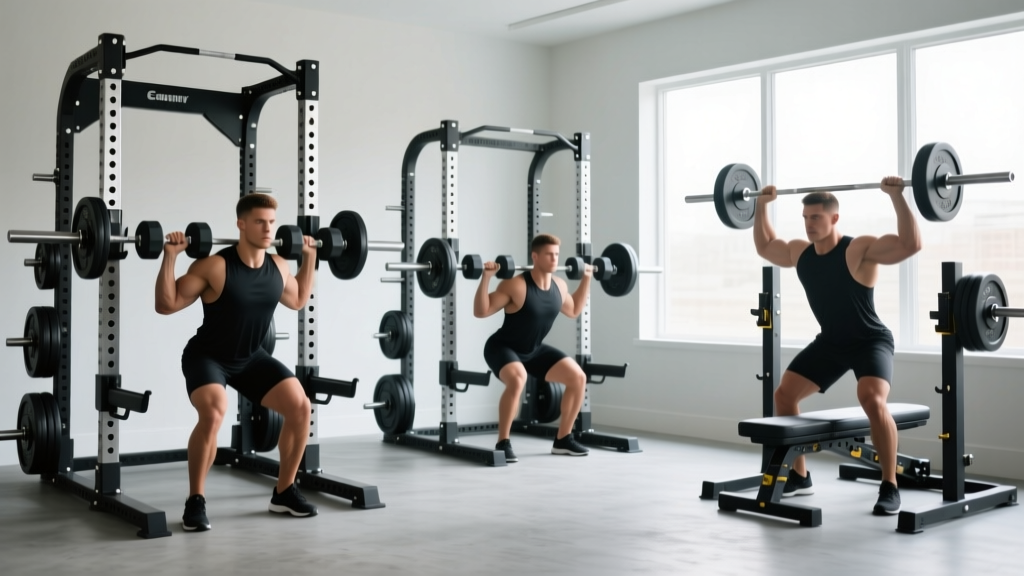
A true power rack (or full cage) features four vertical uprights connected by a continuous perimeter base and top crossmembers. Flagship 2026 models like the Rep Fitness PR-4000 and the Rogue R-3 Power Rack dominate this space.
Specifications & Pricing
- Steel Profile: 3x3-inch, 11-gauge steel (standard for premium cages).
- Footprint: Typically 47x47 inches or 49x49 inches.
- 2026 Price Range: $900 to $1,600 (base configurations).
The Kickback Test Performance
Power racks pass the standing dumbbell kickback test with flying colors. The 3x3-inch 11-gauge steel uprights exhibit virtually zero lateral flex under human grip pressure. More importantly, the four-point base, combined with the structural rigidity of the top crossmembers, creates a closed kinetic loop. When you lean into the upright to balance during a heavy 80-pound dumbbell kickback, the force is dispersed across the entire 16-square-foot footprint. There is no sway, no lift, and no wobble.
Pros: Unmatched stability; supports heavy band pegging; allows for lat-pulldown attachments (enabling cable standing kickback variations); maximum safety for solo lifters.
Cons: Massive footprint; high cost; requires significant ceiling clearance (84+ inches).
Squat Racks (Half Racks): The Open-Front Compromise
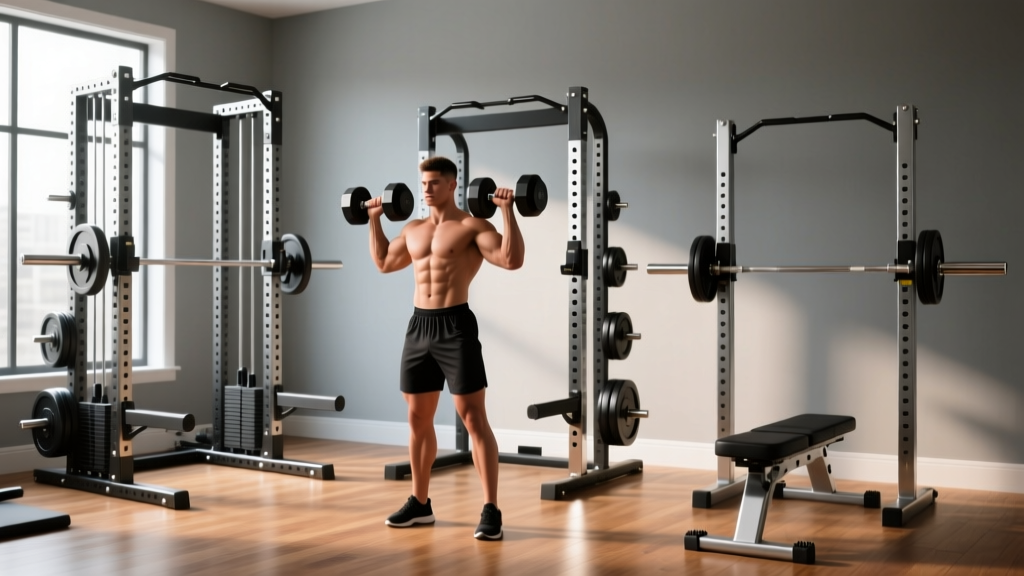
Squat racks, often called half racks, feature two main front uprights and a rear stabilizer bar. Popular models include the Titan T-2 Series and the Rogue S-2 Squat Stand. They are designed to save space while still offering a degree of safety for barbell movements.
Specifications & Pricing
- Steel Profile: 2x2-inch or 2x3-inch, 11-gauge or 14-gauge steel.
- Footprint: Typically 48x24 inches (excluding rear stabilizer).
- 2026 Price Range: $450 to $850.
The Kickback Test Performance
Half racks introduce a variable that full cages eliminate: open-front torque. When you grip the front upright of a squat rack to perform standing dumbbell kickbacks, your body weight and the rotational force of the hip extension pull laterally on the upright. Because there is no top crossmember connecting the front uprights to a rear structure, the upright will exhibit a micro-sway (usually 1 to 3 millimeters) unless it is aggressively bolted to a concrete subfloor.
While this sway is negligible for a barbell bench press, it is highly distracting during a slow, controlled unilateral isolation movement. You will feel the rack 'give' slightly at the peak contraction of the kickback, forcing your core to overcompensate.
Pros: More accessible pricing; easier to store barbell plates on rear horns; open front allows for easier overhead pressing clearance in low-ceiling basements.
Cons: Lateral sway during supported isolation; requires mandatory floor bolting; less safe for bailing on heavy squats without spotter arms.
Squat Stands: Minimalist Footprint, Maximum Balance Challenge
Squat stands are independent, twin-pillar structures. The Rogue SML-1 Monster Lite Squat Stand and the Bells of Steel 2.0 Stands are prime examples. They are essentially just two J-cups on heavy bases.
Specifications & Pricing
- Steel Profile: 2x2-inch or 3x3-inch steel, varying gauges.
- Footprint: Two independent 24x24-inch bases.
- 2026 Price Range: $250 to $450.
The Kickback Test Performance
From a strict biomechanical standpoint, independent squat stands are not recommended for standing dumbbell kickbacks or any supported single-leg movement. Because the uprights are not connected, gripping one stand and leaning your body weight into it shifts the center of gravity outside the 24x24-inch base pad. If you are holding a heavy dumbbell and lose your balance slightly, the lateral pull can cause the unbolted stand to tip or slide across rubber matting.
Even if bolted, the lack of a top crossmember means the upright itself can flex like a diving board under heavy lateral load, completely ruining the mind-muscle connection required for effective glute isolation.
Pros: Extremely affordable; can be folded or moved aside to create an open garage gym space; ideal for Olympic lifting variations.
Cons: Dangerous for supported isolation exercises; zero attachment compatibility; requires lifting the barbell over the uprights to rerack.
2026 Comparison Matrix: Heavy Lifts vs. Isolation Support
| Feature | Power Rack (Full Cage) | Squat Rack (Half Rack) | Squat Stands (Independent) |
|---|---|---|---|
| Upright Flex (Lateral) | Near Zero | Low to Moderate | High (Tipping Risk) |
| Standing Kickback Suitability | Excellent (10/10) | Fair (6/10) | Poor (2/10) |
| Average 2026 Cost | $1,250 | $650 | $350 |
| Cable/Band Integration | Full (Lat rows, cable kickbacks) | Limited (Band pegs only) | None |
The Anchoring Imperative: Concrete vs. Wood Subfloors
No matter which rack you choose, the National Strength and Conditioning Association (NSCA) emphasizes the importance of environmental stability in training spaces. If you are performing standing dumbbell kickbacks in a squat rack or half rack, anchoring is non-negotiable.
- Concrete Slabs: Use 3/8-inch wedge anchors. Drill through the base plate directly into the concrete. This eliminates all lateral sway, effectively turning a half rack into a rigid post suitable for heavy unilateral support.
- Wood Subfloors (Garage over Crawlspace): Do not use standard lag bolts into joists if you plan on doing dynamic supported movements. The rotational torque of a heavy standing dumbbell kickback can strip the wood grain over time. Instead, use structural screws (like Simpson Strong-Tie SDWS) driven at opposing angles, or bolt through the floor to a sistered joist beneath.
Cable Conversions: Future-Proofing Your Kickbacks
While the standing dumbbell kickback is a staple, advanced lifters often transition to cable variations to maintain constant tension on the glute throughout the entire range of motion. This is where the power rack vs. squat rack debate shifts dramatically.
A 2026 power rack with a 3x3-inch profile and Westside hole spacing allows you to mount a dedicated cable pulley attachment (such as the Rep Fitness Lat Pulldown / Low Row attachment). By setting the pulley to the lowest position and using an ankle cuff, you can perform cable standing kickbacks with up to 200 pounds of smooth, stack-loaded resistance. Squat racks and squat stands simply cannot accommodate these attachments, locking you into the dumbbell variation permanently.
Expert Verdict: Which Setup Should You Build?
If your programming relies heavily on supported isolation movements like standing dumbbell kickbacks, single-leg RDLs, and Yates rows, the power rack is the only logical choice. The initial investment of $1,000+ is justified by the absolute kinetic stability it provides, ensuring that your target muscles—not your stabilizers or your equipment—are the limiting factor in your hypertrophy.
Choose a squat rack only if your ceiling height is under 82 inches or your budget is strictly capped at $700, but be prepared to spend an afternoon bolting it to your floor with masonry anchors. Avoid squat stands entirely if supported unilateral isolation is a priority in your training split; they are tools for Olympic weightlifters and powerlifters on the move, not for controlled, stabilized hypertrophy work.
FitGearPulse Pro Tip: When performing standing dumbbell kickbacks inside a power rack, grip the upright at waist height rather than chest height. This lowers your center of gravity, reduces the lever arm on the rack, and promotes a more neutral pelvic tilt, maximizing glute maximus fiber recruitment according to ACE Fitness biomechanics guidelines.
More gear to consider
All reviews
Loadable Dumbbell Care to Maximize Your Dumbbell Only Exercises
Barbell Collar Types & Dumbbell Step Up Alternative
Olympic vs Standard Plates: Guide to Dumbbell Squats for Men

Space-Saving Dumbbell Racks for Women's Leg Workouts with Dumbbells
Pulling Exercises with Dumbbells: Adjustable Set Mistakes & Fixes