Space-Saving Racks to Organize Your Baadass Dumbbells
Maximize your home gym layout with space-saving racks for your baadass dumbbells. Compare footprints, layouts, and tiered vs. wall-mounted storage.

The Spatial Reality of Free Weight Storage
Designing a highly functional home gym in 2026 requires more than just buying premium iron; it demands rigorous spatial planning. When you invest in a rugged, heavy-duty set of baadass dumbbells—whether that means ultra-dense urethane hex bells, thick-handled grip trainers, or custom steel shot-filled rounds—the last thing you want is to trip over them or sacrifice valuable floor space for dead zones. Free weights are notoriously difficult to store due to their awkward geometry and extreme point-loads. A 50-pound hex dumbbell concentrates massive weight into a few square inches, meaning standard shelving will buckle under the pressure.
Optimizing your layout starts with acknowledging the footprint your equipment demands. According to facility design guidelines published by the National Strength and Conditioning Association (NSCA), free weight zones require specific clearance parameters to ensure safe lifting, proper spotting, and unobstructed movement. Ignoring these metrics leads to cramped, hazardous environments. This guide breaks down the exact dimensions, load capacities, and layout strategies for storing your premium dumbbell sets without compromising your gym's flow.
Footprint Math: Calculating Your Storage Zone
Before purchasing a rack, you must calculate the "active footprint" versus the "static footprint." The static footprint is the physical dimensions of the rack itself. The active footprint includes the clearance required to safely approach, grip, and lift the weights off the rack.
- Static Footprint: A standard 3-tier horizontal rack typically measures between 34 and 36 inches wide, and 22 to 24 inches deep.
- Active Clearance: You must add a minimum of 36 inches of clearance in front of the rack. This allows the lifter to hinge at the hips, grip the dumbbell, and stand up vertically without clipping the rack's uprights.
- Aisle Width: If placing a rack opposite a squat stand or bench, maintain at least 48 inches of aisle space to allow for carrying heavy dumbbells to the workout station safely.
Rack Archetypes: Tiered, A-Frame, and Wall-Mounted
Choosing the right storage solution depends entirely on your room's geometry. Below is a comparison matrix of the three primary rack archetypes available on the market today, evaluating their spatial efficiency and load limits.
| Rack Type | Avg. Static Footprint | Weight Capacity | Best Layout Scenario | Avg. Price (2026) |
|---|---|---|---|---|
| 3-Tier Horizontal | 35" W x 23" D | 1,000 - 1,500 lbs | Open walls, dedicated weight zones | $300 - $450 |
| Vertical A-Frame | 24" W x 24" D | 600 - 800 lbs | Corners, tight garages, apartments | $200 - $350 |
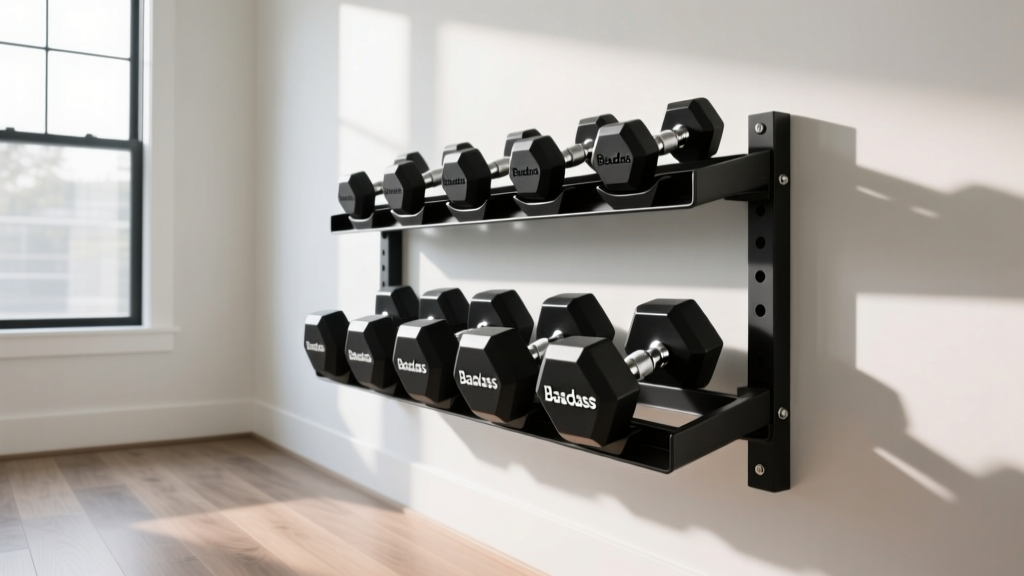
| Wall-Mounted Shelves | 36" W x 6" D (Zero floor space) | 300 - 500 lbs (per shelf) | Studded walls, maximizing floor mats | $150 - $250 |
1. The 3-Tier Horizontal Standard
The 3-tier horizontal rack is the undisputed king of commercial and high-end garage gyms. Models like the Rogue Fitness 3-Tier Dumbbell Rack are constructed from 11-gauge steel and feature a 34.5" x 22.5" footprint. Priced around $425, it easily accommodates a full set of rubber hex dumbbells from 5 to 50 pounds. The horizontal layout allows for easy readability of the weight markings and keeps the center of gravity low, preventing tip-overs even when multiple pairs are removed simultaneously.
Pro-Tip: If you are storing specialized baadass dumbbells with oversized grips or odd-shaped heads (like spherical grip bells), ensure the tier saddles are wide enough. Standard saddles are designed for 5.5-inch hex heads; thick-handled bells may require flat-shelf racks rather than contoured cradles.
2. The Vertical A-Frame Tower
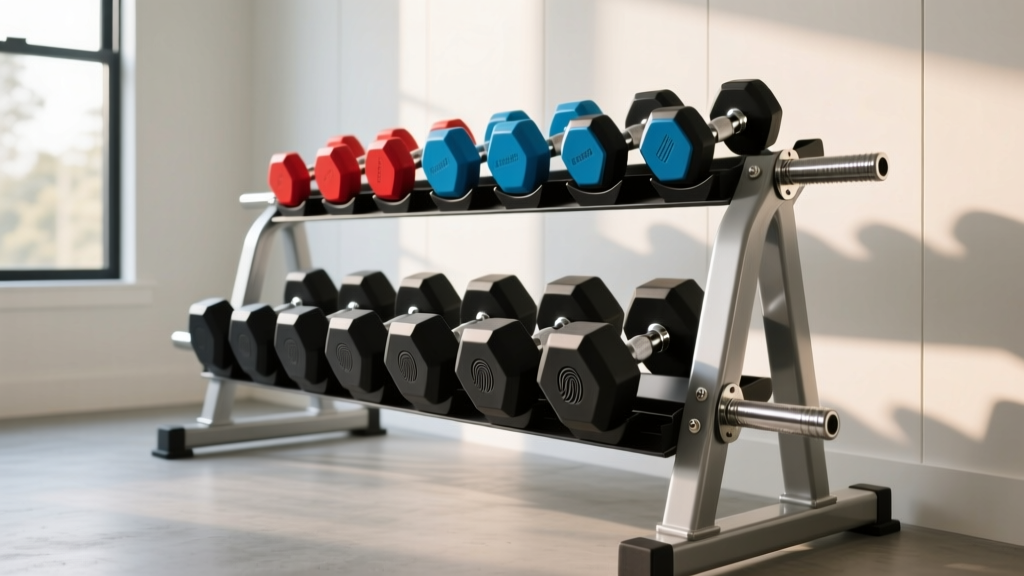
For home gyms operating in single-car garages or spare bedrooms, the A-Frame tower is a spatial lifesaver. By stacking weights vertically, these racks reduce the width requirement to roughly 24 inches. The Rep Fitness A-Frame models utilize a steep incline, allowing gravity to keep the dumbbells seated securely in their trays. While they save horizontal space, they do require more vertical clearance and can become unstable if loaded asymmetrically (e.g., removing all heavy bells from the left side before the right).
3. Wall-Mounted Floating Shelves
The ultimate space hack for 2026 is eliminating floor footprint entirely. Wall-mounted dumbbell shelves bolt directly into wooden wall studs (typically spaced 16 inches on center). Brands like Titan Fitness offer heavy-duty wall shelves that project only 6 to 8 inches from the wall. This allows you to push your workout benches or squat racks flush against the wall when not in use. However, this requires structural verification; drywall anchors will instantly fail under the dynamic load of cast iron.
⚠️ Structural Warning for Wall Mounts: A pair of 50lb dumbbells exerts over 100lbs of sheer force on the mounting brackets. Always use lag bolts (minimum 3/8" diameter, 3" length) driven directly into the center of wooden studs or use toggle bolts rated for 250+ lbs if mounting into commercial concrete block walls.The "Lift Triangle" and Ergonomic Flow
Space optimization is not just about storing the weights; it is about the flow of the workout. Interior gym designers utilize the "Lift Triangle" concept, which maps the three most frequent points of contact in a session: the storage rack, the primary lifting station (bench or platform), and the drop zone.
- Storage to Station: Keep your dumbbell rack within 4 to 6 feet of your adjustable bench. Carrying 80-pound dumbbells across a 15-foot garage wastes energy and increases the risk of dropping a bell on your foot or damaging your flooring.
- Line of Sight: Position the rack so you can see the weights while performing your primary lifts. This aids in mental preparation and workout pacing.
- Choke Points: Never place an A-frame or horizontal rack in a high-traffic doorway or directly in the path between the gym entrance and the main lifting platform.
Subfloor and Drop Zone Engineering
No matter how perfectly you organize your baadass dumbbells, they will eventually be dropped. Space optimization must include a designated "drop zone" adjacent to your rack. Standard EVA foam puzzle mats will compress and tear under the impact of a 40-pound hex dumbbell. Instead, dedicate a 4x6 foot section of flooring near your storage area using 3/4-inch thick vulcanized rubber horse stall mats. These mats absorb the kinetic energy of dropped iron, protecting both the concrete subfloor and the urethane coating on your premium dumbbells.
Furthermore, consider the "sweep zone" under your rack. Horizontal 3-tier racks often leave a 10-inch gap between the bottom tier and the floor. This is a notorious dust trap and makes vacuuming a nightmare. To optimize maintenance, either choose a rack with a solid bottom shelf (which doubles as a kettlebell or medicine ball storage zone) or elevate the rack on 4-inch rubber risers so a standard shop-vac can easily pass underneath.
Frequently Asked Questions
Can I store round rubber dumbbells on a flat shelf rack?
Yes, but it is highly discouraged unless the shelf has raised lip edges. Round dumbbells are prone to rolling, especially on slightly unlevel garage floors. Always use contoured cradle racks or install a 2-inch wooden lip on the front edge of DIY wooden shelving to prevent catastrophic roll-offs.
How do I organize a massive 5-100lb set in a small room?
For sets exceeding 50 pounds, the physical size of the dumbbell heads increases dramatically. A standard 3-tier rack will not fit a full 5-100lb set. You will need to split your storage: use a heavy-duty 2-tier rack for the 50-100lb bells (which require wider, deeper saddles) and a vertical A-frame or wall-mounted solution for the lighter 5-45lb pairs.
Does the orientation of hex dumbbells on the rack matter?
Absolutely. Always store hex dumbbells with the flat sides of the heads resting against the saddle rails, rather than the corners. Storing them on the corners concentrates the point-load onto a tiny surface area of the rack's plastic UHMW lining, which will eventually crack and expose the bare steel, leading to scratched dumbbell heads and rust.
More gear to consider
All reviews
Dumbbell Goblet Squat Care: Urethane vs Rubber Hex Longevity
How to Store and Maintain Your Set Dumbbell Rack for Longevity

Best Adjustable Dumbbells for Barbell and Dumbbell Curls (2026)

Dumbbell Bench vs Bench Press: Loadable Space Optimization
Complete Home Gym Setup: Racking Your 17.5 Dumbbells
