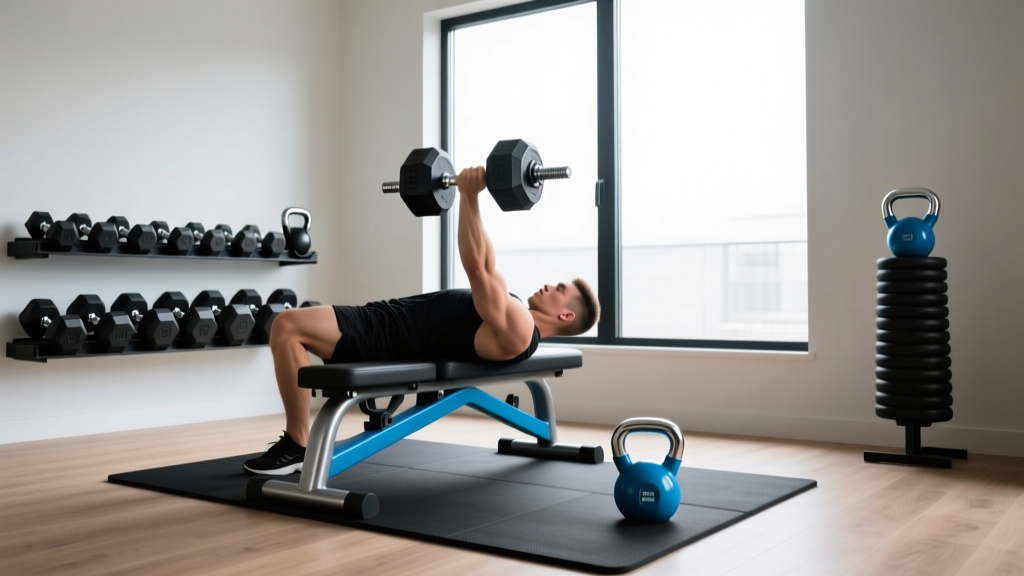
Single Arm Dumbbell Press Layouts: Cast vs Comp Bells
Optimize your home gym layout for the single arm dumbbell press. Compare cast iron vs competition kettlebells for space-efficient storage and training.

Designing the Compact Unilateral Training Zone
When engineering a high-performance home gym in a constrained footprint—typically under 150 square feet—every inch of floor and wall space must serve a distinct biomechanical purpose. For athletes prioritizing unilateral upper-body strength and ballistic conditioning, two primary movements dictate the spatial layout: the single arm dumbbell press and the kettlebell swing or snatch. While these exercises seem unrelated, their equipment requirements directly compete for your gym's limited square footage.
In 2026, the trend in garage and apartment gym design has shifted away from sprawling power racks toward modular, free-weight-centric zones. This guide breaks down the exact spatial requirements for heavy unilateral pressing and provides a definitive buying guide on choosing between cast iron and competition kettlebells to optimize your storage footprint.
Spatial Biomechanics of the Single Arm Dumbbell Press
Unlike a bilateral barbell bench press, which locks the torso into a fixed, symmetrical plane, the single arm dumbbell press introduces significant rotational torque. When pressing a 75 lb dumbbell with your right arm, your core must aggressively brace to prevent your torso from twisting leftward. This biomechanical reality dictates your equipment choice and spatial clearance.
Bench Selection and Clearance Requirements
To safely execute this movement, you need an adjustable bench with a wide, stabilizing base. Flimsy, foldable benches with narrow rear legs will tip under the offset load. The Rep Fitness AB-3100 2.0 (retailing around $349) features a 17.5-inch width and a robust ladder adjustment system, providing the necessary stability. According to exercise biomechanics databases like ExRx, the anterior deltoid and sternal pectoralis major require a full range of motion, meaning your elbow must drop below the torso line.
Space Allocation Rule: For a standard adjustable bench (approx. 48" L x 18" W), you must allocate a minimum operational zone of 6 feet by 5 feet. This allows 36 inches of lateral clearance on the pressing side for the elbow drop and dumbbell arc, and 24 inches on the non-pressing side for balance and spotting.The Kettlebell Dilemma: Cast Iron vs. Competition
Adjacent to your pressing zone, you need dedicated storage for kettlebells. The type of kettlebell you purchase—traditional cast iron or uniform competition style—fundamentally alters how you design your storage racks and manage your floor plan. Let us break down the physical dimensions and spatial impact of both styles.
Cast Iron Kettlebells: The Variable Dimension Problem
Cast iron kettlebells (like those from Rogue Fitness or CAP Barbell) are poured into molds that scale with weight. A 16kg (35 lb) cast iron bell is relatively compact, but a 32kg (70 lb) bell is massive, often exceeding 11 inches in width and 12 inches in height.
- Pros: Significantly cheaper per pound (averaging $1.50 to $2.00/lb in 2026); smaller bells take up minimal space.
- Cons: Varying base widths make flush, uniform racking impossible. A 3-tier storage rack must be excessively deep (over 14 inches) to accommodate the 32kg bell, eating into your gym's walkway.
Competition Kettlebells: The Uniform Advantage
Competition kettlebells, governed by international standards and popularized by brands like Kettlebell Kings, feature identical physical dimensions regardless of weight. From 8kg all the way to 32kg, every bell measures exactly 280mm tall and 210mm wide, with a standardized 35mm handle diameter.
- Pros: Perfect for space optimization. You can design a sleek, low-profile storage rack (exactly 9 inches deep) that holds any weight flush against the wall. Muscle memory remains consistent across different loads.
- Cons: Premium pricing (averaging $3.50 to $4.50/lb); the 8kg and 12kg bells have the same physical footprint as the 32kg, meaning lighter weights take up disproportionately more space relative to their mass.
Equipment Comparison Matrix
Use the table below to evaluate which kettlebell style best suits your spatial and financial constraints.
| Feature | Cast Iron (Standard) | Competition Style |
|---|---|---|
| Dimensions (16kg) | ~215mm H x 170mm W | 280mm H x 210mm W |
| Dimensions (32kg) | ~280mm H x 230mm W | 280mm H x 210mm W |
| Handle Diameter | Variable (30mm - 40mm+) | Strict 35mm |
| Rack Depth Required | 14+ inches (Staggered) | 9 inches (Flush) |
| 2026 Avg. Cost | $1.50 - $2.00 / lb | $3.50 - $4.50 / lb |
Integrating the Layout: Step-by-Step Zone Design
To seamlessly blend your pressing zone with your ballistic kettlebell work in a compact space, follow this layout sequence:
- Anchor the Bench First: Place your adjustable bench parallel to your longest wall, leaving 36 inches of clearance on the side you intend to press on. Keep the head of the bench at least 18 inches away from the wall to allow for incline adjustments.
- Mount Flush-Profile KB Storage: If you opt for competition kettlebells, mount a 3-tier horizontal wall rack exactly 9 inches deep on the adjacent wall. This keeps the bells off the floor, eliminating trip hazards during heavy single arm presses where foot placement is critical for anti-rotation bracing.
- Define the Drop Zone: Allocate a 4x4 foot rubber-matted area directly in front of the KB rack. This is your swing and snatch zone. Ensure this zone does not overlap with the 36-inch lateral clearance required for your dumbbell press.
Expert Insight: Transitioning from a heavy single arm dumbbell press to kettlebell snatches in the same workout requires grip management. The standardized 35mm handle of a competition bell closely mimics the thickness of a standard Olympic barbell, whereas cast iron handles on heavier bells can exceed 45mm, leading to premature forearm fatigue and compromised grip strength for subsequent pulling movements.
Final Verdict on Space Optimization
If your primary goal is absolute spatial efficiency and uniform storage design, competition kettlebells are the undisputed winner. Their strict 280mm x 210mm footprint allows you to install shallow, wall-mounted racks that preserve valuable floor space for your single arm dumbbell press clearance zones. However, if budget constraints are your primary limiting factor and you don't mind a deeper, staggered floor rack, cast iron bells remain a highly effective, cost-efficient alternative. By understanding the exact dimensional footprint of your free weights, you can engineer a home gym layout that supports elite-level training without sacrificing your living space.
More gear to consider
All reviews
Barbell Collar Comparison & Dumbbell Exercises to Lose Weight

Beginner 20 Pound Dumbbell Exercises Using Neoprene Weights
Reverse Fly Dumbbell Bench Setup: Olympic vs Standard Plates
Power Rack vs Squat Rack vs Stand: Setup for Dumbbell Box Step Ups

Bumper vs Iron Plates: Space Design & Two Handed Single Dumbbell Curl
