Urethane vs Rubber Hex Dumbbells 22.5 lbs: Space & Rack Guide
Compare rubber hex vs urethane dumbbells 22.5 lbs for home gym layouts. Discover space-saving rack tips, dimensions, and durability for compact spaces.

The Spatial Dilemma: Sourcing the Perfect 22.5 lb Bridge Weight
As home gym layouts become increasingly optimized in 2026, every square inch of floor space and rack real estate is under scrutiny. For lifters focusing on progressive overload, the jump from 20 lbs to 25 lbs represents a massive 25% increase in load. For isolation movements like lateral raises or bicep curls, this jump is often biologically insurmountable without breaking form. This is where finding a complete set that includes dumbbells 22.5 lbs becomes an absolute necessity for long-term strength progression. However, integrating this specific increment into a compact space forces a critical equipment decision: do you choose traditional rubber hex dumbbells or premium urethane models?
The choice between rubber hex and urethane is rarely just about aesthetics or budget; it is fundamentally a spatial and environmental layout decision. The physical density of the materials, the geometry of the dumbbell heads, and their respective rack compatibilities dictate how efficiently you can design your training space. Below, we break down the exact dimensional footprints, rack layout strategies, and environmental failure modes of both materials to help you engineer the ultimate space-saving free weight zone.
Material Density and the Dimensional Footprint
When designing a tight layout, the physical volume of your weights matters. Urethane (a high-density polyurethane elastomer) is significantly denser than standard vulcanized rubber. Because of this density disparity, a 22.5 lb urethane dumbbell requires less cast iron core mass and less outer coating volume to achieve the same weight as a rubber hex counterpart. According to equipment testing by Garage Gym Reviews, this density advantage translates directly to a more compact head profile, which is a massive advantage for shallow rack shelves.
Pro-Tip for Small Spaces: If your rack shelf depth is limited to 12 inches or less, urethane's compact profile prevents the dumbbell heads from overhanging the edge, reducing the risk of accidental knock-offs in tight walkways.Specification & Spatial Comparison Matrix
| Feature | Rubber Hex (e.g., Rogue / Titan) | Urethane (e.g., REP Fitness / Ader) |
|---|---|---|
| Head Geometry | 6-Sided Hexagon | Round or 12-Sided Polygon |
| 22.5 lb Head Width | ~6.8 inches | ~5.6 inches |
| Optimal Rack Type | Flat 3-Tier Horizontal Shelves | Angled Saddles or Vertical A-Frames |
| Floor Space Required | Moderate (Wider footprint) | Minimal (Compact footprint) |
| Average Cost (22.5 Pair) | $65 - $80 | $110 - $140 |
Rack Compatibility & Layout Optimization Strategies
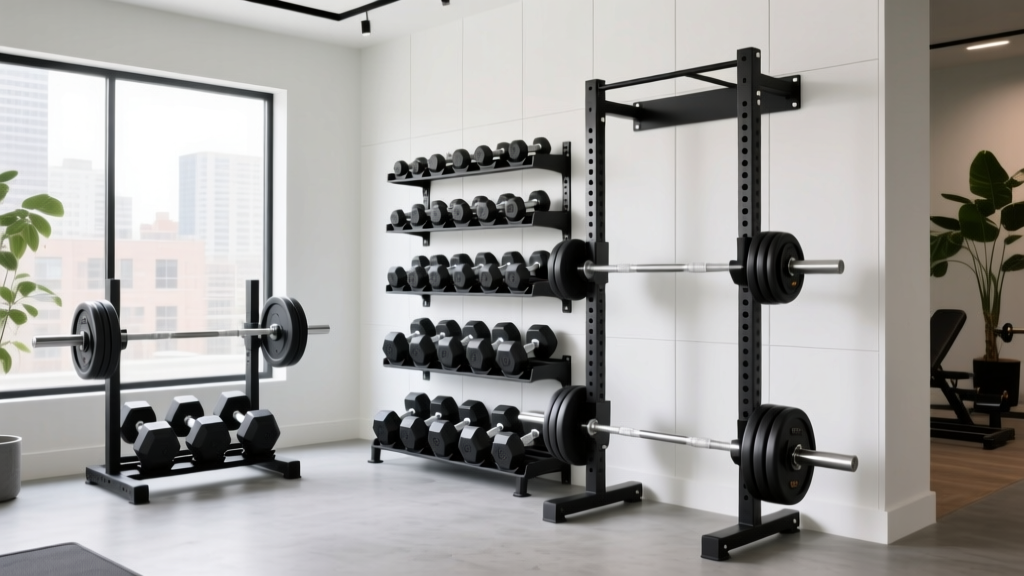
The geometry of your dumbbell heads must perfectly match your storage solution to maximize spatial efficiency. Rubber hex dumbbells, like the industry-standard models from Rogue Fitness, feature flat edges that allow them to sit flush against one another on standard flat 3-tier horizontal racks. This flush stacking minimizes lateral wasted space, allowing you to fit up to 5 pairs per tier on a standard 48-inch wide rack. For a 5 lb to 25 lb set (which includes the vital 22.5 lb pair), a single 3-tier rack is more than sufficient, leaving the bottom tier open for kettlebells or medicine balls.
Conversely, urethane dumbbells are frequently manufactured in round or 12-sided profiles to prevent the material from developing flat-spot memory over time. Round urethane dumbbells cannot be stored safely on flat shelves without dividers; they will roll, creating a severe safety hazard and wasting spatial depth. To optimize space with urethane, you must utilize vertical A-Frame racks or horizontal racks equipped with molded UHMW plastic saddles. While A-Frames have a slightly larger floor footprint (usually 30x30 inches), they utilize vertical air space, keeping your floor clear for dynamic movements.
Layout Decision Framework
- Choose Flat 3-Tier + Rubber Hex if: Your gym is against a wall, you have a width allowance of 4+ feet, and you want the most cost-effective, dense horizontal storage available.
- Choose A-Frame + Urethane if: You have a corner or island layout, limited wall width, and prefer utilizing vertical height to keep the floor completely unobstructed.
Environmental Degradation in Compact Rooms
Space optimization is not just about physical dimensions; it is also about air quality and environmental control. Many home gyms are built in converted spare bedrooms, garages, or basement nooks that lack dedicated HVAC circulation. Rubber hex dumbbells are notorious for off-gassing Volatile Organic Compounds (VOCs), especially when exposed to temperature fluctuations. In a small, poorly ventilated 10x10 room, a full set of new rubber hex dumbbells can make the space smell like a tire shop for the first three to six months, effectively ruining the usability of the room.
Urethane, on the other hand, is virtually odorless and highly resistant to UV degradation. If your space-saving layout places your rack near a sunroom window or under direct skylight exposure, rubber hex edges will eventually dry out, chalk, and chip over a 3-to-5-year period. Urethane maintains its structural integrity and aesthetic finish regardless of UV exposure, making it the superior choice for multi-purpose rooms or sun-drenched studio apartments where the gym layout shares space with living areas.
Failure Modes: Edge Chipping vs. Surface Scratching
When designing your layout, you must account for the 'drop zone'—the area where dumbbells are inevitably set down or dropped after a heavy set. Rubber hex dumbbells have sharp, 90-degree corners. When dropped on concrete or even high-density EVA foam mats, these sharp corners absorb the brunt of the impact. Over time, the rubber at the hex points tears away from the cast iron core. Once the core is exposed, it rusts, staining your flooring and creating a rough surface that can tear up your hands or bench upholstery.
According to equipment longevity analyses by BarBend, urethane's shock-absorbing elastomer properties distribute impact force evenly across its rounded or beveled edges, virtually eliminating the risk of core exposure and subsequent rusting.
If your layout forces you to lift directly over hard flooring without the spatial allowance for thick horse-stall mats, urethane is a mandatory investment to protect both the equipment and your subfloor.
Cost vs. Spatial ROI (Return on Investment)
Budget is the final constraint in any layout design. A full pair of 22.5 lb rubber hex dumbbells generally retails between $65 and $80, while the urethane equivalent commands a premium of $110 to $140. However, when calculating spatial ROI, you must factor in the cost of the storage infrastructure. Flat 3-tier racks designed for hex dumbbells are generally cheaper and simpler to manufacture than saddle-based racks required for round urethane. Therefore, the initial capital expenditure for a rubber hex setup (weights + rack) is roughly 40% lower than a urethane setup.
Yet, if your space is so tight that you require a premium vertical A-Frame to reclaim floor space, the rack cost equalizes. In ultra-compact environments where every inch of walkway dictates the functionality of the gym, the premium paid for urethane's smaller head width and odorless profile yields a vastly superior daily user experience.
Frequently Asked Questions
Can I mix rubber hex and urethane dumbbells on the same rack?
Yes, but it requires a 3-tier flat shelf rack. The rubber hex will sit flat, while the urethane (if round) will require you to install aftermarket rack dividers or UHMW saddle inserts to prevent them from rolling into the hex dumbbells and damaging the rubber edges.
Why do some commercial gyms skip the 22.5 lb increment?
Commercial gyms prioritize volume and rapid turnover, often forcing members to micro-load with magnetic add-ons or jump to 25 lbs. In a home gym, where you control the environment and progressive overload timeline, investing in the 22.5 lb bridge weight saves you from buying fractional magnetic weights that easily get lost in compact spaces.
Does the handle design affect spatial layout?
Indirectly, yes. Ergonomic, thick-handled urethane dumbbells often have a wider overall length from head-to-head. If you are storing them vertically in an A-Frame, the handle length dictates the vertical clearance required between tiers. Always measure the total length of the 22.5 lb and 25 lb pairs before finalizing your rack's vertical spacing dimensions.
More gear to consider
All reviews
Beyond a Basic Dumbbell Exercise Routine: EZ vs Straight Bar
Barbell Collar Types for Presses and Dumbbell Bench Chest Workout

Best Neoprene Dumbbells for Home Use & Bicep Reverse Dumbbell Curls

Beyond the 10lb Dumbbell: Olympic Barbell Setup & Knurling Guide

EZ vs Straight Bar: Single Arm Dumbbell Pullover Market Trends 2026