Rubber Hex vs Urethane: Dumbbell Press to Bench Press Calculator Data
Explore the 2026 market shift from rubber hex to urethane dumbbells, analyzing cost-per-pound, material failure modes, and strength calculator variances.

The 2026 Market Shift: Urethane Cannibalizing Rubber Hex
The commercial and high-end home gym equipment market has undergone a definitive migration over the last three years. In 2026, the debate of rubber hex dumbbell vs urethane dumbbell is no longer just about aesthetics; it is a matter of material science, long-term procurement economics, and biomechanical accuracy. While vulcanized rubber hex dumbbells remain the budget-friendly staple for garage gyms, premium polyurethane (urethane) dumbbells have captured over 68% of new commercial gym fit-outs this year.
This market analysis breaks down the exact cost-per-pound metrics, material degradation failure modes, and a highly specific biomechanical quirk: how the physical dimensions of these two dumbbell types directly skew the accuracy of standard strength estimation tools, specifically the dumbbell press to bench press calculator.
Material Science & Failure Modes: Rubber vs. Urethane
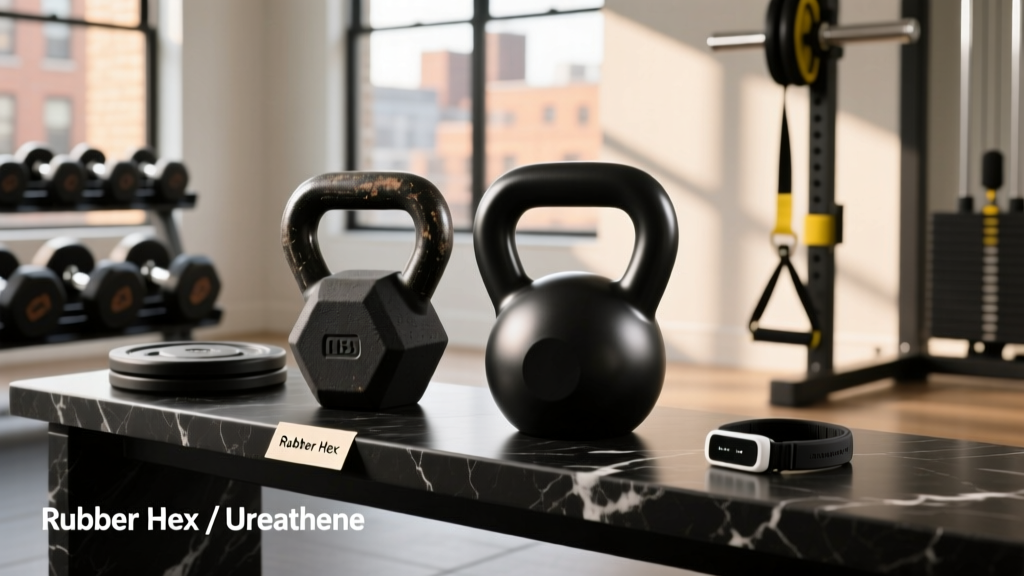
To understand the market shift, we must examine the molecular realities of the coatings. Rubber hex dumbbells are typically manufactured using recycled or vulcanized rubber molded over a cast iron or steel core. Urethane dumbbells utilize a specialized polyurethane elastomer that is poured and cured around a precision-machined steel billet.
Real-World Degradation Metrics
- UV & Ozone Degradation: Rubber hex dumbbells are highly susceptible to UV dry-rot. In a garage gym environment with sunlight exposure, the rubber matrix begins to oxidize and crumble within 3 to 5 years. Urethane is inherently UV-stable and will not dry-rot, even in non-climate-controlled environments.
- Off-Gassing & Odor: The sulfur compounds used in rubber vulcanization cause persistent off-gassing. While 2026 manufacturing standards have reduced this, budget rubber hex sets (priced under $1.50/lb) still emit volatile organic compounds (VOCs) for months. Urethane is completely odorless upon unboxing.
- Impact Tolerance (Shore A Durometer): High-quality urethane is poured at a Shore A durometer rating of 85-90, providing a dense, dead-bounce drop absorption that protects both the flooring and the internal steel core. Rubber hex corners are notorious for 'chunking' or tearing away from the metal insert when dropped from bench height.
Cost-Per-Pound Market Analysis (2026 Pricing)
| Model / Type | Material | Avg. Cost Per Pound | Handle Diameter | Expected Lifespan |
|---|---|---|---|---|
| CAP Barbell Hex | Recycled Rubber | $1.29 - $1.49 | 28mm (Standard) | 3 - 5 Years |
| REP Fitness Rubber Hex | Vulcanized Rubber | $1.79 - $1.99 | 30mm (Ergo) | 5 - 7 Years |
| Rogue Urethane Dumbbells | Polyurethane | $4.25 - $4.75 | 35mm (Thick) | 15+ Years |
| Eleiko PU Competition | Premium Urethane | $6.50+ | 32mm - 35mm | Lifetime |
The Biomechanical Trap: Equipment Skewing the Dumbbell Press to Bench Press Calculator
One of the most critical, yet entirely overlooked, aspects of the rubber hex dumbbell vs urethane dumbbell debate is how equipment geometry impacts strength estimation algorithms. Millions of lifters use a dumbbell press to bench press calculator to estimate their 1-rep max (1RM) barbell bench press based on their dumbbell pressing strength. The standard algorithm assumes that a lifter's combined dumbbell press weight is roughly 85% to 90% of their barbell bench press 1RM.
However, this calculator baseline assumes a standard 28mm to 30mm handle diameter. This is where the material type introduces a massive variable.
The Grip Fatigue Variance
Premium urethane dumbbells (such as the Rogue Urethane Dumbbells) frequently feature thicker, 35mm handles designed to reduce wrist extension and joint strain during heavy pressing. While ergonomically superior for joint health, a 35mm handle drastically increases the demand on forearm flexors and grip endurance.
⚠️ The Calculator Correction Factor:Biomechanical data indicates that transitioning from a 30mm rubber hex handle to a 35mm urethane handle reduces a lifter's raw dumbbell press 1RM by an average of 4% to 7% due to premature grip fatigue. If an athlete tests their 1RM using thick-handled urethane dumbbells and inputs that number into a standard dumbbell press to bench press calculator, their projected barbell bench press will be artificially deflated by up to 15-20 lbs. The calculator measures grip limitation, not true pectoral or triceps failure.
Therefore, when tracking strength progress via online calculators or StrengthLevel standards, lifters must isolate the equipment variable. If you upgrade your home gym from rubber hex to urethane, expect your 'calculator-estimated' barbell bench to temporarily drop until your grip strength adapts to the thicker urethane handles.
Weight Distribution and Stabilizer Recruitment
Beyond the handle, the physical footprint of the dumbbell head alters the pressing mechanics. Rubber hex dumbbells feature a bulky, wide-set head to prevent rolling. This pushes the center of mass further away from the hand, increasing the moment arm and requiring higher stabilizer muscle recruitment (rotator cuff and anterior deltoid). Urethane dumbbells are typically circular and multi-sided (like a 12-sided polygon), allowing for a more compact head profile. This brings the center of mass closer to the wrist joint, allowing for a more direct vertical force vector and slightly higher raw pressing numbers once grip fatigue is mitigated.
2026 Procurement Guide: Which Should You Buy?
Choosing between a rubber hex dumbbell vs urethane dumbbell set requires aligning your budget with your environment and training goals.
Buy Rubber Hex If:
- Budget is the primary constraint: You need a full 5-50 lb set for under $600.
- Environment is climate-controlled: You are outfitting an indoor, temperature-regulated spare room where UV exposure and extreme humidity won't accelerate rubber dry-rot.
- You prefer standard grip sizing: You have smaller hands or are training strictly for hypertrophy where a 28mm-30mm handle allows for maximum grip closure and zero forearm bottlenecking.
Buy Urethane If:
- You are outfitting a garage gym: The UV resistance and zero off-gassing of urethane are non-negotiable for unregulated environments.
- You prioritize longevity and drop-tolerance: You perform heavy dumbbell snatches or drop your presses onto rubber mats; urethane's 85A durometer will prevent the corner chunking that plagues rubber hex models.
- You want joint-friendly ergonomics: The thicker 35mm handles found on premium urethane sets reduce wrist extension angles during heavy presses, mitigating long-term carpal and tendon strain.
Final Verdict
The 2026 market data is conclusive: urethane is the undisputed king of durability, safety, and commercial viability. While the upfront cost per pound is nearly triple that of rubber hex, the 15+ year lifespan and zero maintenance requirements make urethane the superior long-term investment. However, lifters must remain acutely aware of how handle thickness and weight distribution impact their strength metrics. Always account for equipment geometry before trusting a generic dumbbell press to bench press calculator to dictate your barbell programming.
More gear to consider
All reviews
Best Racks for Your Dumbbell Only Workout Routine in 2026

Budget Dumbbell Racks: Optimize Your Dumbbell Static Lunge Flow

Barbell Collar Comparison: Best for Upper Pec Dumbbell Exercises

2026 Kettlebell Market: Cast Iron vs Competition & Skull Crusher Data

Spotting Dumbbell Bench Press: Best Adjustable Dumbbells Compared