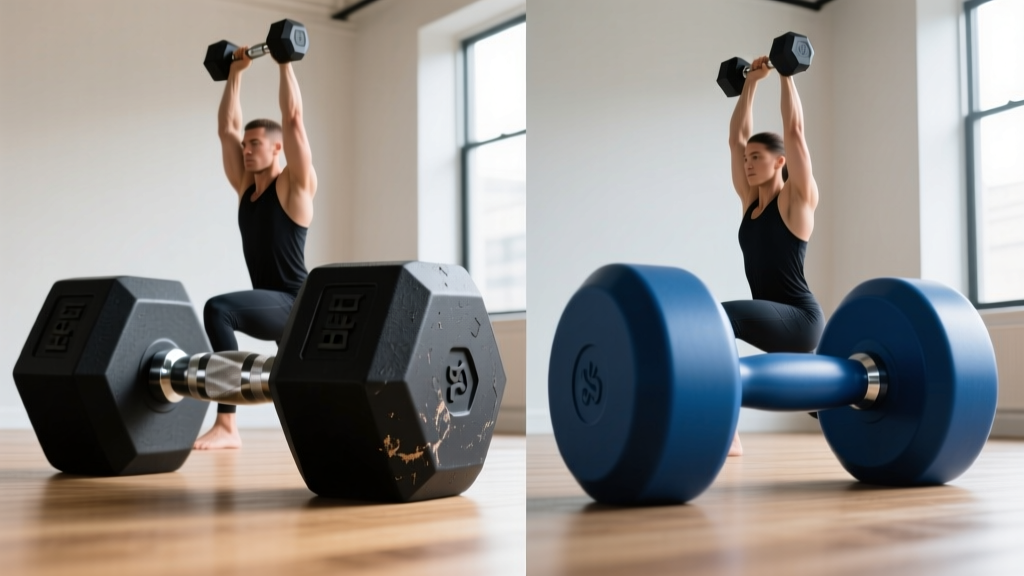
Rubber Hex vs Urethane: Care for the Dumbbell Step Back Lunge
Compare rubber hex and urethane dumbbells for the dumbbell step back lunge. Expert maintenance tips, failure modes, and longevity insights for your gym.

The Biomechanical Toll of the Dumbbell Step Back Lunge
When programming for lower-body hypertrophy and unilateral stability, the dumbbell step back lunge is a staple movement. However, from an equipment longevity perspective, this exercise is notoriously brutal on free weights. Unlike a controlled bicep curl where weights are gently racked, a heavy set of lunges often ends in fatigue-induced drops. According to ExRx.net's biomechanical breakdown of the dumbbell lunge, the eccentric loading and subsequent release phase generate significant kinetic energy.
When a lifter finishes a grueling set of 12 reps, those 40-pound dumbbells are frequently dropped from a height of three feet directly onto rubber flooring or hastily slammed onto metal rack shelves. Over hundreds of cycles, this repetitive impact exposes the structural weaknesses of your equipment. This brings us to a critical debate for home and commercial gym owners: rubber hex dumbbells vs. urethane dumbbells. Which material survives the abuse of dynamic lunging, and how do you maintain them to ensure a decade-long lifespan?
Rubber Hex Dumbbells: Failure Modes and Maintenance
Rubber hex dumbbells are the budget-friendly workhorses of the fitness industry, typically costing between $1.20 and $1.80 per pound. The hexagonal head prevents rolling, which is a safety plus when setting weights down mid-lunge. However, the vulcanized rubber used in these models is highly susceptible to environmental and mechanical degradation.
The 'Sulfur Bloom' and Edge Chipping
The most common failure mode for rubber hex dumbbells subjected to high-impact drops is edge chipping. When the dumbbell strikes the floor at an angle during a fatigued lunge set, the rigid hex corners bear the brunt of the force. Over time, micro-fractures develop. Additionally, cheaper rubber compounds suffer from 'sulfur bloom'—a white, powdery residue that rises to the surface as the rubber oxidizes and dries out. This not only looks unsightly but makes the dumbbell head brittle, accelerating the chipping process when dropped.
⚠️ Warning: The Cleaning Agent TrapMany gym owners use undiluted Simple Green or bleach-based wipes to clean sweat off dumbbells post-lunge. These harsh alkaline solvents strip the natural oils from vulcanized rubber, accelerating dry rot and edge crumbling. Never use ammonia or bleach on rubber hex weights.
Rubber Care Protocol
- Weekly Cleaning: Wipe down with a microfiber cloth dampened with a mild dish soap and water solution (1:10 ratio).
- Quarterly Conditioning: Apply a UV-protectant like 303 Aerospace Protectant to the rubber heads. This restores moisture and creates a barrier against UV degradation and oxidation.
- Storage: Keep away from direct sunlight and unventilated sheds where extreme temperature fluctuations cause the rubber to expand and contract, weakening the bond to the steel core.
Urethane Dumbbells: Engineering Longevity
Urethane (polyurethane) dumbbells represent the premium tier of free weights, commanding $3.50 to $5.50 per pound. For high-volume dynamic movements like the dumbbell step back lunge, urethane is the undisputed champion of durability. According to Smooth-On's material science guide on urethane vs. rubber, cast polyurethane offers vastly superior tear strength, abrasion resistance, and load-bearing capacity compared to traditional vulcanized rubber.
Shore A Hardness and Impact Dissipation
Urethane dumbbells are typically poured at a Shore A durometer rating of 90A to 95A. While this makes them feel harder to the touch than rubber, their molecular structure allows them to absorb and dissipate kinetic energy without deforming or tearing. When dropped from lunge height, a urethane hex dead-bounces with minimal acoustic resonance and zero edge chipping. Furthermore, urethane is completely impervious to UV light, sweat acidity, and the harsh chemical cleaners that destroy standard rubber.
Urethane Care Protocol
While the urethane heads are virtually indestructible in a standard gym environment, the maintenance focus shifts to the handle junction and cosmetic upkeep.
- Sweat Mitigation: The primary enemy of urethane dumbbells is not the head, but the chrome handle. Salty sweat from heavy lunge sets pools at the crevice where the steel handle meets the urethane head, leading to hidden rust rings.
- Sanitization: You can safely use commercial gym wipes (like GymWipes or 70% isopropyl alcohol solutions) on urethane without fear of chemical degradation.
- Junction Drying: After wiping the handles, always run a dry towel along the seam between the metal and the urethane to wick away trapped moisture.
Head-to-Head Longevity Matrix
How do these two materials stack up when subjected to the daily rigors of unilateral leg training? The data below highlights the long-term ownership realities.
| Feature | Rubber Hex Dumbbells | Urethane Dumbbells |
|---|---|---|
| Average Cost (per lb) | $1.20 - $1.80 | $3.50 - $5.50 |
| Impact Resistance (3ft Drop) | Moderate (Edge chipping likely) | Exceptional (No deformation) |
| Chemical Resistance | Low (Degrades with alkaline cleaners) | High (Impervious to sweat/solvents) |
| Bounce Factor | High (Safety hazard on drops) | Low (Dead-bounce safety) |
| Estimated Lifespan | 3 - 5 Years (Heavy use) | 10 - 15+ Years (Heavy use) |
The 5-Minute Post-Lunge Maintenance Routine
To maximize the ROI of your free weight investment, implement this rapid maintenance protocol immediately following high-volume leg days. The NSCA's research on kinetic variables reminds us that the forces exerted during fatigued eccentric movements drastically increase the likelihood of equipment mishandling. Proper post-workout care mitigates this damage.
"Equipment longevity is rarely about the initial manufacturing quality; it is almost entirely dictated by the micro-habits of the end-user during the final 60 seconds of their workout."
- The Visual Sweep (1 min): Inspect the hex edges. If using rubber hex, look for early signs of white sulfur bloom or micro-tears at the corners. Catching a failing dumbbell early prevents it from shedding rubber chunks onto your lifting platform.
- Targeted Wipe-Down (2 mins): Use a pH-neutral gym wipe. Focus heavily on the knurling of the handle and the exact seam where the handle enters the dumbbell head. Lunges generate massive grip sweat; this sweat drips directly down the handle into the crevice.
- Seam Drying (1 min): Take a dry, lint-free towel and run it along the urethane or rubber junction. Capillary action will pull trapped moisture out of the seam, preventing the steel core from rusting from the inside out.
- Controlled Racking (1 min): Never drop the dumbbells onto the rack shelf from chest height after your final lunge rep. Place them deliberately. The lateral force of a dumbbell hitting a metal rack shelf is the number one cause of shattered rubber hex casings.
Expert Verdict: Which Should You Buy?
If your programming heavily features dynamic, high-fatigue movements like the dumbbell step back lunge, walking lunges, or drop-set complexes, urethane dumbbells are a mandatory investment. The initial sticker shock ($4.00+/lb) is easily offset by a 15-year lifespan, zero edge chipping, and the elimination of toxic rubber odors. Urethane's dead-bounce characteristic also makes it significantly safer for home gyms where a dropped lunge weight could otherwise bounce into drywall or mirror panels.
Conversely, rubber hex dumbbells remain a viable option for budget-conscious lifters or commercial gyms with strict replacement cycles. If you choose rubber, you must commit to a rigorous, chemical-free cleaning regimen and quarterly UV conditioning to prevent the hex edges from turning into brittle shrapnel. Treat your equipment with the same respect you apply to your training mechanics, and your free weights will easily outlast your fitness plateaus.
More gear to consider
All reviews
EZ Bar vs Straight Bar: The Dumbbell Neutral Grip Chest Press Shift

Olympic vs Standard Plates: Fixing Dumbbell Bench Press Variations
Barbell Collars Compared: Securing Squats & Dumbbell Floor Press

Olympic vs Standard Plates & the Pullover Exercise with Dumbbells
Arm Toning Workouts with Dumbbells vs. Olympic Barbells: Knurling