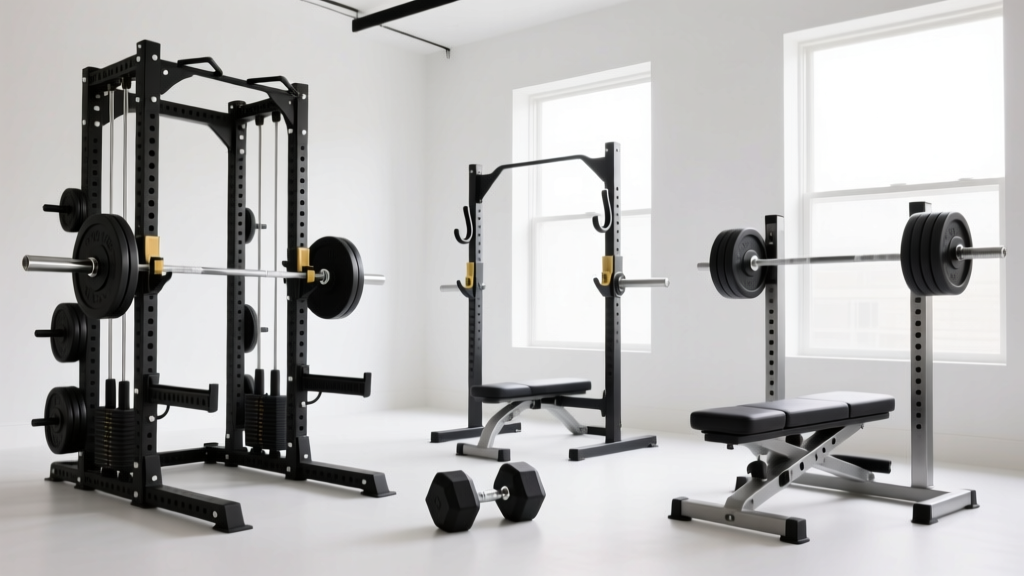
Power Rack vs Squat Rack vs Stand for Dumbbell Hamstring Exercises
Compare power racks, squat racks, and squat stands to build the perfect home gym for heavy lifts and dumbbell hamstring exercises.

The Home Gym Leg-Day Dilemma: Beyond the Barbell Squat
When outfitting a home gym, most lifters fixate on barbell squats and bench presses. However, a complete, injury-resilient lower-body routine demands heavy isolation and unilateral work. This is where your choice of rig becomes critical. The debate between a power rack, a squat rack (half rack), and a squat stand is usually framed around barbell safety. But if your programming relies heavily on dumbbell hamstring exercises—like heavy Romanian deadlifts (RDLs), goblet squats, and rack-assisted Nordic curls—the spatial footprint, safety spotter configurations, and interior depth of your rack will dictate your training quality.
In this 2026 buying guide, we break down the metallurgical specs, spatial requirements, and pricing of the three primary rack styles, specifically analyzing how each accommodates high-intensity dumbbell hamstring exercises.
The Contenders: Definitions and Structural Profiles
Before diving into specific models, it is essential to understand the structural differences that impact your floor plan and exercise clearance.
- Power Rack (Full Cage): Four uprights connected by crossmembers, creating an enclosed 'cage.' Features adjustable safety pins or straps inside the footprint.
- Squat Rack (Half Rack): Two main front uprights with an open front, relying on extended spotter arms extending outward from the rear or sides to catch dropped bars.
- Squat Stand: Two independent, freestanding uprights with a wide base. No physical connection between the left and right sides.
Power Racks: The Ultimate Enclosure for Heavy Dumbbell Work
A full power rack is the gold standard for safety, but its enclosed nature requires careful spatial planning. For dumbbell hamstring exercises, the interior depth is the most critical metric.
Why Interior Depth Matters for Hamstrings
The hamstrings act as both knee flexors and hip extensors. To target the hip extension function via dumbbell RDLs, you need a clear vertical path. According to biomechanical analyses cited by the ACE Fitness exercise library, the dumbbells will travel down the midline of the thigh and past the knee. If your power rack has a shallow 24-inch interior depth, 50-pound hex dumbbells will physically collide with the front uprights during the eccentric phase of the RDL.
Pro-Tip: Always opt for a power rack with a minimum 30-inch interior depth (like the REP Fitness PR-4000 or Rogue R-3) if you plan to perform standing dumbbell hamstring exercises inside the cage. This provides enough clearance to hinge at the hips without striking the steel.
Top 2026 Power Rack Models & Pricing
- REP Fitness PR-4000: Features 3x3-inch 11-gauge steel, 1-inch hole spacing (Westside spacing in the bench zone), and a 30-inch depth option. Price: $999 - $1,200.
- Rogue R-3 Power Rack: Built with 3x3-inch 11-gauge steel and 5/8-inch hole spacing. Known for its rigid 24-inch or 30-inch depth configurations and UHMW plastic-lined safeties. Price: $1,100 - $1,350.
Squat Racks (Half Racks): The Open-Front Compromise
Half racks offer a middle ground. They save floor space by eliminating the rear uprights, replacing them with extended spotter arms. This open-front design is highly advantageous for dumbbell hamstring exercises that require a wide stance or forward momentum.
The Spotter Arm Interference Issue
While the open front is great for stepping into the rack, the rear spotter arms can become a tripping hazard during dynamic dumbbell hamstring exercises like walking lunges or deficit reverse lunges. If you are performing heavy dumbbell sumo deadlifts or wide-stance RDLs, the outward-protruding spotter arms (which typically extend 18 to 24 inches from the rear uprights) may limit your lateral movement.
Top Half Rack Models & Pricing
- Titan Fitness T-2 Series Half Rack: 2x3-inch steel, 1-inch holes. The spotter arms are relatively compact, making it a decent choice for smaller garages where dumbbell clearance is tight. Price: $450 - $550.
- Rogue SML-2C Monster Lite Squat Stand: Technically a hybrid stand/half-rack with a rear crossmember for stability. Excellent build quality but requires significant depth for the spotter arms. Price: $675 - $800.
Squat Stands: Minimalist, Budget-Friendly, and Highly Adaptable
Squat stands consist of two independent uprights. They are the most versatile option for lifters who prioritize dumbbell and kettlebell work alongside basic barbell movements.
Unrestricted Movement for Hamstring Isolation
Because there is no cage and no rear spotter arms, squat stands offer 360-degree unrestricted movement. You can perform heavy dumbbell RDLs, single-leg deadlifts, and dumbbell good mornings without any fear of clipping a steel upright. Furthermore, you can use the heavy base plates of the stands to anchor your feet for Nordic hamstring curls—a highly effective bodyweight and weighted hamstring exercise.
The National Strength and Conditioning Association (NSCA) emphasizes the importance of proper spotting and safe failure zones. With squat stands, you must rely on dump zones (dropping the dumbbells to the floor) rather than internal safety catches, which means your flooring must be reinforced with high-density rubber mats (at least 3/4-inch thick).
Top Squat Stand Models & Pricing
- REP Fitness SR-4000: 3x3-inch 11-gauge steel, 1-inch holes. Includes integrated plate storage on the base to prevent tipping. Price: $449.
- Rogue SML-2 Monster Lite Squat Stands: 3x3-inch steel, 5/8-inch holes. The gold standard for stability in a minimalist footprint. Price: $495 - $550. (Check current Rogue Fitness equipment specifications for exact lead times).
Comparison Matrix: Specs, Pricing, and Dumbbell Clearance
| Feature | Power Rack (e.g., REP PR-4000) | Half Rack (e.g., Titan T-2) | Squat Stand (e.g., REP SR-4000) |
|---|---|---|---|
| Steel Gauge | 11-Gauge (3x3') | 11-Gauge (2x3') | 11-Gauge (3x3') |
| Hole Spacing | 1' (Westside in bench zone) | 1' Standard | 1' Standard |
| Price Range | $999 - $1,350 | $450 - $800 | $350 - $550 |
| Dumbbell RDL Clearance | Excellent (if 30' depth chosen) | Good (open front) | Unrestricted (no cage) |
| Failure Safety | Internal Safety Straps/Pins | Rear Spotter Arms | Dump to Floor (No safeties) |
| Nordic Curl Anchor | Use barbell on low pins | Use barbell on spotter arms | Anchor feet under base plates |
Optimizing Your Rig for Dumbbell Hamstring Exercises
Regardless of which rack style you purchase, you can leverage the equipment to elevate your hamstring training. Here are three advanced setups to integrate into your leg day:
1. The Safety-Strap RDL Catch Zone
If you are training to failure with heavy dumbbells (e.g., 80lb+ hex bells), grip fatigue often precedes hamstring failure. Inside a power rack, set your safety straps at mid-shin height. This allows you to perform dumbbell RDLs and simply release the weights at the bottom of the movement, saving your lower back from the awkward mechanics of lowering heavy dumbbells all the way to the floor.
2. Rack-Assisted Deficit Step-Ups
Set the J-cups on one side of your squat stand or power rack to roughly knee height. Rest a high-quality wooden plyo box or a flat bench against the uprights. Holding heavy dumbbells at your sides, perform deficit step-ups. The rack provides a stable backstop, and the elevated starting position drastically increases the stretch-mediated hypertrophy stimulus on the hamstrings and glutes.
3. The Nordic Curl Anchor Hack
Nordic curls are elite for hamstring injury prevention, but they require a secure ankle anchor. If you own squat stands, load 45-pound bumper plates onto the base pegs. Slide your feet under the heavy base plates, rest on a thick foam pad, and perform eccentric Nordic curls. If you own a power rack, simply load a barbell onto the lowest safety pins and wedge your heels under the bar.
Final Verdict: Which Rig Should You Buy?
Your decision should be driven by your floor plan, budget, and failure-point tolerance.
- Choose the Power Rack if: You have the floor space (minimum 48x60 inches), you train alone to absolute failure, and you want the ability to safely drop heavy dumbbells onto internal straps during intense hamstring isolation work.
- Choose the Squat Stand if: You are in a small apartment or garage, your budget is under $600, and your programming heavily favors unrestricted dumbbell hamstring exercises, kettlebell swings, and dynamic movements where a cage would feel claustrophobic.
- Choose the Half Rack if: You want the aesthetic and open-front accessibility of a squat stand, but require the rear stability and spotter arms for heavy barbell squats, accepting that the spotter arms may slightly impede wide-stance dumbbell work.
Ultimately, the best rack is the one that fits your space and keeps you training consistently. Prioritize 11-gauge steel, ensure your interior depth matches your dumbbell dimensions, and build a leg-day station that supports both your barbell ambitions and your dumbbell hamstring exercises.
More gear to consider
All reviews
Rack Layouts for the Standing Overhead Press with Dumbbells

Rubber Hex vs Urethane Care for a Home Dumbbell Workout for Women

Bumper vs Iron Plate Care: Beyond the Dumbbell Lateral Raise Workout

Shoulder Exercises with Dumbbells: Neoprene Home Mistakes & Fixes
Smith Machine Squat vs Leg Press vs Neoprene Dumbbells for Home Use
