2026 Market Trends: Racks for Proper Dumbbell Press Form
Explore 2026 dumbbell rack market trends, analyzing how ergonomic storage solutions and angled tiers directly support proper dumbbell press form.

The Hidden Biomechanical Link: Storage and Setup
In the evolving landscape of strength training equipment, the focus has historically been on barbell mechanics and power rack geometry. However, as of 2026, the free weights market has seen a massive pivot toward optimizing the dumbbell ecosystem. Industry leaders and biomechanists are increasingly recognizing a critical, often overlooked reality: proper dumbbell press form does not begin when you lie back on the bench; it begins the moment you grip the handle on the rack.
For decades, commercial gyms relied on flat, waist-high shelving units. While space-efficient, these traditional racks force lifters into lumbar flexion and excessive shoulder internal rotation during the pickup phase. This pre-stretches the anterior joint capsule and compromises the scapular retraction required for safe pressing. According to guidelines published by the American Council on Exercise (ACE), maintaining a neutral spine and retracted scapulae is critical for shoulder health during heavy pressing movements. When a poorly designed rack forces you to bend over awkwardly to retrieve 80-pound dumbbells, you lose this foundational setup before the first rep even begins.
'The lift-off is the most vulnerable phase of the dumbbell press. If the storage solution requires spinal flexion and asymmetric reaching, the lifter's neurological bracing pattern is compromised, making proper dumbbell press form nearly impossible to achieve safely.' — 2025 Biomechanics in Resistance Training Symposium
2026 Market Shift: Ergonomic Tiers and Integrated Docks
The global fitness equipment market, valued at over $15 billion and growing, is seeing a distinct sub-sector boom in 'ergonomic storage,' according to recent industry analysis by Grand View Research. Manufacturers are no longer treating dumbbell racks as mere shelving; they are engineering them as the first step in the lifting kinetic chain. Here are the dominant trends shaping the 2026 market.
1. The 35-to-45-Degree Presentation Standard
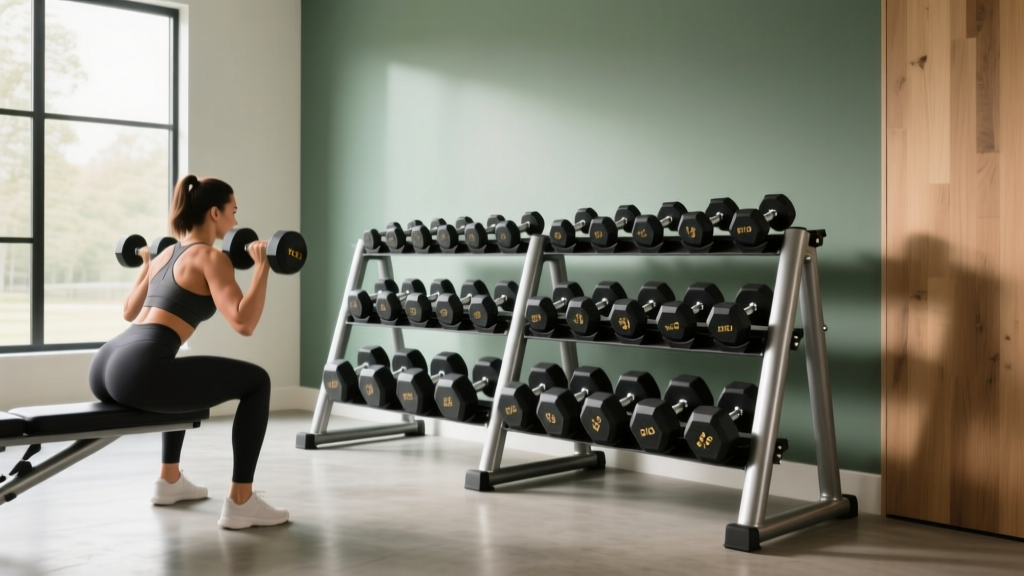
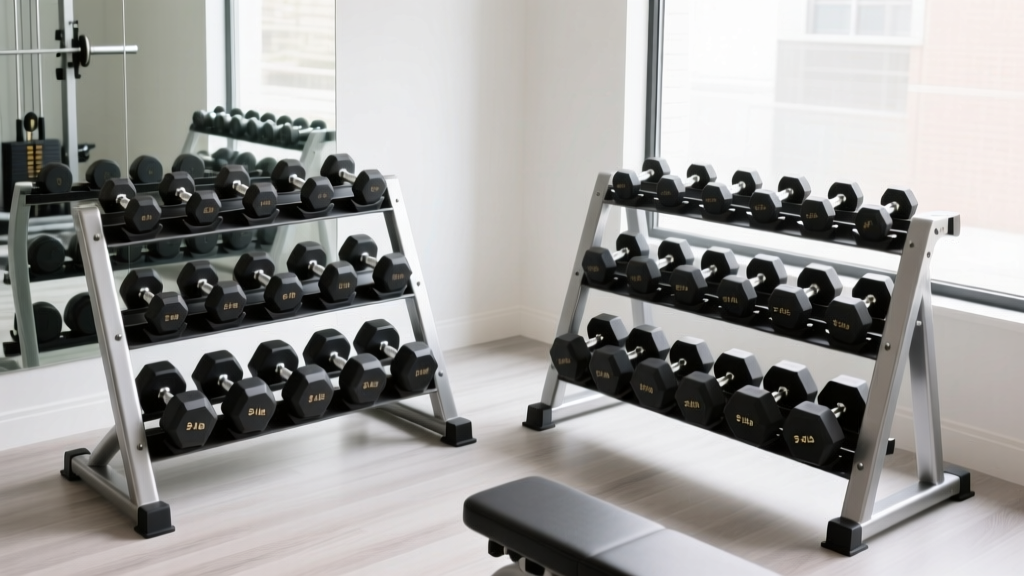
The flat shelf is officially obsolete in premium facilities. The 2026 standard for high-end racks—such as the Rogue RM-6 Ramp Dumbbell Rack ($795) and the Eleiko Angled Dumbbell Rack ($1,450)—features tiered trays angled between 35 and 45 degrees. This presentation angle allows the lifter to approach the rack, grip the dumbbell with a neutral wrist, and lift vertically using the legs, completely bypassing the dangerous 'bent-over row' motion that typically precedes a heavy set.
2. Zero-Walk Integrated Bench Systems
Walking across a gym floor with 100-pound dumbbells in a farmer's carry position induces core fatigue and shoulder protraction. By the time the lifter sits on the bench, their postural integrity is degraded. To solve this, brands like Sorinex and Prime Fitness have popularized integrated dock systems. These racks feature a recessed footprint that allows a flat or incline bench to slide directly into the rack structure. This 'Zero-Walk' design ensures the lifter can transition from grip to thigh-rest to pressing position in a single, fluid motion, perfectly preserving the scapular tension necessary for proper dumbbell press form.
⚠️ Biomechanical Warning: Tray Depth and Wrist Neutrality
Not all angled racks are created equal. A common failure mode in budget racks (under $300) is insufficient tray depth. While a 12-inch deep tray is sufficient for 5-40 lb hex dumbbells, heavy round urethane dumbbells (55-150 lbs) feature massive head diameters up to 7.5 inches. If the tray is too shallow, the dumbbell overhangs, creating a tipping hazard and forcing the user to grip the handle off-center. This asymmetrical grip immediately introduces valgus stress to the wrist, destroying your setup.
2026 Ergonomic Rack Comparison Matrix
Below is a market analysis of the top-tier storage solutions available in 2026 that prioritize biomechanical safety and lift-off ergonomics.
| Model / Brand | Tier Angle | Tray Depth | Max Capacity | Est. Price (2026) |
|---|---|---|---|---|
| Rogue RM-6 Ramp Rack | 35° | 16 inches | 1,200 lbs | $795 |
| Eleiko Angled Rack (5-Tier) | 40° | 18 inches | 800 lbs | $1,450 |
| REP Fitness 3-Tier Angled | 30° | 14 inches | 600 lbs | $349 |
| Sorinex Dumbbell Press Station | 45° + Dock | 20 inches | 1,500 lbs | $2,100 |
Lift-Off Mechanics: Executing the Scoop from Modern Racks
Having an ergonomic rack is only half the equation; the lifter must utilize the angled presentation to execute the 'scoop and roll' technique. The Health & Racquet Network (IHRSA) frequently highlights equipment-user interaction as a primary metric for facility safety and member retention. Here is how modern rack geometry supports the optimal lift-off sequence:
- The Staggered Stance: Approach the angled tier. Place one foot slightly behind the other. The 35-degree angle allows you to hinge at the hips with a neutral spine, rather than rounding the lumbar vertebrae.
- The Neutral Grip Scoop: Grip the dumbbells firmly. Because the handles are presented upward, your wrists remain in a neutral, stacked position rather than bending backward (extension) to clear a flat shelf lip.
- The Vertical Drive: Drive through the heels, using the quadriceps and glutes to stand the weight up. Keep the dumbbells close to the body's center of mass.
- The Thigh Rest & Roll: Sit on the edge of the bench, resting the dumbbell heads on your distal thighs. As you roll backward, use the momentum of your knees kicking up to guide the weights into the pressing position, immediately locking the scapulae into the bench pad.
Material Science: UHMW Liners and Acoustic Shock
A secondary but vital trend in the 2026 storage market is the integration of UHMW (Ultra-High Molecular Weight) polyethylene liners on tray lips and cradles. In previous years, dropping heavy urethane dumbbells onto bare steel racks caused acoustic shock (deafening noise in commercial spaces) and micro-tearing of the dumbbell coatings. The 1/2-inch UHMW lining now standard on premium racks reduces acoustic impact by up to 40%. This seemingly minor material upgrade encourages lifters to re-rack weights properly rather than leaving them on the floor, maintaining a safe environment free of tripping hazards that could compromise a lifter's focus and setup.
Buyer's Framework: Commercial vs. Home Gym Investments
When allocating budget for free weight storage, facility owners and home gym builders must align their purchases with their heaviest dumbbell pairs and spatial constraints.
- For the Heavy-Pressing Home Gym (80+ lb pairs): Invest in a 3-tier angled rack with a minimum 16-inch tray depth. The REP Fitness or Rogue RM-6 models offer the best ROI, ensuring that heavy round-headed dumbbells do not overhang and tip. Expect to spend between $400 and $800.
- For Commercial Facilities & Boutique Studios: The 2026 standard demands 5-tier angled racks with UHMW lining and integrated bench docks. The upfront cost ($1,500 - $2,500 per station) is offset by reduced equipment wear, lower injury liability, and enhanced member experience. Space efficiency is achieved by vertical 5-tier stacking rather than horizontal sprawling.
- For Light Dumbbell / Rehab Zones (5-40 lb Neoprene/Hex): Traditional flat or slightly angled 3-tier racks remain sufficient and cost-effective. Tray depths of 10-12 inches are adequate for the smaller footprint of hex dumbbells.
Final Verdict: Form Starts on the Rack
The 2026 market has definitively proven that storage is not an afterthought; it is an integral component of the lifting apparatus. By eliminating spinal flexion, preserving wrist neutrality, and integrating zero-walk bench docks, modern ergonomic racks remove the physical barriers that traditionally compromised the lift-off. If you are serious about maintaining proper dumbbell press form and protecting your shoulder joints for the long term, upgrading your dumbbell rack from a flat steel shelf to an angled, biomechanically aligned presentation system is the most impactful equipment investment you can make this year.
More gear to consider
All reviews
Troubleshooting Dumbbell RDL Form With Neoprene Weights

Rubber Hex vs Urethane Dumbbells: Space Layouts & Rotating Options

Rubber Hex vs Urethane: One Dumbbell Shoulder Workout Value

Rubber Hex vs Urethane Dumbbells: Expert Review for the Alternating Dumbbell Upright Row

Best Adjustable Dumbbells for Dumbbell Pushup With Row (2026)