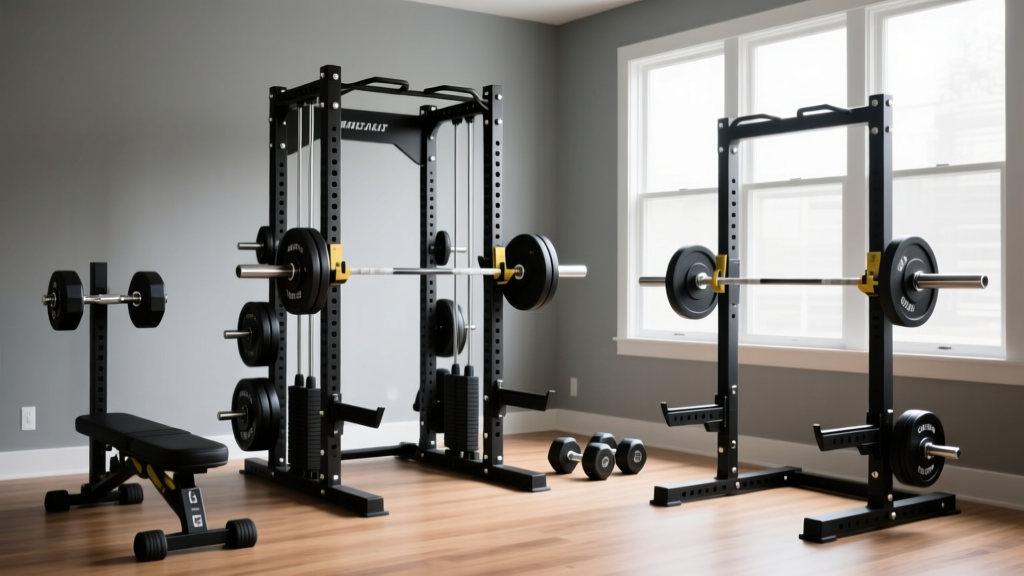
Power Rack vs Squat Rack vs Squat Stand: Setup for Lateral Raises with Dumbbells
Compare power rack vs squat rack vs squat stand. Learn how to choose the right rig for heavy compounds and lateral raises with dumbbells in your home gym.

The Home Gym Dilemma: Heavy Compounds vs. Isolation Space
Building a home gym in 2026 requires balancing two competing needs: the absolute safety required for heavy barbell compounds, and the open spatial freedom needed for high-rep hypertrophy work. Beginners often make the mistake of buying a rig solely based on its squat capacity, completely forgetting how the footprint will impact their accessory movements. When you transition from heavy barbell squats to standing isolation exercises—like lateral raises with dumbbells—the physical boundaries of your equipment suddenly matter.
If you are trying to decide between a power rack vs squat rack vs squat stand, this step-by-step guide will walk you through the exact dimensions, safety profiles, and spatial requirements of each. We will help you choose a rig that keeps you safe under a 300-pound barbell while giving you the freedom to execute lateral raises with dumbbells without busting your knuckles on steel uprights.
Step 1: Decoding the Big Three Rigs
Before comparing brands and prices, you must understand the structural differences between the three main categories of free weight enclosures. According to guidelines from ACE Fitness, matching your equipment footprint to your available floor space and lifting style is the foundational step of home gym design.
1. Power Racks (Full Cages)
A power rack consists of four vertical uprights connected by crossmembers, creating a fully enclosed cage. They typically feature front and rear pull-up bars and accept a wide array of cable and lat-pulldown attachments.
- Standard Footprint: 48 inches wide by 24 to 36 inches deep (4x2 or 4x3).
- Interior Width: Usually 43 inches between the uprights.
- Best For: Powerlifters, heavy bench pressers, and lifters who train alone without a spotter.
2. Squat Racks (Half Racks)
Squat racks (often called half racks) feature two main front uprights and two shorter rear uprights that act as weight storage and a counterbalance. The front is entirely open, but safety spotter arms extend outward to catch dropped barbells.
- Standard Footprint: 48 inches wide by 24 inches deep, though the open front requires an additional 3 to 4 feet of clearance for safe barbell dumping.
- Interior Width: 43 to 49 inches.
- Best For: Olympic weightlifters, CrossFit athletes, and those who want an open feel but still need integrated safety spotters.
3. Squat Stands (Independent Uprights)
Squat stands are two completely independent, freestanding vertical posts with adjustable J-cups. They have no connecting crossmembers at the top.
- Standard Footprint: Just two 24x24 inch bases. They can be pushed together for storage or spread apart to accommodate any barbell width.
- Interior Width: Infinitely adjustable.
- Best For: Garage gyms with low ceilings, tight budgets, and lifters who prioritize maximum open space for accessory work.
Step 2: The Spatial Reality of Accessory Work
The 'Lateral Raises with Dumbbells' Spatial Test
Why do we use lateral raises with dumbbells as a benchmark for rack selection? Because it is a standing, wide-wingspan isolation movement that exposes the spatial limitations of your rig. The average adult male has a wingspan of roughly 70 inches. When performing lateral raises with dumbbells, the dumbbells extend your reach even further. If you attempt to do lateral raises with dumbbells inside a standard 43-inch interior power rack, you will repeatedly strike the steel uprights or safety pins, disrupting your tempo and risking injury. Half racks and squat stands allow you to simply step two feet forward into open space, giving you unlimited lateral clearance for strict, uninterrupted hypertrophy sets.
Step 3: 2026 Comparison Matrix
Use this matrix to evaluate which rig aligns with your budget, ceiling height, and spatial requirements.
| Feature | Power Rack (Full Cage) | Squat Rack (Half Rack) | Squat Stands |
|---|---|---|---|
| Avg. Price (2026) | $450 - $800 | $350 - $600 | $150 - $250 |
| Safety for Solo Lifting | Excellent (Enclosed) | Very Good (Spotter Arms) | Poor to Fair (Requires Strap Safeties or Spotter) |
| Accessory Clearance | Restricted (Must step outside cage) | Good (Step forward past arms) | Unlimited (Move stands aside) |
| Weight Storage | High (Rear uprights) | High (Rear base horns) | None (Requires separate tree) |
| Floor Anchoring | Optional (if 4x3 footprint) | Mandatory (to prevent tipping) | Mandatory (to prevent forward collapse) |
Step 4: Top Model Recommendations by Category
Based on current 2026 manufacturing standards, 11-gauge steel construction, and Westside hole spacing, here are the top picks for beginners.
Best Power Rack: Titan Fitness T-3 Series (4x2)
Priced around $499, the T-3 features 3x3 inch 11-gauge steel uprights with 1-inch Westside hole spacing in the bench press zone. It includes sandwich-style J-cups with UHMW plastic liners to protect your barbell knurling. Pro Tip: Because the interior is 43 inches wide, plan to step outside the rack when performing lateral raises with dumbbells or heavy dumbbell Romanian deadlifts.
Best Squat Rack: Rogue Fitness S-2 Squat Rack 2.0
At approximately $415, the S-2 is a staple in home gyms. It utilizes 2x3 inch 11-gauge steel and features an open front design. The rear weight storage horns act as a counterbalance, meaning you do not necessarily have to bolt it to a concrete floor, provided you keep the base loaded with plates. It offers a great compromise between heavy squat safety and open-floor accessibility.
Best Squat Stands: Rep Fitness PR-1100 Home Gym Stands
For just $189, these 2x2 inch 14-gauge steel stands are perfect for low-ceiling garages or apartment gyms. They feature adjustable safety spotter arms, though they are inherently less stable than a cage. Warning: You must bolt these to a concrete slab or heavily load the rear base with bumper plates to prevent the stands from tipping forward when you re-rack a heavy barbell.
Step 5: Anchoring, Safety, and Failure Modes
The Mayo Clinic emphasizes that proper equipment setup and environmental safety are critical to preventing severe crush injuries during resistance training. A rack is only as safe as its anchor.
- The Forward-Tip Failure Mode: Squat stands and lightweight half racks are highly susceptible to forward tipping. If you fail a rep and drop the barbell onto the front safety pins, the kinetic energy can flip the entire rig forward onto your chest. Always use sandwich J-cups that grip the upright tightly, and bolt 2x2 stands directly into concrete using wedge anchors.
- The Strap Safety Advantage: If you buy squat stands, invest in strap safeties rather than metal pin-and-pipe safeties. Straps absorb the shock of a dropped barbell without bending the metal pins or violently jerking the freestanding uprights out of position.
- Floor Protection: Regardless of the rig you choose, place 3/4-inch thick horse stall mats under the entire footprint. This protects your concrete from dropped dumbbells and provides a non-slip surface for wide-stance movements.
"Beginners often overspend on the barbell and underspend on the rack. Your rack is your mechanical spotter. Never compromise on the thickness of the steel or the integrity of the safety catchers to save fifty dollars."
Final Verdict: Which Should You Buy?
If your primary goal is powerlifting, heavy solo benching, and utilizing cable attachments, invest in a Power Rack. If you are an Olympic lifter or CrossFit athlete who needs to drop bars from overhead, choose a Squat Rack. However, if you are a bodybuilder or general fitness enthusiast on a budget who prioritizes open space for high-volume accessory work—like walking lunges, kettlebell swings, and lateral raises with dumbbells—Squat Stands paired with a heavy-duty folding weight tree will give you the ultimate spatial freedom in a small garage gym.
More gear to consider
All reviews
Barbell Setup: Weight, Knurling & Do You Clean Dumbbells at the Gym?
Dumbbell Workout at Home for Men vs Olympic Barbells

Setup Guide: Olympic vs Standard Plates & Dumbbell Punching
Maximize Your Dumbbell Row Workout: Budget Rack & Storage Analysis

Neoprene Dumbbells for Home: Perfecting Dumbbell Squat Technique
