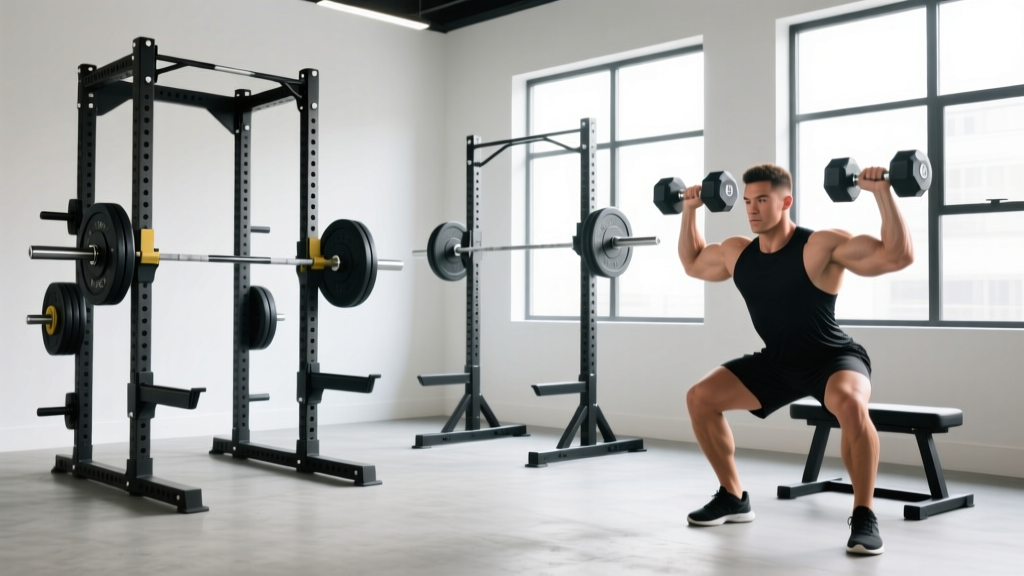
Power Rack vs Squat Rack vs Stand: Plus Easy Dumbbell Arm Workout
Compare power racks, squat racks, and squat stands for your home gym. Includes buying advice and an easy dumbbell arm workout for small spaces.

The Foundation of Your Home Gym: Choosing the Right Rack
Building a home gym in 2026 requires balancing footprint, budget, and versatility. The centerpiece of any serious free-weight setup is the rack system, but the terminology can be confusing. Do you need a full power rack, a half squat rack, or a pair of minimalist squat stands? Furthermore, how do you maximize that footprint for accessory isolation work when you don't have space for dedicated cable towers or preacher curl benches?
This comprehensive guide breaks down the structural and functional differences between power racks, squat racks, and squat stands. We will also show you how to leverage your chosen rack's footprint to execute an easy dumbbell arm workout that rivals any commercial gym setup.
Comparison Matrix: Power Rack vs. Squat Rack vs. Squat Stand
Before diving into the nuances, let's look at the hard data. The following table compares the three main categories using current market standards and popular benchmark models.
| Feature | Power Rack (Full Cage) | Squat Rack (Half Rack) | Squat Stand (Minimalist) |
|---|---|---|---|
| Benchmark Model | Rep Fitness PR-4000 | Rogue SML-2C Monster Lite | Titan T-2 Short Stand |
| Average Footprint | 48' x 48' (Standard) | 49' x 30' (Excluding storage) | 24' x 24' (Per pair) |
| Upright Size | 3' x 3' (11-Gauge Steel) | 3' x 3' or 2' x 3' | 2' x 2' or 2' x 3' |
| Weight Capacity | 1,000 - 1,500+ lbs | 800 - 1,000 lbs | 500 - 800 lbs |
| Safety Mechanism | Internal Pin-Pipe or Straps | External Spotter Arms | Rear Spotter Arms / Straps |
| Price Range | $1,100 - $2,500+ | $600 - $1,200 | $250 - $450 |
Power Racks (Full Cages): The Ultimate Safe Haven
A power rack consists of four (sometimes six) uprights connected by crossmembers, creating an enclosed 'cage.' According to equipment experts at Garage Gym Reviews, full cages are the gold standard for solo lifters because the safety mechanisms (pin-pipe combos or heavy-duty nylon straps) are housed inside the rack. If you fail a squat or bench press, the barbell drops safely onto the internal safeties without tipping the rack forward.
Key Buying Considerations
- Upright Dimensions: Opt for 3x3-inch, 11-gauge steel. This is the industry standard for heavy loading and ensures compatibility with the vast ecosystem of attachments (dip bars, landmines, lat pulldowns).
- Hole Spacing: Look for 'Westside' hole spacing (1-inch spacing in the bench and squat zones) for micro-adjusting your J-cups and safety straps.
- Height & Depth: Standard depths are 24', 30', and 42'. If you plan to do pull-ups or muscle-ups, ensure your ceiling height accommodates an 84' or 90' tall rack.
Squat Racks (Half Racks): The Open-Concept Compromise
Half racks feature two main front uprights and two rear stabilizing uprights. They offer an open front, which many Olympic weightlifters and functional fitness athletes prefer for movements like thrusters, overhead squats, and cleans where the barbell might travel outside the footprint of a traditional cage.
Expert Tip: The primary vulnerability of a half rack is the external spotter arms. If you drop a heavy barbell forward onto the very tip of a long spotter arm, the leverage can tip the rack. Always ensure your half rack has adequate rear weight storage horns loaded with heavy bumper plates to act as a counterbalance.As noted in BarBend's comprehensive rack analysis, half racks are ideal for garage gyms with low ceilings or lifters who prioritize Olympic lifting over heavy, unassisted powerlifting.
Squat Stands: Minimalist and Budget-Friendly
Squat stands are essentially two independent uprights. They are the most space-efficient and budget-friendly option, often costing under $400. Modern iterations, like folding wall-mounted stands, allow you to reclaim your entire garage floor when not in use.
The Trade-offs
- Safety Limitations: You must use separate spotter arms or safety straps. Straps are highly recommended over metal arms for stands, as metal arms can bend or tip the stand if struck unevenly.
- Attachment Scarcity: Most stands use 2x2 uprights with 1-inch holes, severely limiting your ability to add cable pulley systems or specialized J-cups.
- No Internal Pull-Up Bar: You will need to purchase a separate door-frame or ceiling-mounted pull-up bar.
Beyond the Big Lifts: An Easy Dumbbell Arm Workout Inside Your Rack
Many home gym owners assume a rack is only for barbell squats and bench presses. However, your rack footprint—especially when paired with an adjustable FID (Flat/Incline/Decline) bench—is the ultimate station for isolation work. Utilizing the rack for stability and space efficiency allows you to perform an easy dumbbell arm workout without needing a dedicated arm day corner.
The 'Rack-Anchor' Arm Routine
This routine leverages the bench placed inside the power rack or between the squat stands. The enclosed space provides psychological comfort and physical boundaries for strict form.
- Seated Incline Dumbbell Curls (Biceps Long Head)
- Setup: Set your FID bench inside the rack to a 45-degree incline.
- Execution: 3 sets of 10-12 reps. Let your arms hang straight down behind your torso to maximize the stretch on the long head of the bicep.
- Rack-Supported Dumbbell Skullcrushers (Triceps Long Head)
- Setup: Flat bench inside the rack. If using a power rack, set the safety pins just a few inches above your chest to catch the dumbbells if your grip fails.
- Execution: 3 sets of 8-10 reps. Lower the dumbbells slightly behind your head, not directly over your face, to keep constant tension on the triceps.
- Standing Cross-Body Hammer Curls (Brachialis & Forearms)
- Setup: Stand directly in the center of the rack footprint.
- Execution: 3 sets of 12 reps per arm. Curl the dumbbell across your chest toward the opposite shoulder.
- Dumbbell Floor Press or Rack Pin Press (Triceps Lockout)
- Setup: Set the safety pins at the lowest bench height. Lie on the floor or a low pad inside the rack.
- Execution: 3 sets to failure. Press the dumbbells up, focusing purely on the triceps lockout at the top of the movement.
'Integrating dumbbell isolation work into your primary rack footprint saves valuable square footage and keeps your workout flow uninterrupted. You don't need a commercial gym's cable crossover to build serious arm mass.' — Home Gym Engineering Principles
Decision Framework: Which Should You Buy?
Use this practical framework to make your final purchasing decision based on your specific constraints:
- Choose a Power Rack if: You train alone, prioritize heavy barbell bench pressing and squatting, have a ceiling height over 84 inches, and want access to a massive ecosystem of attachments (like lat pulldowns and belt squats).
- Choose a Squat Rack (Half Rack) if: You perform Olympic lifts, have a shorter ceiling (under 80 inches), and need front-mounted weight storage to save lateral space.
- Choose Squat Stands if: You are on a strict budget (under $500), have a multi-purpose garage space requiring fold-away equipment, or primarily train with dumbbells and only need the rack for occasional heavy barbell work.
Frequently Asked Questions
Can I do an easy dumbbell arm workout without a bench?
Yes. If you only have squat stands and no bench, you can perform standing dumbbell curls, overhead triceps extensions, and concentration curls seated on a plyo box or sturdy chair placed between the stands. However, an adjustable bench drastically increases your exercise variety.
Are 2x2 uprights strong enough for a home gym?
For the uprights themselves, 2x2 14-gauge steel can hold 500+ lbs safely. However, the real issue is stability and attachment compatibility. The 3x3 11-gauge standard is highly recommended for preventing rack wobble during pull-ups and ensuring you can use modern sandwich J-cups.
Do I need to bolt my rack to the floor?
Full power racks and heavy half racks with rear storage rarely need bolting if loaded with plates. However, squat stands and folding wall-mounted racks must be bolted to concrete studs or the floor to prevent catastrophic tipping during re-racking or kipping pull-ups.
More gear to consider
All reviews
Beyond the 2 Pound Dumbbell: Power Rack vs Squat Rack Guide
Barbell Collar Types Compared: Slippage & 12.5 lb Dumbbell Hacks
Cast Iron vs Competition Kettlebells vs Back Routine with Dumbbells
EZ Curl Bar vs Straight Bar & One Arm Dumbbell Deadlift
Rubber Hex vs Urethane: Best Gear for a 25 Pound Dumbbell Workout
