
Power Rack vs Squat Rack vs Stand: The One Hand Dumbbell Row Test
Avoid common buying mistakes comparing a power rack, squat rack, and squat stand. See how interior clearance impacts the one hand dumbbell row.

The Spatial Blindspot: Why Your Rack Choice Dictates Your Accessory Work
When outfitting a home gym in 2026, most lifters obsess over ceiling height for pull-ups or the weight capacity of the pull-up bar. However, the most costly mistake buyers make when choosing between a power rack, squat rack, and squat stand is ignoring interior spatial dynamics and lateral clearance. You aren't just buying a place to squat; you are buying a footprint that will either enable or restrict your accessory movements.
Nowhere is this more apparent than when setting up for unilateral back work. The one hand dumbbell row is the ultimate stress test for your rack's spatial geometry. It requires a bench, lateral stance space, and vertical clearance for the dumbbell to drop below the bench line. If you choose the wrong rack configuration, you will find yourself smashing your knuckles against steel uprights or dealing with dangerous bench slippage. Let's troubleshoot the most common setup mistakes across the three main rack categories.
Power Racks (4-Post Cages): The "Trap" of Enclosed Spaces
Power racks like the Rogue R-3, Titan T-3, or REP PR-4000 are the gold standard for safety. They feature four (or six) uprights, creating an enclosed cage. The common mistake? Buying a standard 24-inch interior depth rack without calculating the footprint of your utility bench.
Troubleshooting Callout: The 24-Inch Depth FailureA standard flat utility bench is roughly 45 to 48 inches long. If you place this bench inside a power rack with a 24-inch interior depth, the bench will protrude out the front or back. If you attempt to perform a standing one hand dumbbell row using the bench for support inside the cage, you will have less than 10 inches of lateral clearance between the bench edge and the rear uprights. This restricts your hip hinge, forces lumbar rotation, and guarantees your dumbbell will strike the steel upright on the eccentric descent.
How to Fix the Power Rack Row
- Upgrade to 30" or 41" Depth: If your primary routine involves heavy unilateral dumbbell work inside the cage, you must opt for a 30-inch or 41-inch interior depth. The 2026 pricing delta for a 41-inch deep Titan T-3 is roughly $150 more than the 24-inch model—a necessary investment for spatial freedom.
- The Landmine Workaround: If you are locked into a 24-inch cage, abandon the traditional bench-supported row inside the rack. Instead, use a landmine attachment anchored to the rear upright. Performing a landmine one hand dumbbell row (or Meadows row) requires you to stand outside the rack facing inward, completely bypassing the depth restriction while utilizing the rack's base for stability.
Squat Racks (6-Post & Foldable): The Stability Compromise
Squat racks typically refer to open-face 6-post systems (where the rear uprights are shorter and used for storage) or wall-mounted foldable racks. The mistake here is assuming that open-faced racks offer the same structural integrity for supported, off-center loading as a fully enclosed power rack.
When you set up for a heavy one hand dumbbell row (e.g., pulling a 120 lb dumbbell), you are applying significant lateral and rotational force to the bench. If you push a lightweight bench against the front uprights of a 6-post squat rack to brace yourself, the lack of a rear crossmember (present in 4-post cages) means the rack can shift if not properly bolted to your platform.
Troubleshooting Squat Rack Slippage
According to biomechanical analyses from ExRx, proper stabilization during unilateral rowing requires a solid, non-yielding base to prevent compensatory spinal twisting. If your squat rack is freestanding on rubber mats:
- Use Spotter Arms as Bench Stops: Instead of pushing the bench against the uprights, set a pair of spotter arms at the lowest pin setting (usually hole 1 or 2) on the outside of the uprights. Wedge the bench legs against the spotter arms. This transfers the lateral force of your row into the steel arms rather than relying on the friction of the bench feet.
- Check the Foldable Hinge: If using a wall-mounted foldable squat rack (like the PRx Profile), never use the uprights as a bracing point for rows. The dynamic pulling force can loosen the wall-mount lag bolts over time. Keep your rowing setup entirely independent of the rack's front face.
Squat Stands: Freedom and Frustration
Squat stands consist of two independent uprights. They are incredibly popular for garage gyms with tight spatial constraints or multi-use driveways. The primary advantage for the one hand dumbbell row is absolute freedom of bench placement. You can position your bench anywhere in the room, completely unencumbered by a cage.
However, the mistake lifters make with squat stands is attempting to integrate them into the rowing movement for weight storage or bracing, which introduces severe tipping hazards.
"Unilateral training is vital for correcting left-to-right strength asymmetries, but it inherently introduces rotational torque. Your equipment setup must absorb this torque, not amplify it." — National Strength and Conditioning Association (NSCA) guidelines on unilateral programming.
The Squat Stand Tipping Hazard
If you are doing heavy rows and decide to rest your non-working hand on the J-cup or the top of a squat stand for balance, you risk tipping the stand. Most standard squat stands (like the Rogue S-2) have a base footprint of roughly 24" x 24" and weigh under 100 lbs per stand. Leaning 200 lbs of body weight plus the momentum of a heavy row can easily lift the rear edge of the stand off the floor.
The Fix: Treat squat stands strictly as barbell catchers. For your one hand dumbbell row, use a heavy, commercial-grade utility bench with a wide, flared base (such as the REP AB-3100 or Rogue Flat Utility Bench) placed well away from the stands. Do not use the stands as a makeshift bracing post.
2026 Equipment Comparison Matrix
To help you visualize the spatial and financial commitments, here is a breakdown of the most popular 3x3, 11-gauge steel racks on the market and how they handle unilateral clearance.
| Brand & Model | Type | Interior Depth Options | Approx. 2026 Price | One Hand Row Suitability |
|---|---|---|---|---|
| Rogue R-3 Power Rack | 4-Post Cage | 24" or 30" | $1,045 - $1,195 | Poor (24") / Excellent (30") |
| Titan T-3 Series | 4-Post / 6-Post | 24" or 41" | $749 - $899 | Excellent (41" option) |
| REP Fitness PR-4000 | 4-Post / 6-Post | 16", 24", 30", 41" | $849 - $1,099 | Versatile (Multiple depths) |
| Rogue S-2 Squat Stand 2.0 | Independent Stands | N/A (Open Floor) | $625 (Pair) | Excellent (If floor space allows) |
The Verdict: Aligning Your Rack with Your Routine
The choice between a power rack, squat rack, and squat stand should not be made solely on the price of the steel or the aesthetic of the powder coat. It must be driven by the biomechanical realities of your programming.
If your routine relies heavily on the one hand dumbbell row, chest-supported variations, and complex unilateral movements, a 24-inch deep power rack will become a source of daily frustration. You will either find yourself constantly dragging the bench out of the cage—defeating the purpose of an enclosed gym—or compromising your form to avoid hitting the uprights.
For the dedicated bodybuilder or athlete prioritizing heavy dumbbell accessories, investing in a 30-inch or 41-inch deep power rack (like the Titan T-3 or REP PR-4000) is non-negotiable. Conversely, if you are strictly a powerlifter who only uses dumbbells for light, high-rep finishers done entirely outside the rack footprint, a squat stand or a compact 24-inch cage will save you money and preserve valuable garage square footage. Measure your space, map your movements, and buy the footprint that serves your training, not just your barbell.
More gear to consider
All reviews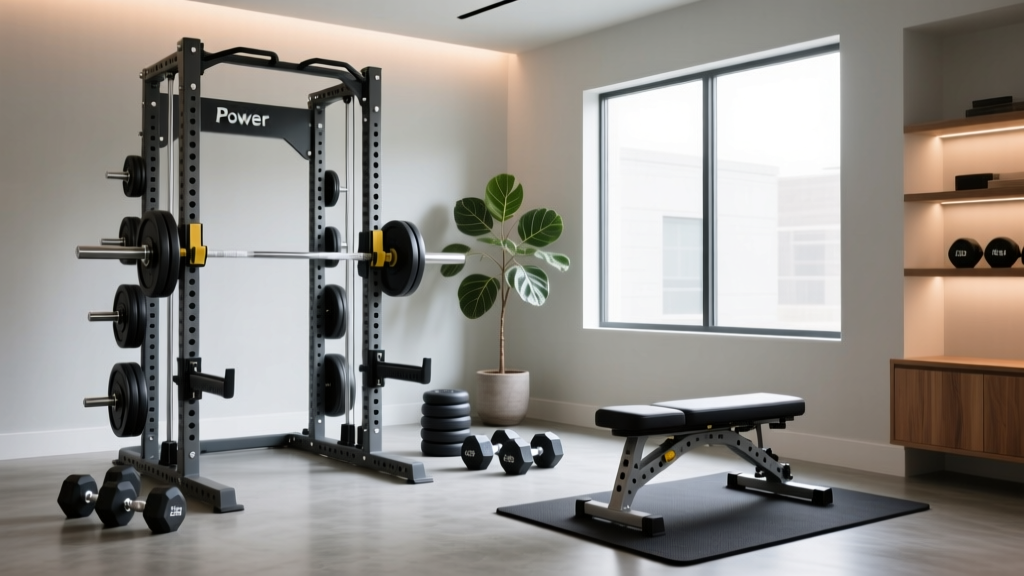
Power Rack vs Squat Stand: Setup for the Dumbbell Lateral Lunge

Racks vs Stands: Fixing the Seated Dumbbell Rear Lateral Raise

Heavy Dumbbell Training Spaces: Cast Iron vs Competition Kettlebells

Top Neoprene Dumbbells for a Home Traps Workout With Dumbbells
Cast Iron vs Competition Kettlebell Care for a 6 Day Dumbbell Workout
