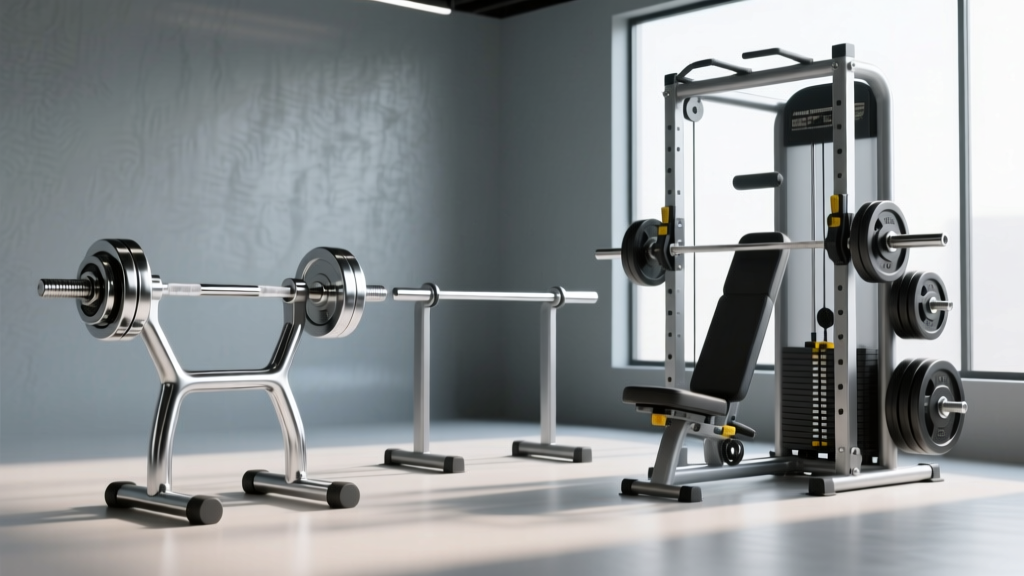
Power Rack vs Squat Rack vs Stand: Seated Dumbbell Shoulder Press Muscles Worked
Compare power rack vs squat rack vs squat stand for your 2026 home gym, plus a beginner's guide to the seated dumbbell shoulder press muscles worked.

Step 1: Choose Your Foundation — Power Rack vs Squat Rack vs Squat Stand
Building a versatile home gym in 2026 requires making smart, space-conscious investments. Selecting the right squatting and pressing station is your most critical financial decision. Beginners often conflate power racks, squat racks, and squat stands, but their safety profiles, spatial footprints, and biomechanical supports vary drastically. According to BarBend's comprehensive rack comparison guide, understanding these differences is paramount for safely executing both heavy barbell lifts and isolated dumbbell movements without risking catastrophic equipment failure.
Comparison Matrix: 2026 Market Leaders
| Rack Type | Model Example | Footprint & Steel | Est. Price (2026) | Safety Rating |
|---|---|---|---|---|
| Power Rack | Rogue R-3 | 49' depth, 11-gauge 3x3 steel | $1,100 - $1,300 | Excellent (Enclosed) |
| Squat Rack | Titan T-2 Short | 24' depth, 11-gauge 2x2 steel | $350 - $450 | Good (Open Front) |
| Squat Stand | REP Fitness SR-1000 | Independent posts, 14-gauge | $180 - $250 | Fair (Requires Spotter Arms) |
The Verdict for Beginners: If you have the space and budget, a full power rack is non-negotiable for safety. It allows you to fail reps securely inside a steel cage. Squat racks offer a middle ground, saving floor space while providing front spotter arms. Squat stands are strictly for minimalist setups and demand strict adherence to spotter arm placement and floor anchoring.
Step 2: Biomechanics Breakdown — Seated Dumbbell Shoulder Press Muscles Worked
Once your rack and adjustable bench (like the REP AB-3100 2.0) are secured, the seated dumbbell shoulder press becomes a cornerstone movement for upper body development. But what exactly is happening beneath the skin? According to ExRx.net's kinesiology directory, removing the leg drive from a standing overhead press isolates the shoulder girdle, shifting the load distribution significantly and demanding strict postural control.
Targeted Muscle Groups
- Primary Movers: Anterior Deltoid (front shoulder). Responsible for the initial 60 degrees of shoulder flexion and the brunt of the pressing load.
- Synergists: Lateral (Medial) Deltoid, Supraspinatus, and the Clavicular head of the Pectoralis Major (upper chest).
- Extensors: Triceps Brachii (specifically the long and lateral heads) to achieve full elbow extension at the lockout.
- Stabilizers: Serratus Anterior, Trapezius, and Levator Scapulae. These anchor the scapula to the thoracic spine, preventing shoulder impingement at the top of the movement.
By performing this movement inside a power rack or squat rack, you create a physical boundary. If muscular failure occurs in the anterior deltoid, the rack's uprights prevent you from falling backward, while the adjustable bench's backrest supports the erector spinae, minimizing lower back shear forces—a critical safety protocol highlighted by the American Council on Exercise (ACE).
Step 3: Step-by-Step Execution & Rack Safety Integration
Follow this precise sequence to integrate your rack setup with the seated dumbbell shoulder press for maximum hypertrophy and zero injury risk.
- Bench Angle Calibration: Do not set your adjustable bench to a strict 90-degree vertical angle. Biomechanically, a 75 to 80-degree incline better aligns with the natural scapular plane, drastically reducing the risk of subacromial impingement.
- Spotter Arm Placement: If using a squat stand or open squat rack, insert spotter arms at waist height. While you won't 'catch' dumbbells on the arms, they provide a visual and physical barrier to drop the weights safely to the sides if your grip fails.
- The Kick-Up: Sit with dumbbells resting on your thighs. Kick one knee up to hoist the right dumbbell to your shoulder, then immediately repeat for the left. Never attempt to clean heavy dumbbells from the floor while seated.
- The Pressing Path: Press the weights up and slightly inward. The dumbbells should end directly over your glenohumeral (shoulder) joint, not in front of your face. Stop 1 inch short of full lockout to keep continuous tension on the anterior deltoid.
- The Descent: Lower the weights under a strict 3-second eccentric tempo until the dumbbell handles align with your earlobes. Going lower stretches the rotator cuff under load, a common failure mode for beginners.
Step 4: Troubleshooting Common Beginner Mistakes
- Flaring the Elbows at 90 Degrees: Keeping elbows perfectly in line with your torso grinds the humerus against the acromion process. Fix: Tuck your elbows slightly forward (about 15 to 30 degrees) into the scapular plane.
- Arching the Lower Back: Turning a shoulder press into a standing-style incline chest press defeats the purpose of the isolation. Fix: Ensure your bench is locked securely in the rack's crossmembers, and brace your core as if preparing for a heavy squat.
- Ignoring Rack Capacity: Budget squat stands (often rated for 500 lbs static) can wobble during the dynamic 'kick-up' phase of heavy dumbbell presses. Fix: Bolt squat stands to a wooden platform or upgrade to a 4-post squat rack if your dumbbell pair exceeds 50 lbs each.
Beginner FAQ: Racks and Overhead Pressing
Can I use a squat stand for seated dumbbell presses?
Yes, but with caution. Squat stands lack the rear cross-bracing of a power rack. When kicking heavy dumbbells up, the forward momentum can tip unanchored stands. Always bolt them down or use a 4-post rack for dumbbells over 60 lbs.
Why do my triceps fatigue before my shoulders?
This usually indicates you are pressing the dumbbells too far in front of your torso, shifting the mechanical advantage to the triceps. Focus on pressing directly over the shoulder joint and ensure your bench is set to 75 degrees, not a flat incline.
How much space does a power rack require?
A standard power rack like the Rogue R-3 requires a footprint of roughly 49 inches by 43 inches, plus an additional 24 inches of clearance on all sides for loading plates and maneuvering dumbbells. If your ceiling height is under 84 inches, look into 'short' rack configurations.
Final Verdict: Building Your 2026 Setup
Understanding the seated dumbbell shoulder press muscles worked is only half the battle; the other half is ensuring your equipment can safely support your progression. Invest in an 11-gauge steel power rack or squat rack, pair it with a commercial-grade adjustable bench, and respect the biomechanics of the shoulder joint. This foundational setup will serve your strength journey reliably for decades.
More gear to consider
All reviews
2026 Budget Dumbbell Racks: Space for KB Swings with Dumbbell

Upper Body Dumbbell Workout Routine: EZ Curl Bar vs Straight Bar
Bumper vs Iron Plates & Standing Abs Workout with Dumbbells

EZ Curl Bar vs Straight Bar: Front Deltoid Dumbbell Raise Space Tips
Bumper Plate vs Iron Plate: Space & Dumbbell RDL vs Barbell RDL