
Power Rack vs Squat Rack vs Stand: Pectoral Exercise with Dumbbells
Compare power rack vs squat rack vs squat stand. Our step-by-step guide helps you choose the best rig for heavy lifts and pectoral exercise with dumbbells.

Step 1: Decode the Terminology and Core Differences
Walking into the world of home gym equipment can feel like learning a new language. If you are looking to build a safe, versatile lifting space, your first major hardware decision is choosing your primary rig. While they all hold barbells, the structural differences between a power rack, a squat rack (half rack), and a squat stand drastically alter your workout capabilities, safety margins, and spatial footprint.
The Power Rack (Full Cage)
A power rack consists of four to six vertical steel uprights connected by crossmembers, creating an enclosed 'cage.' You step inside the cage to lift. Because the safety pins or strap safeties run entirely across the interior, you can fail a rep in any direction without being crushed. Premium models like the Rogue R-3 Power Rack (approx. $3,995) or the budget-friendly Titan T-3 Short Power Rack (approx. $1,199) use 11-gauge steel and feature 'Westside' hole spacing (1-inch spacing in the bench/squat zone) for micro-adjustments.
The Squat Rack (Half Rack)
A half rack typically features two front uprights where the J-cups and spotter arms attach, and two rear uprights that act as weight storage and provide a counterbalance. The Rep Fitness PR-4000 (approx. $1,299) is a prime example. Half racks are excellent for Olympic lifts or exercises where you need to walk the barbell out without the spatial constraints of a full cage.
The Squat Stand (Independent Uprights)
Squat stands are the most minimalist option, consisting of just two independent uprights. Models like the Rogue S-2 Squat Stand 2.0 (approx. $445) or the Rep Fitness PR-1100 (approx. $349) are perfect for tight spaces. However, because they lack an enclosed perimeter, you must rely on extended spotter arms and a wide, bolted-down base to prevent the rig from tipping forward during heavy unracks.
Step 2: Compare Dimensions, Pricing, and Safety Features
Before committing to a purchase, evaluate how each rig type aligns with your garage dimensions and budget. The table below breaks down the 2026 market standards for entry-to-mid-level home gym rigs.
| Rig Type | Popular Model (2026) | Avg. Footprint | Estimated Price | Safety Rating |
|---|---|---|---|---|
| Power Rack (Full) | Titan T-3 Series | 48' x 48' | $1,199 - $1,599 | Maximum (Enclosed) |
| Squat Rack (Half) | Rep Fitness PR-4000 | 48' x 34' | $1,299 - $1,699 | High (Front Spotter Arms) |
| Squat Stand | Rogue S-2 2.0 | 48' x 48' (w/ spotter) | $445 - $650 | Moderate (Requires Bolting) |
Step 3: Align the Rig with Your Exercise Selection
Your rig must support your specific training split. While all three options handle basic barbell back squats, your accessory work and isolation movements dictate which rig is truly optimal.
Spotlight: Pectoral Exercise with Dumbbells
Many beginners assume racks are only for barbells. However, when setting up an adjustable utility bench for a demanding pectoral exercise with dumbbells—such as heavy incline presses or rack-supported chest flyes—the rig's footprint and safety mechanisms are critical. According to biomechanics data from ExRx.net, dumbbell chest variations require immense stabilizer muscle engagement, increasing the risk of a tear or dropped weight if a spotter isn't present.
A full power rack allows you to position an adjustable bench completely inside the cage. You can set the safety straps just an inch below your lowest range of motion. If your muscles fail during a heavy pectoral exercise with dumbbells, you can simply drop the dumbbells safely to the sides or let them rest on the interior straps, completely eliminating the need for a human spotter.
Conversely, squat stands require you to drag a bench in front of the uprights. If you fail a dumbbell press, you must rely on your own ability to safely guide 70-pound dumbbells to the floor without hyperextending your shoulders.
Step 4: Evaluate Your Spatial and Financial Constraints
Use this step-by-step decision framework to finalize your choice based on your physical environment:
- Measure Your Ceiling Height: Standard power racks are 84 to 90 inches tall. If your basement ceiling is under 8 feet, you must look at 'Short' power racks (72 inches) or squat stands, and pair them with a low-profile bench.
- Assess Floor Anchoring: Squat stands with extended spotter arms act as a lever. If you cannot lag-bolt the stands into concrete, a power rack's 4-point footprint is inherently safer and prevents forward-tipping failure modes.
- Calculate the 'Walk-Out' Distance: Half racks and squat stands allow you to unrack a barbell and walk it out to open space. If you plan on doing heavy barbell lunges or Zercher squats, a half rack provides better clearance than a full cage.
Step 5: Essential Upgrades and Edge Cases
Buying the bare-bones rig is a common beginner mistake. To protect your equipment and your joints, factor these upgrades into your 2026 budget:
- UHMW Plastic Lined J-Cups: Standard metal J-cups will chew up the knurling on your barbell and create deafening metal-on-metal noise. Always upgrade to Ultra-High-Molecular-Weight (UHMW) plastic lined cups.
- Safety Straps vs. Steel Pins: For pectoral and squat work, choose heavy-duty nylon safety straps over steel pins. Straps catch the barbell silently and prevent the bar's chrome or cerakote finish from chipping upon impact.
- Pull-Up Bar Clearance: If you buy a full power rack, ensure the pull-up bar doesn't interfere with your overhead press. Many modern racks offer 'inverted' or 'angled' pull-up bars to solve this exact edge case.
'Proper use of safety catches and spotter arms is non-negotiable for solo home gym training. Crush injuries from failed bench presses or squats are a leading cause of severe home-gym trauma.' — Mayo Clinic Weight Training Safety Guidelines
Frequently Asked Questions (FAQ)
Can I do a pectoral exercise with dumbbells inside a half rack?
Yes, but it requires careful bench placement. You must position the adjustable bench so your head and torso are under the extended front spotter arms. However, because half rack spotter arms are usually spaced 24 to 30 inches apart, dropping wide-grip dumbbells to the sides might bypass the safety arms entirely. A full power rack with interior cross-straps is much safer for wide dumbbell movements.
Are squat stands safe for heavy bench pressing?
They can be, provided they are bolted to a lifting platform or have an exceptionally wide, heavy rear base. The primary failure mode for squat stands during bench pressing is 'forward tip.' If you accidentally rack the barbell too far forward on the J-cups, the center of gravity shifts past the front uprights, causing the entire rig to collapse forward.
What is Westside hole spacing and do I need it?
Westside spacing refers to 1-inch hole spacing in the critical bench and squat zone, compared to standard 2-inch spacing. It is highly recommended because it allows you to set safety pins precisely, ensuring you don't have to 'squeeze' your chest to clear the pins during a heavy pectoral exercise with dumbbells or a barbell bench press.
Final Verdict
If your budget exceeds $1,000 and you have the spatial footprint, a full power rack is the undisputed champion of home gym safety and versatility. It accommodates heavy barbell lifts and provides a secure, spotter-free environment for any intense pectoral exercise with dumbbells. If space is severely limited or your budget is under $500, invest in a high-quality squat stand with extended spotter arms, but strictly adhere to bolting protocols to ensure your safety.
More gear to consider
All reviews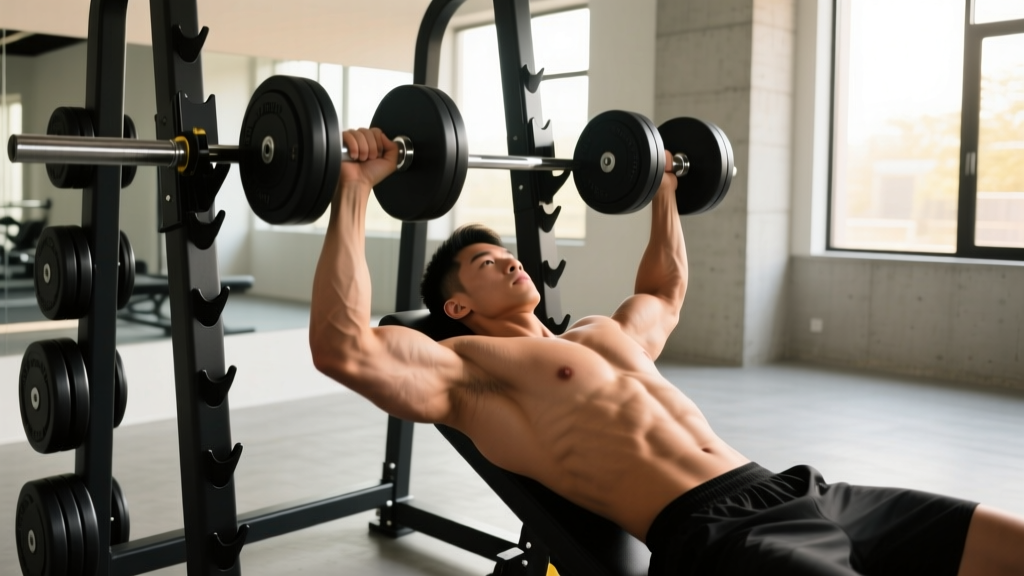
Incline Dumbbell Press Targets Which Muscle? Best Adjustable Dumbbells

EZ Curl vs Straight Bar: Evolving Women's Arm Dumbbell Exercises

Bumper vs Iron Plates & Standing Ab Workout With Dumbbells Layouts

Beyond Dumbbell Rows at Home: Olympic Barbell Weight & Knurling
Upper Body Dumbbell Workout Gear: Rubber Hex vs Urethane Value Guide
