Cast Iron vs Competition Kettlebells: Space & CAP 35 lb Dumbbell Fit
Optimize your home gym layout by comparing cast iron vs competition kettlebells. Includes spatial footprints, storage racks, and CAP 35 lb dumbbell metrics.

The Spatial Dilemma: Uniform vs. Variable Footprints
Designing a high-functioning home gym in 2026 requires more than just buying equipment; it demands rigorous spatial planning. When outfitting your free weight zone, the debate between cast iron and competition kettlebells is rarely just about aesthetics or lifting mechanics—it is fundamentally a question of space optimization and layout design.
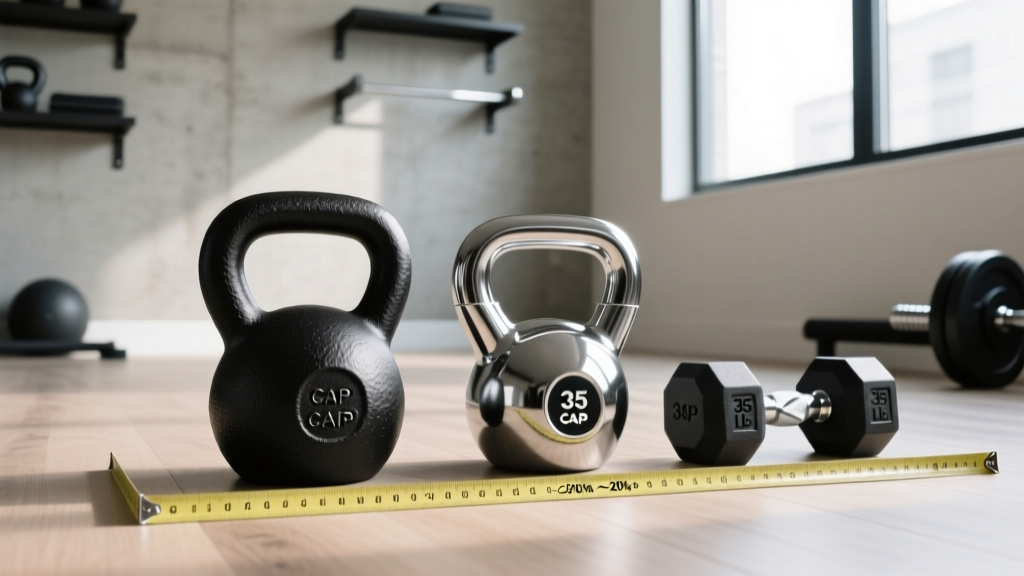
Many lifters anchor their spatial planning around familiar benchmarks, such as the standard hex dumbbell. For instance, when calculating shelf depth and floor clearance, a CAP 35 lb dumbbell (measuring roughly 14.5 inches in length with a 5.5-inch hex head) serves as an excellent baseline for fixed-weight storage. But how do kettlebells compare to this footprint? Choosing between cast iron and competition kettlebells will drastically alter your rack requirements, floor clearance zones, and overall gym flow.
📐 The Golden Rule of Free Weight Layouts: Never purchase a full set of kettlebells without first mapping your rack's depth and your room's swing radius. Competition bells demand uniform, oversized shelving, while cast iron bells allow for tiered, space-saving 'Tetris' storage.Dimensional Breakdown: Cast Iron vs. Competition vs. Hex Dumbbells
To understand the layout implications, we must look at the exact physical dimensions of these tools. According to equipment testing by Garage Gym Reviews, the manufacturing standards for kettlebells vary wildly between the two main styles, directly impacting how they fit on standard 12-inch or 16-inch deep shelving units.
| Equipment Type (approx. 35 lbs / 16kg) | Height x Width | Handle Diameter | Shelf Depth Required |
|---|---|---|---|
| Competition Kettlebell | 280mm x 210mm (11" x 8.3") | 35mm (Uniform) | 10+ inches |
| Cast Iron Kettlebell | 220mm x 180mm (8.6" x 7") | 30mm - 32mm | 8+ inches |
| CAP 35 lb Dumbbell (Hex) | 14.5" Length x 5.5" Head | 28mm - 30mm | 6+ inches (Horizontal) |
The Competition Kettlebell Spatial Penalty
Competition kettlebells are built to exact International Union of Kettlebell Sport (IUKS) specifications. Whether the bell weighs 8kg or 32kg, the physical dimensions remain exactly 280mm tall and 210mm wide. From a layout perspective, this is highly inefficient for a multi-weight home gym rack. An 8kg competition bell takes up the exact same cubic volume on your shelf as a 32kg bell. If you are buying a full set from 12kg to 32kg, you must build or buy a heavy-duty, uniform-depth rack capable of holding massive steel spheres, wasting valuable vertical and horizontal air space.
The Cast Iron Advantage for Compact Gyms
Cast iron kettlebells scale in size proportionally to their weight. A 16kg (35 lb) cast iron bell is noticeably more compact than its competition counterpart. For apartment dwellers or those utilizing shallow, wall-mounted shelving, cast iron allows you to stagger your storage. You can place lighter, smaller bells on upper, shallower shelves, and reserve the deeper, lower shelves for the heavier, bulkier cast iron models.
Storage Layouts: Designing Your Free Weight Zone
When integrating kettlebells into a space alongside traditional dumbbells, your storage hardware must match the equipment's geometry.
The Linear Rack Method (Best for Competition Bells)
If you opt for competition kettlebells, horizontal 3-tier racks are mandatory. Because the bells are perfectly uniform, they slide into dedicated cradles seamlessly. However, you must account for the handle overhang. Competition bells have wide, flat horns. If your rack relies on vertical dividers spaced less than 9 inches apart, the horns will clash, forcing you to angle the bells and waste 20% more rack width.
The 'Tetris' Shelf Method (Best for Cast Iron & Dumbbells)
If your gym layout relies on heavy-duty wall shelves (like steel garage shelving), cast iron kettlebells and hex dumbbells are superior. The flat bottoms of cast iron bells and the anti-roll hex heads of a CAP 35 lb dumbbell allow them to be pushed flush against a wall or packed tightly side-by-side without rolling off the edge.
"In a 50-square-foot garage gym, every inch of shelf depth matters. I frequently recommend cast iron kettlebells for clients using standard 12-inch deep wire racks, as competition bells often overhang the wire grating, creating a dangerous tipping hazard when loaded or unloaded." — Home Gym Layout Specialist
Clearance Zones: Swing and Snatch Radii
Space optimization isn't just about where the weights rest; it's about where they move. According to StrongFirst training standards, the biomechanics of the kettlebell swing require specific spatial clearances to prevent drywall damage and joint impingement.
- Lateral Clearance: You need a minimum of 48 inches of unobstructed width to perform single-arm snatches safely. Competition bells, with their wider 210mm bodies and 35mm handles, require a slightly wider grip and stance for two-handed swings, pushing the lateral safety margin closer to 54 inches for taller athletes.
- Forward/Backward Clearance: A standard swing arc requires 36 inches of space behind the lifter (for the hike pass) and 36 inches in front.
- Ceiling Height: If you are training in a basement with low ceilings, the uniform 11-inch height of a competition kettlebell (plus the length of your arm) might cause overhead lockout issues during snatches or Turkish get-ups. Cast iron 35 lb bells sit roughly 2.5 inches shorter, providing critical overhead clearance in sub-8-foot basements.
Floor Load & Drop Zones in Compact Spaces
In a space-optimized gym, your drop zone is often directly adjacent to other equipment. Competition kettlebells are typically made of solid steel with a thin e-coat or powder coat. When dropped on rubber matting, they have a high rebound rate due to the dense steel core and spherical shape. Cast iron bells, while still prone to bouncing, often feature thicker powder coatings or rubberized bases (depending on the brand) which slightly dampens the acoustic impact and rebound in tight, multi-use rooms.
Furthermore, the price per pound dictates how much space you can afford to dedicate to a full set. In 2026, competition kettlebells average $2.00 to $2.80 per pound, while high-quality cast iron bells hover around $1.10 to $1.50 per pound. The lower entry cost of cast iron allows budget-conscious lifters to invest the savings into space-saving modular wall racks rather than leaving weights scattered on the floor.
Buying Decision Matrix: Which Should You Choose?
✅ Buy Cast Iron If:
- Your gym is under 80 sq. ft.
- You use shallow, wall-mounted shelving.
- You have low basement ceilings (under 8 ft).
- You prefer a thinner handle (30-32mm) for high-rep grip endurance.
✅ Buy Competition If:
- You have a dedicated, deep 3-tier floor rack.
- You are training specifically for Kettlebell Sport (Girevoy).
- You require a uniform 35mm handle across all weights for muscle memory.
- Your ceiling clearance exceeds 9 feet.
Frequently Asked Questions
Can I mix cast iron and competition kettlebells on the same rack?
Yes, but it requires a custom layout. Because competition bells are 11 inches tall and cast iron bells vary from 8 to 11 inches, you cannot use uniform vertical dividers. Use open horizontal shelving and group the bells by style rather than by weight to maintain a clean visual layout and prevent handle snagging.
How does a 35 lb kettlebell compare to a CAP 35 lb dumbbell for goblet squats?
A 35 lb cast iron kettlebell is significantly more compact and easier to hold at the chest than a 14.5-inch long CAP 35 lb hex dumbbell. The dumbbell's elongated handles and hex heads can dig into your clavicle or wrists during deep goblet squats, whereas the kettlebell's spherical body and smooth horns allow for a flush, ergonomic rack position, requiring less spatial adjustment from your elbows.
Do rubber-coated kettlebells save space?
Rubber coatings actually increase the overall dimensions of a cast iron kettlebell by 5mm to 10mm in all directions. If you are strictly optimizing for maximum weight density on a small shelf, bare cast iron with a thin powder coat (like those reviewed by Rogue Fitness for their steel lines) offers the most space-efficient footprint.
More gear to consider
All reviews
Top Adjustable Dumbbells for a Beginner Dumbbell Workout (2026)

Bumper vs Iron Plates: Budgeting for Dumbbell Back Lunges & Squats
Kettlebell Guide: Cast Iron vs Competition & One-Arm Dumbbell Rows

Bumper vs Iron Plate Care After Exercising with Dumbbells (Beginners)

Kettlebell Guide & Incline Dumbbell Bench Press Angle Trends 2026
