
Power Rack vs Squat Rack vs Squat Stand: Triceps Pushdown with Dumbbells
Compare power racks, squat racks, and squat stands for your 2026 home gym. Discover rigging tips, cable attachments, and triceps pushdown with dumbbells hacks.

The 2026 Home Gym Foundation: Choosing Your Rack
Building a home gym in 2026 requires navigating a saturated market of steel, laser-cut logos, and proprietary attachment ecosystems. The centerpiece of any serious free-weight setup is the rack. But choosing between a full power rack, a half squat rack, and minimalist squat stands isn't just about your heavy squats and bench presses—it fundamentally dictates your accessory options.
Your rack choice determines whether you can bolt on a $400 cable pulley system for isolation work, or if you will be forced to engineer workarounds, such as mastering the triceps pushdown with dumbbells to hit the lateral head of your triceps without a cable stack. According to testing data from Garage Gym Reviews, the gap between budget and premium racks has narrowed significantly, with 11-gauge steel and 3x3 uprights becoming the new baseline standard. Let us break down the structural differences, safety profiles, and accessory hacks for each rig type.
Head-to-Head Comparison Matrix
Before diving into biomechanical workarounds and accessory hacks, we must establish the physical and financial footprint of the three main contenders. The table below reflects average 2026 market pricing for commercial-grade, 11-gauge steel models.
| Feature | Power Rack (Full Cage) | Squat Rack (Half Rack) | Squat Stand (Dual Pillars) |
|---|---|---|---|
| Avg. Footprint | 49" x 49" (Standard) | 48" x 34" (Compact) | 48" x 48" (Open) |
| Upright Profile | 3x3" (11-Gauge Steel) | 3x3" or 2x3" (11 to 14-Gauge) | 2x2" or 3x3" (Varies) |
| Weight Capacity | 1,000 - 1,500+ lbs | 800 - 1,200 lbs | 500 - 800 lbs |
| Safety Mechanism | Internal Pin-Pipe or Straps | External Spotter Arms | External Spotter Arms (Tippy) |
| Cable Attachment? | Yes (Lat/Low Row compatible) | Rare (Brand specific) | No |
| 2026 Price Range | $700 - $1,600+ | $600 - $1,100 | $250 - $450 |
The Accessory Dilemma: Cable Pulleys vs. Free Weight Hacks
The most significant divergence between a power rack and a squat stand is attachment versatility. Premium power racks like the Rep Fitness PR-4000 or Rogue RM-490 allow you to integrate a lat pulldown and low-row cable attachment. This turns your rack into a functional cable crossover machine, enabling true constant-tension isolation movements like rope pushdowns.
However, if you opt for a half rack or squat stand to save space or budget, you lose cable functionality. This brings us to a highly searched home gym dilemma: how to execute a triceps pushdown with dumbbells. Strictly speaking, a "pushdown" requires a cable to provide resistance parallel to gravity's horizontal plane. But you can replicate the biomechanical lockout and lateral head activation using dumbbells and an adjustable bench.
Expert Hack: The Incline Dumbbell Pushdown
To mimic a cable pushdown without a rack pulley system, set an adjustable bench to a 45-degree incline. Lie chest-down on the incline. Grab two dumbbells with a neutral grip. Pin your elbows to your ribs and extend the weights downward toward the floor. Because your torso is angled, the gravity vector pulls the dumbbells down and slightly back, closely mimicking the resistance curve of a cable triceps pushdown. Squeeze at the bottom for a full 1-second isometric hold.
Mastering the triceps pushdown with dumbbells via this incline method is a staple for minimalist gym owners who refuse to sacrifice arm hypertrophy just because they skipped the $450 cable attachment upgrade. For more on adapting bodybuilding splits to minimalist equipment, strength sports publications like BarBend frequently emphasize the importance of leveraging adjustable benches to alter gravity vectors when cables are unavailable.
Safety Margins: Where Budget Racks Fail
When evaluating squat stands versus full cages, safety is the ultimate deciding factor. A power rack encloses you. If you fail a heavy back squat, you simply drop the bar onto internal safety straps or pin-pipes. The bar cannot bounce out, and the rack cannot tip.
The Squat Stand Tipping Hazard
Squat stands rely on external spotter arms. In 2026, almost all reputable brands (Titan Fitness, Bells of Steel) include rear base extensions to increase the footprint. However, if a lifter fails a rep and dumps the bar forward onto the very tip of the spotter arms, the leverage can lift the rear of the stand off the ground.
Failure Mode Warning: Never use squat stands without either bolting them to a wooden platform or loading the rear base extensions with heavy 45-lb bumper plates. A dynamic forward dump of 300+ lbs on unweighted squat stands will result in a catastrophic forward tip.
Half racks (squat racks) offer a middle ground. They feature a single crossmember at the top and uprights that extend backward, providing a dedicated storage area for weight plates. This built-in plate storage acts as a counterweight, vastly improving stability compared to standalone squat stands, while still allowing you to perform standing overhead presses without hitting a top crossmember.
Three 2026 Home Gym Builds Based on Your Needs
1. The "No Compromise" Cable & Lift Build
- Core: 49x49 Power Rack with 1" Westside hole spacing in the bench zone.
- Attachments: Lat/Low Row pulley system, multi-grip pull-up bar, roller j-cups.
- Best For: Bodybuilders and powerlifters who want to transition seamlessly from heavy squats to cable triceps pushdowns without leaving the rig.
- Estimated Cost: $1,200 - $1,800.
2. The Garage Space-Saver Hybrid
- Core: 48x34 Half Squat Rack (e.g., Rogue SML-2C or Titan T-3 Half Rack).
- Attachments: Sandwich j-cups, extended spotter arms, band pegs.
- Best For: Lifters with low ceilings or shallow garages who need built-in weight storage for stability but don't care about integrated cable systems.
- Estimated Cost: $750 - $1,100.
3. The Minimalist Dumbbell-Heavy Setup
- Core: Heavy-duty 3x3 Squat Stands with 24" spotter arms.
- Accessories: A highly adjustable FID (Flat/Incline/Decline) bench and a set of adjustable dumbbells (e.g., Nuobell or PowerBlock).
- Best For: Athletes prioritizing open floor space for Olympic lifts, kettlebell flows, and dumbbell hypertrophy work (utilizing the triceps pushdown with dumbbells incline hack mentioned above).
- Estimated Cost: $350 - $600 (excluding dumbbells).
Frequently Asked Questions
Is 14-gauge steel acceptable for a home gym rack in 2026?
For a squat stand or a light-duty half rack used strictly for benching and light squats, 14-gauge steel is adequate. However, for a full power rack where you plan to use safety straps for heavy, unassisted failing, 11-gauge steel is the industry standard and highly recommended to prevent upright flexion under 500+ lb loads.
Can I mount resistance bands to a squat stand for pushdowns?
Yes. If you are using squat stands and want to avoid the triceps pushdown with dumbbells workaround, you can loop heavy loop bands around the top crossmember or pull-up bar of the stands. While the resistance curve of a band is variable (heaviest at the bottom lockout), it provides a viable, cable-free pushdown stimulus for under $30.
What is the ideal hole spacing for j-cups?
Look for racks that feature "Westside spacing"—1-inch hole spacing in the bench press zone, and 2-inch spacing higher up. This allows you to set the j-cups precisely at the bottom of your bench press range of motion, eliminating the dangerous 2-3 inch gap found in older, uniformly spaced racks where unracking heavy weight becomes a mini-press in itself.
More gear to consider
All reviews
Power Rack vs Squat Rack vs Stand: Setup & SpongeBob Dumbbells

Power Rack vs Squat Stand: Back Workouts with Dumbbells at Home
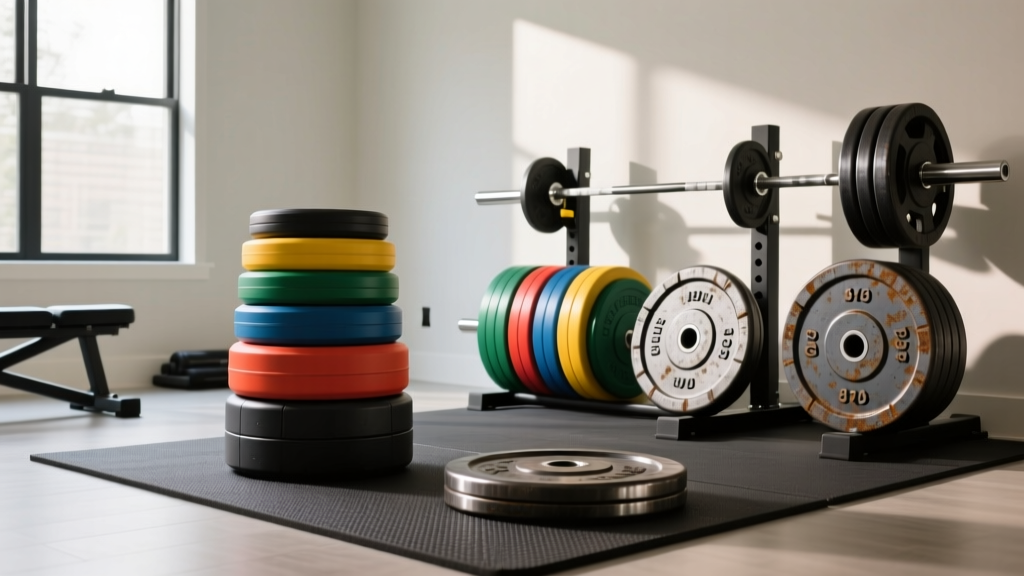
Beyond The Dumbbell Cartoon: Bumper vs Iron Plate Layouts

Power Rack vs Squat Rack vs Stand: Setup & Dumbbell Workout Plan PDF
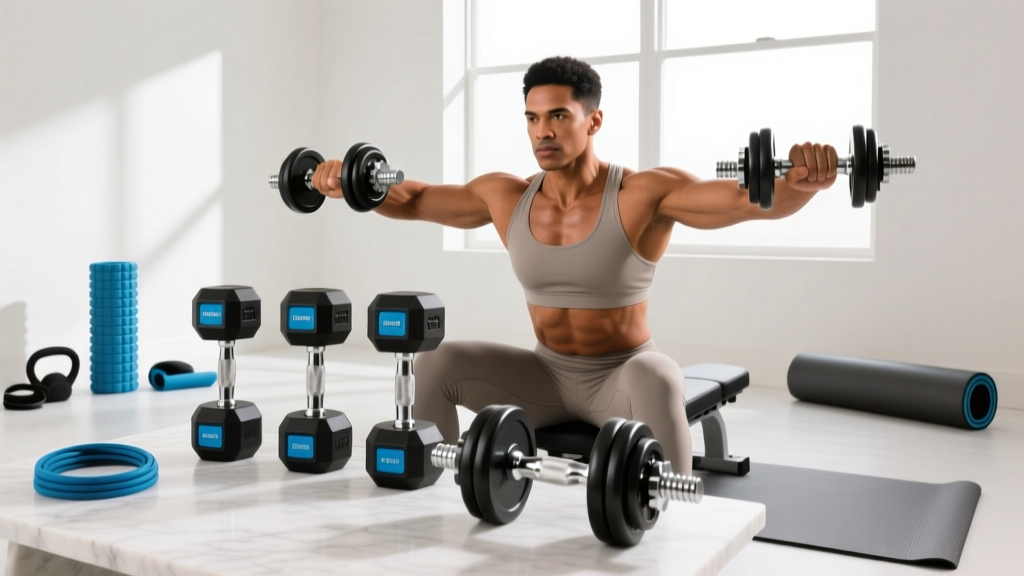
Exercise for Upper Chest with Dumbbells: Loadable Budget Guide
