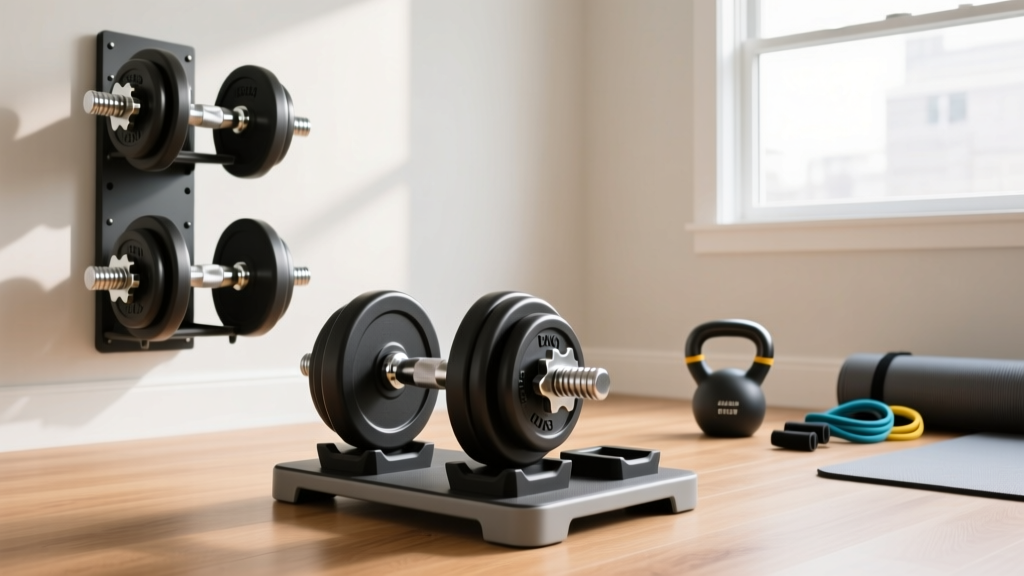
Maximize Space for Your Free Dumbbell Workout with Loadable Plates
Discover how to optimize your home gym layout for a complete free dumbbell workout using loadable handles and interchangeable plates to save space and money.

The Spatial Mathematics of Fixed vs. Loadable Dumbbells
As urban living spaces shrink and home gym real estate becomes a premium commodity in 2026, the traditional three-tier dumbbell rack is increasingly viewed as a spatial luxury. If your primary goal is to execute a comprehensive free dumbbell workout without dedicating 40 square feet of your garage to a static rubber hex dumbbell set, transitioning to loadable dumbbell handles with interchangeable plates is the ultimate layout optimization.
A standard 5-to-50-pound fixed dumbbell set requires roughly 35 square feet of floor space when accounting for the rack footprint and necessary clearance for loading and unloading. In stark contrast, a pair of Olympic loadable dumbbell handles paired with 200 pounds of precision-machined steel plates can be stored in a vertical footprint of less than 4 square feet. This spatial efficiency allows you to reclaim valuable square footage for functional movement zones, kettlebell flows, or cardio equipment.
| Metric | Fixed Hex Dumbbell Set (5-50 lbs) | Loadable Handle + Plate Setup |
|---|---|---|
| Total Equipment Cost | $1,200 - $1,800 | $350 - $500 |
| Storage Footprint | ~35 sq. ft. (Rack + Clearance) | ~4 sq. ft. (Vertical Tree/Wall) |
| Weight Increments | Fixed 5 lb. Jumps | Micro-loadable (0.25 lb to 2.5 lb) |
| Setup Time per Set | 0 seconds (Grab and go) | 45 - 90 seconds (Plate swapping) |
| Max Weight Capacity | 50 lbs (per dumbbell) | Up to 120+ lbs (per handle) |
Selecting the Right Loadable Handles for Compact Layouts
Not all loadable dumbbell handles are engineered equally, and choosing the wrong model can severely bottleneck your space optimization strategy. When designing your layout, you must consider sleeve length, knurling depth, and collar mechanics. According to comprehensive testing by BarBend's equipment experts, the tolerance between the sleeve diameter and the plate hole is the most critical factor in preventing rotational slop during unilateral movements like single-arm dumbbell rows.
Rogue Fitness Olympic Loadable Dumbbell Handles
The Rogue Fitness Olympic Loadable Dumbbell Handles remain the gold standard for serious home gym owners prioritizing durability and barbell-like feel. Priced around $130 per pair, these feature a 1.9-inch grip diameter with aggressive knurling and 10.25-inch loadable sleeves. The sleeves are machined to strict Olympic tolerances, meaning your interchangeable plates will slide on smoothly without the 'clanking' slop found in cheaper imports. However, their longer sleeve length means you must account for a slightly wider storage profile on wall-mounted racks.
Titan Fitness Loadable Dumbbell Handles
For budget-conscious lifters optimizing a tight corner setup, Titan Fitness offers a highly capable alternative at approximately $89 per pair. While the knurling is slightly more passive and the sleeve finish isn't as polished as Rogue's, the overall spatial footprint is nearly identical. The primary trade-off is the included spring collars; for a secure free dumbbell workout involving high-velocity movements like snatches or cleans, upgrading to aftermarket locking collars is mandatory.
⚠️ The Bumper Plate Clearance Problem (Critical Edge Case)
Many lifters attempt to load standard 45-pound bumper plates (17.7-inch diameter) onto their loadable dumbbells to save space by using their barbell plates. Do not do this for floor-level movements. An Olympic barbell sleeve sits 8.75 inches from the floor, allowing a 17.7-inch plate to clear the ground. A dumbbell handle's center axis sits only 4 to 5 inches off the floor. If you load a full-size bumper plate onto a dumbbell, the plate will extend 4+ inches below the handle, striking the floor prematurely during Romanian Deadlifts and dragging during renegade rows. Solution: Dedicate a set of calibrated steel plates (14.5-inch diameter) or specialized compact change plates exclusively for your dumbbell layout.
Designing the 24-Square-Foot Free Dumbbell Workout Zone
To fully capitalize on the space saved by ditching fixed dumbbells, you must design an intentional layout that streamlines the plate-loading process. The friction of loading interchangeable plates is the primary reason users abandon loadable setups. By engineering a 'loading zone' into your gym layout, you eliminate this friction.
- The Anchor Point (4x6 ft Mat): Place a heavy-duty 3/4-inch rubber horse stall mat in the center of your designated zone. This serves as your primary workout area and protects your subfloor from dropped steel plates.
- The Vertical Plate Tree: Position a vertical Olympic plate tree exactly 24 inches behind the head of your mat. This specific distance allows you to reach back and slide plates onto the dumbbell handles without taking a step, minimizing the 'setup fatigue' that plagues loadable dumbbell routines.
- The Collar Tray: Mount a small, 12-inch magnetic shelf on the adjacent wall at waist height. Store your aluminum locking collars and fractional micro-plates here. Searching for a rogue 1.25 lb change plate mid-workout destroys momentum; dedicated magnetic storage solves this instantly.
Interchangeable Plate Storage & Micro-Loading Strategies
The true power of a loadable dumbbell system lies in micro-loading—the ability to make 0.5 lb or 1 lb jumps in weight, which is biomechanically superior for upper-body isolation exercises like lateral raises and triceps extensions. Fixed dumbbells force 5 lb jumps, which represents a massive 20-30% increase in load for small muscle groups.
'Progressive overload on small muscle groups requires granular weight increments. A 5-pound jump on a 15-pound lateral raise is a 33% increase in intensity, often leading to form breakdown and injury. Micro-loading via interchangeable fractional plates is the safest path to hypertrophy.' — National Strength and Conditioning Association (NSCA) Principles of Resistance Training
To optimize your layout for micro-loading, invest in a set of Urethane-Coated Fractional Plates (0.25, 0.5, 0.75, and 1.25 lbs). Unlike raw cast iron, urethane-coated plates will not chip your flooring if dropped, and they resist rust in humid garage environments. Store these in a tiered desktop organizer or a specialized wall-mounted acrylic rack to keep them visible and accessible.
Managing Plate Thickness and Sleeve Real Estate
When designing your interchangeable plate collection, prioritize thin-profile steel plates over thick rubber hex plates. A 10-pound rubber hex plate can be up to 1.5 inches thick, whereas a 10-pound machined steel plate is roughly 0.9 inches thick. Because loadable dumbbell sleeves are typically limited to 10-12 inches of usable space, thick plates will max out your sleeve capacity before you reach your target weight, rendering the handles useless for heavy pressing movements.
FAQ: Troubleshooting Loadable Dumbbell Setups
Can I use my standard 1-inch plates on Olympic loadable handles?
No. Olympic handles feature a 2-inch (50mm) sleeve diameter. Standard plates have a 1-inch (25mm) center hole. While you can purchase plastic adapter sleeves to convert standard plates to Olympic sizes, these adapters introduce rotational slop and add unnecessary bulk to the sleeve, severely limiting your maximum loadable weight. Always match your plate hole diameter to the handle sleeve natively.
How do I prevent the collars from slipping during overhead presses?
Spring collars are insufficient for the dynamic rotational forces generated during exercises like the dumbbell snatch or overhead press. You must use spin-lock collars or specialized aluminum locking collars (like the Rogue HG 2.0 or OSO Pro Collars) that utilize a clamping mechanism with an internal rubber grip. Ensure the sleeve is wiped free of chalk and sweat before clamping to prevent micro-slippages.
Is the setup time worth the space saved?
If you structure your free dumbbell workout using supersets or rest-pause methodologies, the 60 seconds it takes to swap interchangeable plates becomes your built-in rest period. By placing your plate tree within arm's reach of your workout mat, the loading process becomes a seamless part of your training cadence rather than a disruptive chore.
More gear to consider
All reviews
Concrete Dumbbell Molds vs Loadable Dumbbells: 2026 Top Picks

Olympic Barbell Guide: Knurling vs. 15 Minute Dumbbell Arm Workout
Rack Setup Guide: Power vs Squat & Wrist Pain Dumbbell Curls Fixes

Dumbbell Workouts for Men: Cast Iron vs Competition Kettlebell ROI

Cast Iron vs Competition Kettlebells & Neck Exercises with Dumbbells
