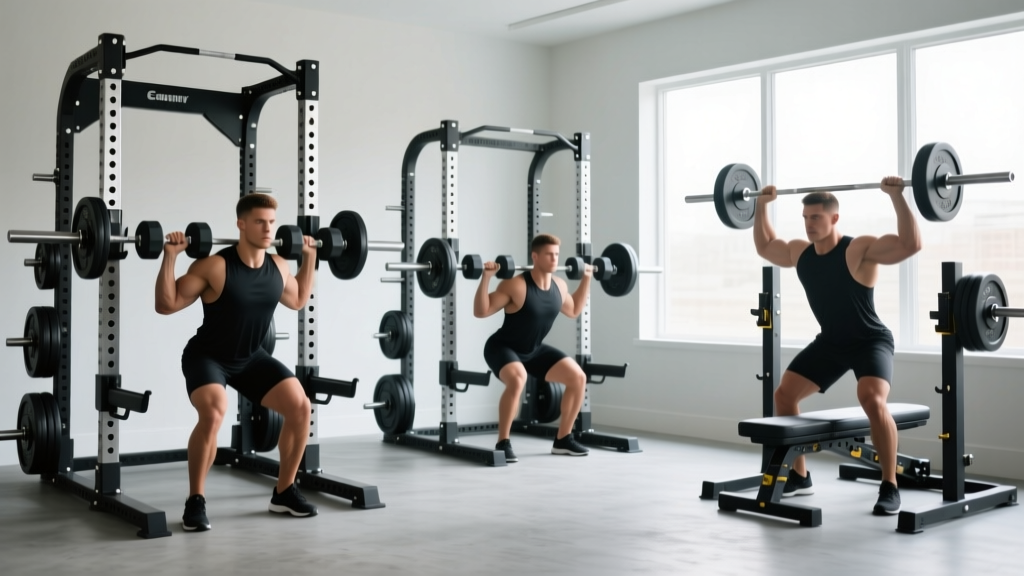
Power Rack vs Squat Rack vs Stand for Full Body Dumbbell Exercises
Compare power racks, squat racks, and squat stands to find the safest, most space-efficient rig for full body dumbbell exercises in your home gym.

The 2026 Home Gym Dilemma: Barbell Rigs for Dumbbell Workouts
When outfitting a home gym, most lifters obsess over barbell compatibility. Yet, the reality of modern training is that a significant percentage of weekly volume comes from full body dumbbell exercises. With the 2026 market dominated by premium adjustable dumbbells like the Nuobell 80s and PowerBlock Pro 100 EXPs, lifters are pairing heavy, bulky dumbbells with traditional barbell rigs. But which rig is actually best for dumbbell training? The choice between a power rack, a half rack (squat rack), and a squat stand drastically alters your safety, spatial footprint, and workflow when executing everything from heavy dumbbell bench presses to walking lunges and renegade rows.
This head-to-head comparison strips away the barbell bias and evaluates these three foundational pieces of equipment strictly through the lens of dumbbell utility, safety, and spatial efficiency.
Footprint and Clearance: Navigating Full Body Dumbbell Exercises
Unlike barbell movements, which are largely linear and confined to the sagittal plane, full body dumbbell exercises require multi-planar clearance. When performing dumbbell step-ups, Bulgarian split squats, or lateral lunges, your body moves outside the immediate footprint of the rack.
The Squat Stand Advantage
Squat stands, such as the Rogue SML-2 Monster Lite (which features a 30-inch by 30-inch base), offer the ultimate spatial freedom. Because there is no overhead crossmember or rear uprights, you can perform dynamic full body dumbbell exercises in a 360-degree radius around the stands. If your routine involves heavy dumbbell goblet squats transitioning into overhead presses, the lack of a restrictive cage prevents the dumbbells from clanging against steel uprights at the top of the movement.
The Power Rack Constraint
Conversely, a standard 4-post power rack (like the Rogue R-3, measuring 34 inches deep by 49 inches wide) creates a physical cage. While excellent for containment, the interior width is typically 43 inches. For taller lifters performing dumbbell floor presses or wide-stance sumo deadlifts inside the rack, the uprights can obstruct elbow flare or dumbbell travel paths. Furthermore, overhead dumbbell presses inside a standard 84-inch or 90-inch power rack often result in the weights striking the pull-up bar or top crossmembers.
⚠️ Safety Warning: According to the Mayo Clinic's guidelines on weight training safety, maintaining a clear, unobstructed path of motion is critical to preventing joint impingement and accidental drops. Never force a dumbbell movement inside a cage if the uprights restrict your natural biomechanical groove.Safety First: Spotter Arms and Solo Dumbbell Benching
The most critical failure point in any home gym is the solo dumbbell bench press. When lifting 70lb+ adjustable dumbbells to failure, the standard bailout technique is the 'lateral dump'—dropping the weights out to the sides to protect the rotator cuff and chest.
The Lateral Dump Problem with Squat Stands
Squat stands are inherently dangerous for heavy solo dumbbell benching. Most squat stand spotter arms are only 17 to 19 inches long and are mounted on independent uprights. If you fail a rep and dump an 80lb Nuobell dumbbell laterally, it will almost certainly miss the short spotter arm, crashing to the floor (or worse, bouncing into your face). The independent uprights can also be kicked out of alignment if you drop a heavy weight onto one side of the safety bar.
The Power Rack Solution
A power rack solves this with full-width crossmembers and 24-inch (or longer) flip-down spotter arms. When you dump a dumbbell laterally inside a power rack, it hits the continuous safety strap or steel crossmember. The structural integrity of a 4-post rack bolted to the floor ensures that a violent, uneven drop will not tip the rig. For lifters prioritizing heavy dumbbell chest and shoulder work, the power rack is the only solo-safe option.
Head-to-Head Utility Matrix
To visualize how these rigs compare specifically for dumbbell training, review the matrix below based on 2026 equipment standards and pricing.
| Feature | Squat Stand | Half Rack (Squat Rack) | 4-Post Power Rack |
|---|---|---|---|
| Avg. Price Range | $350 - $500 | $600 - $900 | $800 - $1,400+ |
| Dumbbell Benching Safety | Poor (Lateral dump risk) | Good (Long safety straps) | Excellent (Full containment) |
| Movement Clearance (Lunges/Step-ups) | Unrestricted 360° | Open front, restricted rear | Restricted by cage width |
| Overhead Press Clearance | Unlimited | High (Open top) | Limited by pull-up bar |
| Dumbbell Storage Integration | None (Requires separate tree) | Excellent (Horn storage) | Moderate (Saddle attachments) |
Storage and Workflow: Managing Adjustable Dumbbells
Full body dumbbell exercises often require rapid load changes. A complex involving dumbbell thrusters, renegade rows, and weighted carries might require dropping from 60 lbs to 30 lbs mid-circuit. Workflow efficiency is dictated by where the dumbbells live when not in your hands.
Squat Stands offer zero integrated storage. You must purchase a separate dumbbell tree or tray, which eats into your floor space and forces you to walk away from your lifting station to change weights, cooling down your muscles and disrupting your heart rate zone.
Half Racks (Squat Racks), like the Titan Fitness T-3 Series, feature front-mounted weight storage horns. While designed for barbell plates, many lifters use the lower horns or specialized saddle attachments to cradle adjustable dumbbells. This keeps the weights within arm's reach of the bench or lifting platform, streamlining drop-sets and complex circuits.
According to equipment analysts at BarBend, the half rack provides the optimal middle ground for garage gyms, offering the storage density of a power rack without the claustrophobic footprint of a 4-post cage.
Real-World Scenario: The 45-Minute Full-Body Dumbbell Complex
To understand the practical implications of your choice, let's map a standard full-body dumbbell circuit to the three rigs. The workout consists of heavy Dumbbell Bench Press, Dumbbell Bulgarian Split Squats, and Standing Overhead Presses.
- The Squat Stand Experience: You breeze through the split squats and overhead presses with zero spatial restrictions. However, when you move to the bench press, you must keep your spotter arms dangerously close to your armpits to prevent a fatal drop, restricting your range of motion and causing psychological hesitation on the final reps.
- The Half Rack Experience: You pull the dumbbells directly off the lower storage horns. You bench press safely using long nylon safety straps that catch lateral drops. You step out of the open front of the rack to perform split squats, enjoying ample clearance.
- The Power Rack Experience: You feel incredibly safe on the bench press, dumping a failed rep laterally onto the steel crossmembers without a second thought. However, during the standing overhead press, your knuckles scrape the powder-coat on the rear uprights, and you have to angle your body awkwardly to avoid the pull-up bar.
Final Verdict: Matching the Rig to Your Routine
There is no universally 'best' rig; there is only the right rig for your specific programming. If your full body dumbbell exercises lean heavily into athletic, multi-planar movements like lunges, carries, and dynamic step-ups, and you rarely bench heavy without a human spotter, the Squat Stand is your most cost-effective and spatially efficient choice.
If you train solo, push your adjustable dumbbells to absolute failure on horizontal and inclined presses, and value a clean, integrated storage footprint, the Half Rack (Squat Rack) represents the ultimate 2026 home gym compromise. It delivers the safety of a cage with the open-air freedom required for expansive dumbbell movements.
Reserve the Power Rack for lifters who treat dumbbells as an accessory to heavy, solo barbell squatting and benching, accepting the spatial compromises required to maintain a fortress of safety. For more detailed biomechanics on executing these movements safely, refer to the exercise directories maintained by the ExRx exercise database to ensure your rig setup supports, rather than hinders, your natural range of motion.
More gear to consider
All reviews
Dumbbell Workout Plan for Women: Barbell Collar Troubleshooting
Neoprene Female Dumbbells: Complete Home Gym Setup
Beginner Guide: Using a 20 Pound Dumbbell in kg (9kg) at Home

Beyond Dumbbell CrossFit: 2026 Olympic Barbell Weight & Knurl Guide
Bumper vs Iron Plates: 2026 Trends & The Woman Lifting Dumbbells Boom
