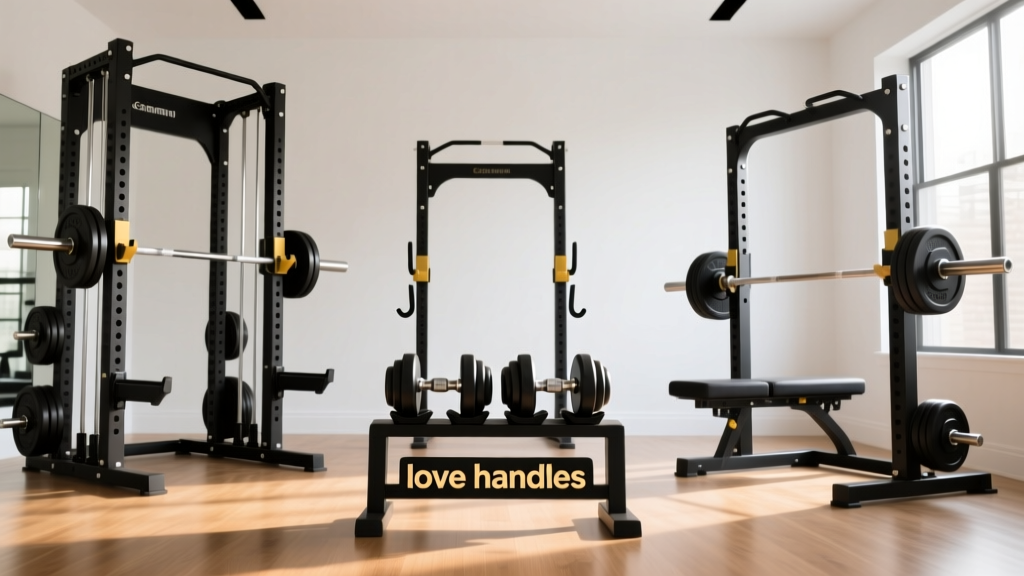
Power Rack vs Squat Rack vs Stand: Dumbbells for Love Handles Setups
Compare power racks, squat racks, and squat stands to find the best home gym rig for heavy dumbbells for love handles workouts and core training.

The 'Love Handle' Dilemma: Why Your Rack Choice Matters
When fitness enthusiasts begin searching for the best dumbbells for love handles, they usually start with a pair of 15-pound neoprene weights and a YouTube tutorial on side bends. However, as you progress into 2026, the reality of core hypertrophy sets in. Building the underlying musculature of your obliques and quadratus lumborum requires progressive overload. Eventually, you will be hoisting 70-pound urethane hex dumbbells for strict, controlled repetitions.
At that stage, leaving heavy dumbbells on the floor between sets isn't just inconvenient; it's a safety hazard and a disruption to your workout flow. Furthermore, advanced core training requires anchoring points for landmines and cable pulleys. This brings us to a critical home gym infrastructure decision: Power Rack vs. Squat Rack vs. Squat Stand. Which rig best supports a heavy dumbbell core and functional training routine?
⚠️ The Spot Reduction Reality Check: According to the Cleveland Clinic, spot reduction (burning fat in one specific area by exercising it) is a physiological myth. You must maintain a caloric deficit to lose the fat covering your midsection. However, heavy dumbbell training builds the muscle underneath, ensuring that when the fat drops, you have a tight, muscular, and defined waistline rather than a hollow one.Head-to-Head Breakdown: The 2026 Rig Contenders
To determine the best setup for heavy dumbbell core work, we need to evaluate the three main categories of squat racks based on footprint, attachment ecosystem, and safety profiles.
1. The Power Rack (Full Cage): The Ultimate Anchor
Top 2026 Model: Rogue RM-6 Monster Rack 3.0
Typical Price Range: $2,200 - $3,500+
Footprint: 49" x 43" (Standard 3x3 Uprights)
A full power rack is a four-post cage enclosed by safety spotter straps or pin-pipe safeties. For a lifter focused on heavy dumbbell oblique work, the power rack offers one massive advantage: the attachment ecosystem. Because it is a fully enclosed, bolted-together cage, it can support dual-cable pulley systems.
- Core Application: Cable woodchoppers and kneeling rotational twists are superior to dumbbell side bends for maintaining constant tension on the obliques throughout the entire range of motion. A power rack allows you to mount these pulleys directly to the uprights.
- Dumbbell Storage: Full cages easily accommodate saddle-style dumbbell horns, allowing you to rack your 100lb+ hex dumbbells safely between heavy sets of farmer's walks or side bends.
- The Drawback: The footprint is massive. If your home gym is in a standard spare bedroom or garage bay, a full cage will dominate the space, leaving little room for the actual dumbbell movements.
2. The Squat Rack (Half Rack): The Versatile Hybrid
Top 2026 Model: Rep Fitness PR-4000 Power Rack
Typical Price Range: $999 - $1,400
Footprint: 48" x 52" (Including upright spotter arms)
Half racks feature two main uprights in the front and a rear stabilizer crossmember. They offer an excellent middle ground. As noted by Rep Fitness, modern half racks utilize 3x3-inch 11-gauge steel with 1-inch Westside hole spacing, making them incredibly rigid.
- Core Application: The half rack is the undisputed king of the landmine attachment. By dropping a barbell into a base landmine and utilizing a V-handle or T-bar attachment, you can perform heavy rotational landmine twists. This movement directly targets the deep core stabilizers and obliques with a resistance curve that dumbbells simply cannot replicate.
- Safety: The rear crossmember provides enough counter-balance to safely mount lat/low-row pulley attachments without the rack tipping forward during heavy kneeling cable twists.
- The Drawback: You lose the front safety catches for barbell squatting, though this is irrelevant if your primary focus is dumbbell and functional core training.
3. The Squat Stand: The Minimalist Dumbbell Valet
Top 2026 Model: Rogue SML-1 Monster Lite Squat Stand
Typical Price Range: $495 - $650
Footprint: 24" x 24"
Squat stands are essentially two independent metal posts with J-cups. They are designed purely to hold a barbell (or act as a massive dumbbell rack) at a specific height.
- Core Application: Squat stands do not support cable pulleys or landmines. Their utility for 'love handle' workouts is strictly as a heavy-duty storage and staging area. If you are doing drop-sets with 80lb, 60lb, and 40lb dumbbells for side bends, a squat stand allows you to load the barbell sleeves with your dumbbells (using dumbbell hooks) or utilize add-on storage horns.
- Space Efficiency: At just 24x24 inches, it leaves the entire floor open for sprawling functional movements like dumbbell Russian twists and weighted planks.
- The Drawback: Severe tipping hazards. Squat stands have a high center of gravity and a tiny base.
Feature Comparison Matrix
| Feature | Power Rack (Full Cage) | Squat Rack (Half Rack) | Squat Stand |
|---|---|---|---|
| Best Core Attachment | Dual Cable Pulleys | Landmine Base | None (Storage Only) |
| Dumbbell Storage | Excellent (Horn attachments) | Good (Rear crossmember) | Fair (Barbell sleeves) |
| Space Required | High (4x4 ft + clearance) | Medium (4x5 ft) | Low (2x2 ft) |
| Tipping Risk | Zero (Fully enclosed) | Low (Rear stabilizer) | High (Must be bolted/loaded) |
| Avg. 2026 Cost | $2,500+ | $1,100 | $550 |
Biomechanics & Safety: Executing the Movements
According to the kinesiology database ExRx.net, the dumbbell side bend primarily targets the quadratus lumborum and the obliques. However, improper execution with heavy weights can lead to spinal shear and lower back injury.
🛑 Form Failure Warning: When using heavy 80lb+ dumbbells for love handle targeting, never perform side bends while seated on a bench. The lack of lower-body stabilization forces the lumbar spine to absorb rotational shear forces. Always perform heavy dumbbell side bends standing, using a squat rack's upright as a tactile guide to ensure you are moving strictly in the frontal plane (side-to-side) without leaning forward or backward.
The Tipping Hazard of Squat Stands
If you opt for the minimalist Squat Stand to save space and money for premium urethane dumbbells, you must address the physics of the rig. When you rack an 80-pound dumbbell onto a barbell sleeve attached to a squat stand, the center of gravity shifts violently.
The Fix: You must either bolt the squat stands to a wooden platform using lag screws, or use the stand's base crossmembers to store your heaviest dumbbells. By loading the base with 100lb hex dumbbells, you lower the center of gravity and create a counter-balance that prevents the stand from tipping onto your foot during heavy racking.
Final Verdict: Which Rig Should You Buy?
Your choice ultimately depends on your budget, available square footage, and how you prefer to train your core.
- Choose the Power Rack if: You want the ultimate aesthetic and functional setup. You plan to use cable pulleys for high-rep, constant-tension oblique twists and have the budget ($2,500+) and space for a full cage.
- Choose the Squat Rack (Half Rack) if: You want the best bang for your buck. The ability to mount a landmine attachment for heavy rotational core work makes the half rack the undisputed champion of functional midsection training in 2026.
- Choose the Squat Stand if: You are strictly a free-weight purist. If your 'love handle' routine consists entirely of standing dumbbell side bends, heavy farmer's carries, and weighted Russian twists on the floor, the squat stand serves as a heavy-duty valet to keep your expensive dumbbells organized and off the ground.
Remember, no piece of equipment will erase love handles without a disciplined nutritional approach. But by pairing a caloric deficit with the heavy, progressive overload that these racks facilitate, you will build a core that is as strong as it is defined.
More gear to consider
All reviews
Brachialis Dumbbell Workout: Dumbbell Rack Budget Guide
Squat Rack vs Power Rack: Space for Lateral Lunge with Dumbbells
Prone Dumbbell Hamstring Curl vs RDL: Olympic Knurling Guide
Gym Layouts: Kettlebell Sizing & How to Adjust Bowflex Dumbbells

Standard vs Olympic Plates & The Thomas Inch Dumbbell Diameter
