Power Rack vs Squat Rack vs Stand: Hack Squat Alternative with Dumbbells
Compare power rack vs squat rack vs squat stand for home gyms. Plus, master a beginner-friendly hack squat alternative with dumbbells for quad growth.

The Ultimate Leg Day Dilemma: Choosing Your Rack
Building a home gym is an exciting milestone, but when it comes to leg day, your equipment choices dictate both your safety and your gains. If you are serious about squatting heavy, you need a dedicated station. But with limited space and budget, how do you choose between a full power rack, a half squat rack, or minimalist squat stands? Furthermore, what if you want to isolate your quadriceps with a machine-like movement but lack the $3,000 budget and 80-square-foot footprint for a commercial hack squat machine?
This beginner-friendly guide breaks down the power rack vs squat rack vs squat stand debate with exact dimensions and pricing. Then, we will walk you through a highly effective, biomechanically sound hack squat alternative with dumbbells that you can perform in any home gym setup.
Breaking Down the Big Three: Rack vs. Rack vs. Stand
Before loading up the barbell, you need to understand the structural differences, safety profiles, and spatial requirements of the three main squatting stations available on the market in 2026.
1. The Power Rack (Full Cage)
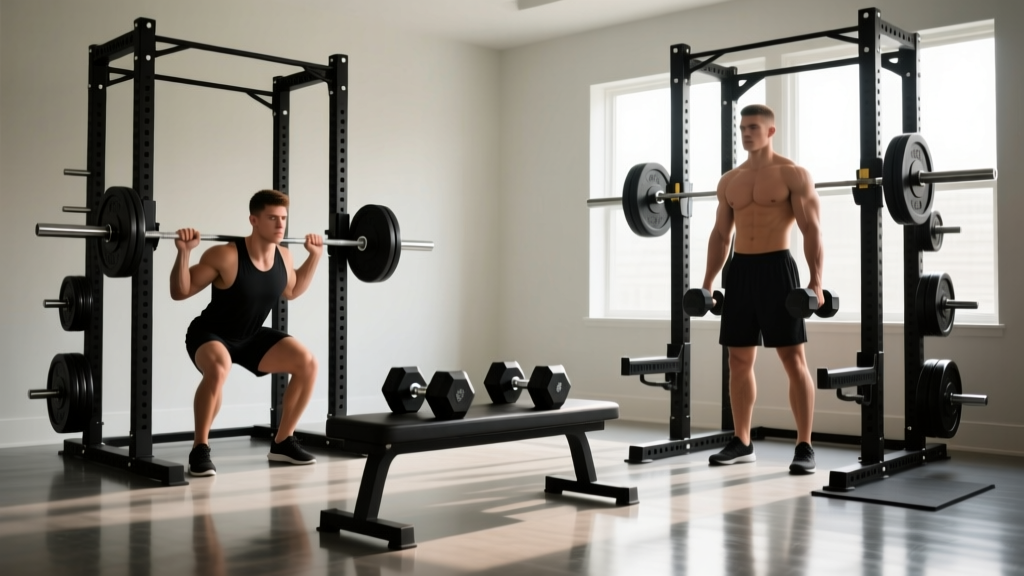
A power rack consists of four heavy-duty steel uprights connected by crossmembers, creating a fully enclosed 'cage.' Standard models feature 3x3-inch 11-gauge steel uprights with Westside hole spacing (1-inch holes in the primary squat/bench zone) for micro-adjusting your J-cups and spotter arms.
- Footprint: Typically 48x48 inches (outside) to 49x78 inches if using a depth extension.
- Average Cost: $450 to $900+ (e.g., Titan T-3 or Rogue R-3).
- Safety Rating: 10/10. The enclosed cage and full-length spotter bars mean you can safely fail a rep without a spotter.
- Best For: Beginners lifting alone, heavy barbell squats, bench presses, and utilizing attachments like lat pulldowns or belt squat mechanisms.
2. The Squat Rack (Half Rack)
A half rack utilizes two main uprights at the front and a rear stabilizing crossmember. It often includes spotter arms that extend outward. The open-front design is the primary differentiator.
- Footprint: Usually 48x48 inches, but the open front makes it feel less claustrophobic.
- Average Cost: $350 to $700.
- Safety Rating: 7/10. Spotter arms catch the bar, but if you bail forward or backward awkwardly, you are outside the protected zone.
- Best For: Olympic weightlifters who need an open path for cleans and snatches, and intermediate lifters who want a balance of safety and space.
3. Squat Stands
Squat stands are two independent, freestanding uprights. They are the most minimalist option, often featuring a wide, flat base or a bolt-down flange for stability.
- Footprint: As small as 24x24 inches when in use; can be pushed into a corner when not in use.
- Average Cost: $150 to $300 (e.g., Rep Fitness PR-1100 or Rogue S-1).
- Safety Rating: 4/10. Re-racking heavy weights requires precision. A missed lift can easily tip an un-bolted stand.
- Best For: Garage gyms with severe space constraints, budget-conscious beginners, and outdoor workouts.
Comparison Matrix: Which Rig Fits Your Garage?
| Feature | Power Rack (Full Cage) | Squat Rack (Half Rack) | Squat Stands |
|---|---|---|---|
| Uprights | 4 | 2 (plus rear supports) | 2 (independent) |
| Avg. Weight Capacity | 800 - 1,200 lbs | 600 - 1,000 lbs | 400 - 800 lbs |
| Solo Lifting Safety | Excellent | Good | Poor |
| Attachment Compatibility | High (Cable systems, dip bars) | Medium (Pull-up bars, J-cups) | Low (Basic J-cups only) |
Step-by-Step: The Best Hack Squat Alternative with Dumbbells
Commercial hack squat machines are fantastic for isolating the quadriceps—specifically the vastus lateralis and rectus femoris—because they remove the lower back and core from the equation, allowing for maximum knee flexion. According to biomechanics research highlighted by the National Strength and Conditioning Association (NSCA), greater knee flexion angles directly correlate with increased quadriceps hypertrophy.
If you only have a power rack and a set of adjustable dumbbells, you can replicate this machine-like tension using the Heel-Elevated Dumbbell Squat, widely considered the ultimate hack squat alternative with dumbbells.
💡 Pro Tip: Why Elevate the Heels?Elevating your heels by 1 to 2 inches reduces the ankle dorsiflexion required to hit deep squat depth. This allows your knees to travel further forward over your toes while keeping your torso completely upright, shifting the mechanical load almost entirely onto your quads and away from your glutes and lower back.
Step 1: The Wedge Setup
You need a stable, elevated surface for your heels. The most accessible home gym solution is placing your heels on the edge of a 25-pound or 45-pound iron weight plate (which provides roughly 1 to 1.5 inches of elevation). Alternatively, invest in a dedicated wooden or steel squat wedge (usually priced between $40 and $80), which offers a wider, non-slip surface.
Step 2: Stance and Grip
- Stance: Place your heels on the elevated surface with your feet shoulder-width apart. Point your toes slightly outward (about 15 to 30 degrees).
- Grip: Grab a pair of heavy dumbbells (or kettlebells). Hold them at your sides with a neutral grip (palms facing your thighs). Keep your arms completely straight and relaxed; they are just hooks holding the weight.
Step 3: The Descent (Eccentric Phase)
Unlike a barbell back squat where you hinge at the hips, the hack squat alternative with dumbbells requires a strictly upright torso. Initiate the movement by bending your knees and pushing them forward over your toes. Lower yourself under control for a full 2 to 3 seconds. Your goal is to reach maximum depth—where your hamstrings completely cover your calves—without your lower back rounding (butt wink).
'The magic of the dumbbell hack squat happens in the hole. Do not bounce out of the bottom position. Pause for one full second at maximum depth to eliminate the stretch reflex and force your quads to initiate the concentric drive.' — Strength & Conditioning Best Practices
Step 4: The Ascent (Concentric Phase)
Drive through the mid-foot and the elevated heel. Keep your chest proud and torso vertical. Push the floor away from you until your legs are nearly straight, but do not aggressively lock out your knees. Stopping just a millimeter short of full lockout keeps continuous, agonizing tension on the quadriceps, mimicking the cambered resistance profile of a commercial hack squat machine.
How to Program This Into Your Beginner Routine
Now that you have chosen your rack (we recommend a Power Rack for 90% of beginners due to the safety profile) and learned the movement, how do you program it? The Mayo Clinic recommends allowing at least 48 hours of rest between targeted strength training sessions for the same muscle group.
Sample Quad-Focused Leg Day
- Compound Primary: Barbell High-Bar Back Squats (Inside your Power Rack) — 3 sets of 5-8 reps (RIR 2).
- Isolation Secondary: Hack Squat Alternative with Dumbbells (Heel Elevated) — 3 sets of 10-15 reps (RIR 1, focus on the 2-second pause at the bottom).
- Accessory: Walking Dumbbell Lunges — 2 sets of 12 steps per leg.
- Finisher: Lying Hamstring Curls or Nordic Curls — 3 sets to failure.
Frequently Asked Questions
Can I do the dumbbell hack squat in a squat stand?
Yes. Because the heel-elevated dumbbell squat does not require a barbell, you do not need to be inside a rack or stand to perform it. You can do this movement anywhere in your garage or living room, making it highly versatile if your squat stands are currently occupied by another lifter or stored away.
Is the dumbbell hack squat bad for my knees?
When performed with proper form, knee flexion under load is perfectly safe and actually strengthens the connective tissues around the patellar tendon. However, if you have pre-existing patellofemoral pain syndrome, you should consult a physical therapist. As noted by exercise databases like ExRx.net, monitoring your pain threshold and adjusting your depth or heel elevation height is critical for joint longevity.
What if my dumbbells aren't heavy enough?
If you max out your adjustable dumbbells (e.g., 50-90 lbs per hand), you can increase the difficulty without adding weight by utilizing a 1.5-rep style. Perform a full rep, come halfway up, go back down to the hole, and then stand all the way up. This counts as one rep and will make 50-pound dumbbells feel like 100 pounds.
More gear to consider
All reviews
EZ vs Straight Bar: Care for Bench Dumbbells Exercises

Cast Iron vs Competition Bells & CrossFit Workouts with Dumbbells
Bumper vs Iron Plate Comparison & Dumbbell Shoulder Rotations

Neoprene 5lb Dumbbell Set: Home Gym Setup & Storage Guide

Top Adjustable Dumbbells for a Beginner Dumbbell Workout (2026)