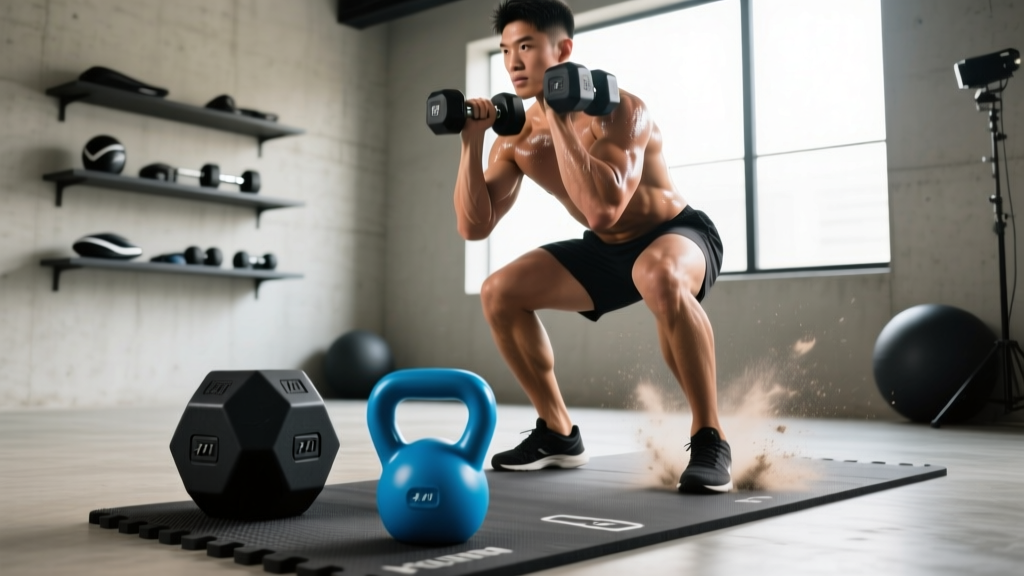
Power Rack vs Squat Stand: Space for Dumbbell Box Step Overs?
Compare power racks, squat racks, and squat stands for your 2026 home gym. Discover which rig leaves room for dumbbell box step overs and functional work.

The Home Gym Spatial Dilemma: Heavy Iron vs. Functional Floor Space
Designing a comprehensive home gym in 2026 requires balancing two competing priorities: the absolute safety needed for heavy barbell compounds and the open floor space required for dynamic, unilateral conditioning. Many lifters blindly purchase the largest, most enclosed power rack they can afford, only to realize their garage is now too cramped for essential athletic movements. If your programming includes dynamic plyometric or unilateral accessory work—specifically dumbbell box step overs—the footprint of your lifting rig becomes just as critical as its weight capacity.
Choosing between a full power rack, a half squat rack, and independent squat stands is not merely a budget decision; it is a spatial geometry problem. In this in-depth buying guide, we break down the structural differences, safety profiles, and exact floor footprints of the market's leading racks to help you build a gym that accommodates both max-effort squats and functional conditioning.
Defining the Big Three: Racks and Stands Explained
Before analyzing floor plans, we must establish the exact definitions of the three primary barbell enclosures, as industry terminology is often misused by big-box retailers.
1. The Power Rack (Full Cage)
A true power rack consists of four (or sometimes six) main uprights connected by top and bottom crossmembers, creating a fully enclosed 'cage.' This design allows for the use of pin-pipe safeties or strap safeties that span the entire width of the rack. Because the barbell is captured within the uprights, a lifter can safely fail a rep without a human spotter. However, this safety comes at the cost of a massive footprint, typically ranging from 48x48 inches to 53x53 inches.
2. The Squat Rack (Half Rack)
Half racks feature two main front uprights where the barbell is j-cupped, supported by a rear frame that usually doubles as weight storage or a pull-up base. They offer a good compromise between safety (using spotter arms that extend forward) and space. The footprint is usually deeper than it is wide, often around 48x30 inches, leaving the sides open but still consuming significant longitudinal floor space.
3. Squat Stands (Independent Uprights)
Squat stands are two completely independent, freestanding uprights with a weighted base. They hold the barbell for squats, bench presses, and overhead presses but offer zero inherent catch mechanisms unless extended spotter arms are attached. Their footprint is incredibly small—often just 24x24 inches per stand—and they can be pushed into a corner or garage track when not in use, entirely freeing up the floor.
The Spatial Analysis: Making Room for Dumbbell Box Step Overs
Why focus on dumbbell box step overs when evaluating rack footprints? Because this specific movement represents the ultimate stress test for home gym spatial planning.
The Biomechanics of Floor Clearance
A standard 20x24-inch plyometric box placed in front of a lifter requires forward clearance. However, a step over requires lateral movement, arm swing with heavy dumbbells (often 40-70 lbs per hand), and deceleration space. To perform dumbbell box step overs safely without striking a rack upright or dropping a dumbbell on a loaded barbell, you need a minimum 6-foot by 6-foot clear zone. If your power rack consumes the center of a standard 10x10 garage gym bay, you are forced to perform conditioning work outside the garage or trip over stored weight plates.
According to facility design guidelines highlighted by Garage Gym Reviews, mapping out your 'active movement zones' before bolting down a rack is the most common mistake home gym owners make. A folding squat stand or a shallow-depth half rack allows you to reclaim that 36-square-foot zone for plyometrics and unilateral work.
2026 Comparison Matrix: Top Models & Specifications
Below is a comparison of three top-tier options across the rack spectrum, reflecting current 2026 pricing, steel gauges, and spatial requirements.
| Model | Type | Footprint (L x W) | Steel / Gauge | Est. Price (2026) |
|---|---|---|---|---|
| Rogue SML-2C Monster Lite | Power Rack | 49" x 49" | 11-Gauge 3x3" | $1,495 |
| REP Fitness PR-4000 | Power Rack | 47" x 47" | 11-Gauge 3x3" | $1,699 |
| Titan Fitness T-2 Series | Power Rack | 48" x 24" (Short) | 14-Gauge 2x2" | $599 |
| Rogue S-2 Squat Stand 2.0 | Squat Stand | 48" x 24" | 11-Gauge 3x3" | $675 |
Breaking Down the Data
- The Short-Depth Hack: The Titan T-2 48x24 power rack is a revelation for tight spaces. By utilizing a 24-inch depth, it encloses the barbell for safety but leaves the rear of the garage open. However, the 14-gauge steel limits heavy attachment use (like lat towers).
- The Premium Stand: The Rogue S-2 Squat Stand utilizes massive 11-gauge steel and a heavy-duty gusseted base. It will not tip during aggressive re-racking, but you must purchase separate spotter arms and accept the inherent risk of missing a rep outside the uprights.
Safety Mechanisms and Failure Modes
When stepping away from a full cage to save space for functional movements, you must understand the failure modes of alternative safety systems.
"The primary risk of independent squat stands is lateral barbell displacement during a failed squat. If the bar rolls forward or backward off the j-cups, independent stands offer no secondary catch net. Pin-pipe safeties on half-racks mitigate this, but only if the lifter fails directly downward or slightly forward."
Spotter Arm Materials: UHMW vs. Bare Metal
If you opt for a half-rack or squat stands with extended spotter arms, ensure the arms feature UHMW (Ultra-High Molecular Weight) plastic lining. In 2026, bare metal spotter arms are unacceptable. Dropping a knurled Olympic barbell onto bare steel spotter arms will destroy the bar's knurling, bend the bar sleeve, and create a jarring acoustic shock that can damage hearing in a closed garage. UHMW plastic absorbs the impact and protects your $300+ barbell.
Hole Spacing and J-Cup Height
For bench pressing inside a shallow rack or on stands, precise j-cup height is vital. Look for racks with Westside hole spacing (1-inch spacing in the bench press zone). Standard 2-inch spacing often forces lifters to choose between a height that is too high (risking shoulder impingement during the un-rack) or too low (making it impossible to clear the uprights).
The Decision Framework: Which Rig Fits Your Garage?
Use this step-by-step framework to finalize your purchase based on your specific training style and spatial constraints.
- Map the Active Zone: Tape out a 6x6 foot square on your garage floor. If this zone overlaps with where your rack must sit to accommodate your car, you must choose folding squat stands or a shallow 24-inch depth rack.
- Audit Your Failure Rate: Do you regularly train to absolute muscular failure on low-bar squats or bench press without a spotter? If yes, abandon squat stands. You need a power rack with strap safeties or a half-rack with wide pin-pipes.
- Check Ceiling Clearance: Standard power racks are 90 inches tall. If your garage ceiling is 8 feet (96 inches), you will not be able to perform strict pull-ups without hitting your head. Look for 80-inch or 84-inch custom height options.
- Factor in Attachment Ecosystems: If you plan to add a cable pulley system, belt squat attachment, or lat tower in the future, you need a 3x3-inch 11-gauge power rack (like the REP PR-4000 or Rogue Monster Lite). Squat stands cannot support these dynamic load attachments.
Frequently Asked Questions
Can I safely do dumbbell box step overs inside a standard power rack?
No. A standard 48x48 inch power rack leaves roughly 24 inches of internal depth once the barbell is sleeved. Dumbbell box step overs require a plyo box, forward stepping clearance, and lateral arm swing. Attempting this inside a cage will result in striking the uprights or dropping dumbbells on the safety straps. Always perform these movements on the open floor outside the rig.
Are folding wall-mounted racks a good alternative to squat stands?
Folding racks (like the Rogue R-3 or PRx Profile) are excellent for saving space when folded flat against the wall. However, when deployed, they still protrude 40+ inches into the room and are bolted to structural studs. They are less flexible than freestanding squat stands if you frequently reconfigure your gym layout for different conditioning circuits.
What is the weight capacity difference between a $600 rack and a $1,500 rack?
While a budget 14-gauge rack might boast a '1,000 lb static capacity,' the real difference lies in lateral stability and fatigue life. An 11-gauge 3x3" rack (like the SML-2C) resists torsional twisting when racking heavy dumbbells or performing kipping pull-ups. Budget racks will sway and eventually warp at the weld joints under dynamic, off-center loading.
More gear to consider
All reviews
Best Hammer Curl Dumbbells: Rubber Hex vs Urethane

2026 Adjustable Dumbbell Comparison: Top Picks for the Close Grip Dumbbell Press
2026 Budget: Bumper vs Iron Plates & Dumbbell Lateral Raises

Top Adjustable Dumbbells for a Quad Workout With Dumbbells: Setup

Smart Dumbbell Rack Storage & the Best Calf Exercise with Dumbbells