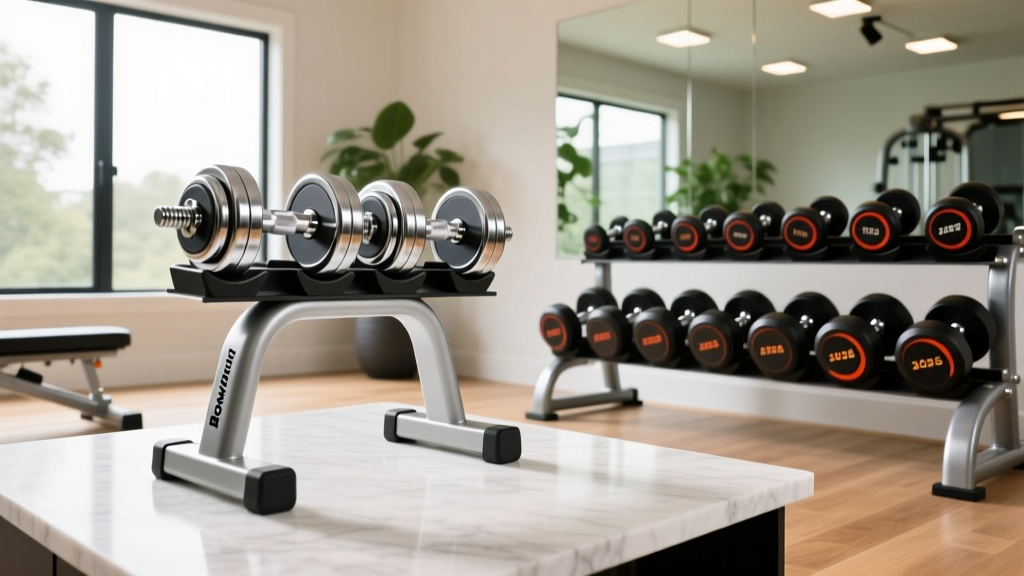
Power Rack vs Squat Rack vs Stand: Standing Chest Press with Dumbbells
Compare power racks, squat racks, and squat stands. A step-by-step guide to choosing the right setup for heavy lifts and standing dumbbell chest presses.

The Home Gym Foundation: Choosing Your Rack
Building a home gym in 2026 requires making critical decisions about your foundational equipment. The centerpiece of any serious free-weight setup is the rack. However, beginners often find themselves paralyzed by the differences between a full power rack, a half squat rack, and a minimalist squat stand. Your choice dictates not only your safety during heavy barbell squats but also your spatial freedom for functional movements.
One common point of confusion is how these structures accommodate upper-body functional work. For instance, programming a standing chest press with dumbbells requires specific spatial clearances, storage solutions, and stabilization parameters that vary wildly depending on the rack you choose. This step-by-step guide will break down the structural differences, spatial requirements, and exact 2026 pricing to help you make an informed, expert-level decision.
Beginner's Rule of Thumb: If you plan to lift heavy barbells alone without a spotter, a fully enclosed power rack with safety straps or spotter arms is the only 100% safe option. Squat stands and open half-racks require strict discipline and proper spotter arm deployment to prevent catastrophic failure.Power Rack vs. Squat Rack vs. Squat Stand: The Core Differences
Before measuring your space, you must understand the architectural distinctions between the 'Big Three' rack categories. Each serves a distinct demographic of lifters.
- Power Rack (Full Cage): Features four main uprights connected by a top frame. It creates an enclosed 'cage' that allows you to fail safely on squats and bench presses inside the structure.
- Squat Rack (Half Rack): Typically features two main front uprights and two rear uprights (often used for weight storage). It offers an open front for easy barbell entry but requires extended spotter arms for safety.
- Squat Stand: Consists of only two independent uprights. It is the most space-efficient and budget-friendly option but offers zero inherent lateral stability unless bolted to a platform.
2026 Equipment Comparison Matrix
| Feature | Power Rack (e.g., Titan T-3) | Half Squat Rack (e.g., Rogue SML-2C) | Squat Stand (e.g., Titan X-2) |
|---|---|---|---|
| Average Footprint | 48' x 48' (or 36' x 48') | 49' x 34' (plus 42' spotter arms) | 49' x 24' (plus 24' spotter arms) |
| Safety for Solo Lifting | Excellent (Enclosed) | Very Good (with long arms) | Fair (Requires bolting) |
| Standing Exercise Clearance | Restricted (Inside cage) | Open (Front of rack) | Unrestricted (Anywhere) |
| Approximate 2026 Cost | $650 - $1,200 | $500 - $850 | $250 - $450 |
Step-by-Step: Evaluating Your Space and Needs
Choosing the right rack is not just about budget; it is a spatial puzzle. Follow this sequential framework to determine which setup fits your training environment.
Step 1: Map Your Ceiling and Depth Clearance
Measure your ceiling height. Standard power racks are 82 to 90 inches tall. If you have an 8-foot (96-inch) ceiling, you cannot do overhead presses inside a 90-inch rack. Next, measure floor depth. A squat stand requires only 24 inches of depth against the wall, making it ideal for cramped apartments or garage corners. A full power rack demands a minimum of 48 inches of depth to allow for proper barbell travel and user movement.
Step 2: Assess Your Anchoring Capabilities
Squat stands have a high center of gravity. If a lifter reracks a heavy barbell slightly off-center, the stand can tip. According to guidelines from the National Strength and Conditioning Association (NSCA), freestanding minimalist racks must be bolted to a structural floor or a heavily weighted lifting platform to ensure safety. If you cannot drill into concrete or build a bolted platform, eliminate squat stands from your list and opt for a 4-post power rack.
Biomechanics and Space: The Standing Chest Press with Dumbbells
Why integrate a standing chest press with dumbbells into your routine instead of simply lying on a flat bench? The answer lies in kinetic chain integration. Research indexed by the National Library of Medicine consistently demonstrates that standing resistance exercises demand significantly higher core stabilization and anti-extension torque from the rectus abdominis compared to supine (lying) variations.
'The standing chest press with dumbbells bridges the gap between raw upper-body pushing power and functional core stability. It forces the athlete to generate force from the ground up, mimicking real-world pushing mechanics far better than a supported bench press.'
How Your Rack Choice Impacts This Movement
While you do not 'rack' the dumbbells on the safety pins during this exercise, your equipment choice heavily influences the execution of the standing chest press with dumbbells in three distinct ways:
- Spatial Restriction (The Cage Effect): If you attempt to perform a standing chest press with dumbbells inside a standard 43-inch deep power rack, your elbows will likely strike the rear uprights during the eccentric (lowering) phase of the movement. To fix this, you must either step entirely outside the power rack or invest in a specialized 24-inch shallow power rack, which sacrifices barbell squat safety.
- Accommodating Resistance Integration: Advanced lifters often attach heavy resistance bands to the base cross-members of a power rack or squat stand. By wrapping the other end of the band around the dumbbells, you add accommodating resistance to the standing chest press, making the lockout exponentially harder. Squat stands with wide, flat base feet are excellent anchor points for these bands.
- Heavy Dumbbell Retrieval: Picking up 80-pound dumbbells from the floor to initiate a standing press places immense shear force on the lumbar spine. Half-racks (like the Rogue Monster Lite series) often feature integrated rear weight storage horns. This allows you to clean the dumbbells from an elevated rack position directly into the standing press stance, preserving your lower back for heavy squats later in the session.
2026 Buyer's Framework: Exact Models and Pricing
To ground this guide in reality, here are three top-tier recommendations based on current 2026 market pricing and structural integrity.
1. The Power Rack Pick: Titan Fitness T-3 Series ($699)
The T-3 features 3x3 inch 11-gauge steel uprights and Westside hole spacing through the bench zone. It is heavy, incredibly stable without bolting, and features a 43-inch interior depth. Verdict: Best for dedicated garage gyms with ample space where heavy barbell lifting is the primary focus, and standing dumbbell work will be performed outside the cage.
2. The Half Rack Pick: Rogue Fitness SML-2C Monster Lite ($545)
This rack offers an open front profile, making it exceptionally easy to step in and out of for functional movements like the standing chest press with dumbbells. The optional storage crossmember allows for seamless dumbbell retrieval. Verdict: The ultimate hybrid for athletes who mix heavy barbell work with high-volume functional dumbbell training.
3. The Squat Stand Pick: Titan Fitness X-2 Series ($299)
With a minimal footprint and adjustable height uprights, the X-2 is perfect for low-ceiling basements. However, you must purchase the bolt-down bracket kit ($45) if you plan to use spotter arms for bench pressing. Verdict: Ideal for apartment dwellers and budget-conscious beginners who primarily use dumbbells and require maximum open floor space.
Frequently Asked Questions
Can I use a squat stand for dumbbell exercises safely?
Yes. Squat stands are perfectly safe for dumbbell exercises like lunges, step-ups, and standing presses, provided you are not aggressively dropping heavy weights onto the spotter arms, which could tip the unanchored uprights.
What is the best ceiling height for a home gym rack?
A minimum of 8 feet (96 inches) is recommended. This allows for an 82-inch rack, a standard barbell resting on top, and enough clearance to load plates without scraping the ceiling drywall.
Do I need a power rack if I only use dumbbells?
If you exclusively use dumbbells, a power rack is overkill. A simple adjustable bench and a set of adjustable dumbbells or a tiered dumbbell rack will serve you better and save significant floor space and budget.
More gear to consider
All reviews
Bumper vs Iron Plate Comparison: Beyond Standard Dumbbell Weights
EZ Curl Bar vs Straight Bar: Beyond Types of Dumbbell Exercises

Neutral Grip Dumbbell Press Muscles Worked: 2026 Rack Trends
Olympic Barbell Knurling & Weight Guide: Dumbbell Box Setups

Cast Iron vs Competition Kettlebells Over an Aesthetic Dumbbell Set