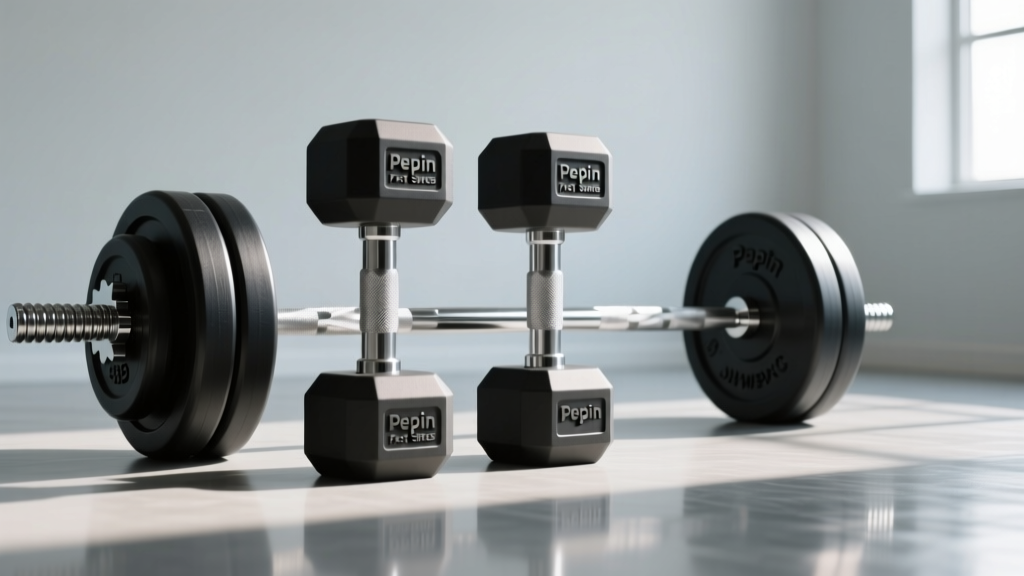
Pepin Fast Series Dumbbells vs Olympic Barbell Weight & Knurl Guide
Compare Pepin Fast Series Dumbbells with top Olympic barbells. Explore our guide on barbell weight tolerances, knurling patterns, and free weight choices.

Building a comprehensive home gym in 2026 often begins with space-saving, highly efficient adjustable weights. For many lifters, the Pepin Fast Series Dumbbells serve as the ultimate entry point, offering a rapid dial-adjust mechanism, a durable urethane casing, and a compact footprint that replaces an entire rack of traditional hex dumbbells. Priced competitively at around $389 for a 5-to-50-pound set, the Pepin Fast Series excels at unilateral movements, isolation work, and high-intensity metabolic conditioning. However, as your central nervous system adapts and your strength outpaces the 50-pound per-hand limit, the biological necessity for heavy, bilateral compound lifting becomes undeniable. This is the exact juncture where you must transition from adjustable dumbbells to a dedicated Olympic barbell setup.
Unlike the standardized, mildly textured 35mm handles found on the Pepin Fast Series Dumbbells, selecting an Olympic barbell requires a deep, technical understanding of metallurgy, weight calibration, and knurling geometry. A barbell is not just a long dumbbell; it is a precision-engineered torsion spring that interacts directly with your skin, joints, and biomechanics. In this comprehensive guide, we bridge the gap between your existing free weight arsenal and the complex world of Olympic barbell buying, focusing heavily on the two most critical factors: weight tolerance and knurling patterns.
The Calibration Imperative: Why Barbell Weight Accuracy Matters
When you load a pair of 50-pound Pepin Fast Series Dumbbells, you trust the internal magnetic dial to deliver exactly what the window displays. But what happens when you slide 45-pound cast-iron plates onto a 7-foot steel shaft? The accuracy of that barbell's base weight is paramount, especially for competitive powerlifters and Olympic weightlifters tracking micro-progressions over a multi-year training cycle.
According to the technical rulebooks published by the International Weightlifting Federation, a certified 20-kilogram (44.09 lbs) men's Olympic barbell must adhere to incredibly strict weight tolerances. Calibrated competition bars must weigh between 19.98 kg and 20.02 kg—a mere 15-gram variance. In contrast, budget-friendly commercial bars often carry a tolerance of +/- 5%, meaning a cheap 45-pound bar could actually weigh anywhere from 42.5 to 47.5 pounds. Over a 5-set volume block of squats, this uncalibrated discrepancy can severely skew your rate of perceived exertion (RPE) and disrupt progressive overload algorithms.
Expert Insight: If you are investing in a premium barbell in 2026, never settle for standard commercial tolerances. Look for manufacturers that explicitly state a +/- 15-gram or +/- 0.1% weight tolerance. Brands like Eleiko, Rogue, and American Barbell machine their shafts from high-grade steel alloys to ensure absolute baseline accuracy.
Decoding Knurling Geometry: Hill, Mountain, and Volcano
The most visceral difference between your Pepin Fast Series Dumbbells and a high-end Olympic barbell is the knurling. Dumbbell handles typically feature a shallow, passive knurl designed to accommodate high-repetition lateral raises and presses without tearing the calluses on your palms. Barbell knurling, however, is engineered to lock a 300-pound deadlift into your central nervous system without the bar slipping from your grip.
Knurling is created on a lathe, where cutting tools carve intersecting diagonal grooves into the steel shaft. The shape of the resulting "peaks" dictates the aggressiveness of the grip. As noted in extensive biomechanical testing by researchers at Stronger By Science, the geometry of these peaks directly influences skin displacement and shear force during heavy axial loading.
1. The Hill Pattern (Passive)
Hill knurling features rounded, flattened peaks. It feels relatively smooth in the hands and is predominantly found on Olympic weightlifting bars (like the Eleiko Olympic WL Bar). The passive nature allows lifters to comfortably execute high-velocity movements like the snatch and clean-and-jerk, where the bar must rapidly rotate and slide against the collarbone and thighs without causing severe lacerations.
2. The Mountain Pattern (Aggressive)
Mountain knurling leaves the peaks sharp and unflattened. The legendary Texas Power Bar is the quintessential example. This pattern acts like a cheese grater, biting deeply into the skin to provide maximum friction. It is ideal for low-rep, maximal-effort powerlifting movements (squats and deadlifts), but it will quickly destroy your hands if used for high-volume hypertrophy work.
3. The Volcano Pattern (The Gold Standard)
Volcano knurling represents the pinnacle of modern barbell engineering. The lathe tool cuts a deep valley but leaves the rim of the peak intact, creating a microscopic crater that resembles a volcano. This design provides immense surface area for friction without the sharp, skin-tearing points of a mountain pattern. The Rogue Ohio Power Bar utilizes a highly refined volcano knurl that grips like sandpaper but remains forgiving enough for daily training.
Knurling Comparison Matrix
| Knurl Type | Peak Geometry | Aggressiveness | Ideal Use Case | Notable 2026 Models |
|---|---|---|---|---|
| Hill | Rounded, Flat | Low / Passive | Olympic Lifts, High-Rep Work | Eleiko Olympic WL |
| Mountain | Sharp, Pointed | High / Severe | Heavy Deadlifts, Low-Rep Squats | Texas Power Bar |
| Volcano | Deep Rim, Cratered | Medium-High | Powerbuilding, Daily Compounds | Rogue Ohio Power Bar |
Grip Mechanics: Dumbbell Isolation vs. Barbell Tension
Why does knurling matter so much when transitioning from the Pepin Fast Series Dumbbells? The answer lies in grip mechanics and center-of-mass distribution. When holding a 50-pound Pepin dumbbell for a chest press, the load is localized to one side of your body. The 35mm handle diameter requires a wide grip, and the mild texture is sufficient because the rotational torque on the wrist is relatively low.
Conversely, when you unrack a 315-pound barbell for a back squat, the load is distributed across your cervical spine and trapezius. Your hands are not lifting the weight; they are creating upper back tension by pulling the bar down into your traps. A sharp volcano or mountain knurl bites into the skin of your palms and fingers, creating a tactile anchor that prevents the bar from rolling up your neck during the descent. Furthermore, the standard 28mm to 29mm shaft diameter of an Olympic barbell allows for a secure hook grip during deadlifts—a biomechanical lock that is virtually impossible to replicate on the thicker, smoother handles of most adjustable dumbbells.
The Center Knurl Debate
If you are buying a barbell strictly for bench pressing and deadlifting, you may want to skip the center knurl to avoid scraping your chest during the bench press. However, if squats are a priority, a center knurl is mandatory. Look for bars with a striated center knurl—it provides just enough friction to grip your t-shirt without acting like a belt sander against your bare skin during front squats or cleans.
Whip, Tensile Strength, and the Spin Factor
Another critical divergence between dumbbells and barbells is whip—the elastic deformation of the steel shaft under heavy loads. Tensile strength is measured in Pounds per Square Inch (PSI) and dictates both the bar's durability and its whip.
- 190,000 PSI: Common in Olympic weightlifting bars. The lower tensile strength allows the bar to bend and "whip" upward, aiding the lifter during the second pull of a clean.
- 205,000 PSI: The sweet spot for powerlifting and general strength. It offers enough rigidity to prevent dangerous oscillations during heavy bench presses, but enough flex to absorb shock during heavy squats.
- 215,000+ PSI: Found in elite, specialized deadlift bars. These bars are incredibly stiff or highly specialized to whip in a specific cadence off the floor.
Additionally, the sleeve construction (bushings vs. needle bearings) affects how fast the sleeves spin. While the Pepin Fast Series Dumbbells have zero rotational mechanics, an Olympic barbell relies on bronze bushings (for slow, controlled powerlifting spins) or needle bearings (for rapid, high-velocity Olympic lifting spins) to protect your wrists from rotational shear forces.
Maintenance: Preserving the Knurl in 2026
A common failure mode for home gym owners is allowing chalk, dead skin, and humidity to clog the valleys of a volcano knurl, effectively turning a $400 barbell into a smooth, slippery pipe. According to equipment maintenance guidelines highlighted by Garage Gym Reviews, a strict monthly cleaning protocol is non-negotiable.
- Dry Brush: Use a stiff nylon brush (never wire, which damages zinc and cerakote finishes) to aggressively scrub the knurling in a circular motion, dislodging compacted chalk.
- Oil Application: Apply a light coat of 3-in-One oil or mineral oil directly to the nylon brush, not the bar. Scrub the shaft to create a micro-emulsion that lifts microscopic rust and skin oils.
- Wipe Down: Use a clean microfiber cloth to wipe the bar completely dry. The shaft should feel tacky and sharp, not greasy.
Frequently Asked Questions
Can I use my Pepin Fast Series Dumbbells for heavy progressive overload?
The Pepin Fast Series Dumbbells max out at 50 pounds per hand. While excellent for hypertrophy, lateral raises, and metabolic conditioning, they cannot replicate the systemic, central nervous system overload provided by a 300+ pound barbell deadlift or squat. You need both tools for a complete 2026 training regimen.
Is a stainless steel barbell worth the extra cost?
Yes. Bare steel rusts quickly, and zinc coatings eventually wear off, altering the feel of the knurl. Stainless steel (like the Rogue Ohio Power Bar Stainless) offers the exact same tactile feel as bare steel but is virtually impervious to oxidation, ensuring your volcano knurl remains sharp for decades.
What diameter barbell should I buy if I have small hands?
If you have smaller hands, avoid 29mm+ power bars. Opt for a 28mm Olympic weightlifting bar or a specialized 25mm women's Olympic bar. The thinner shaft allows for a secure hook grip and reduces forearm fatigue during high-volume pulling movements.
More gear to consider
All reviews
Rubber Hex vs Urethane: Care for a Dumbbell Chest Workout for Size

The Complete Home Gym Setup Guide for Dumbbell Lat Pulls

What Do Dumbbell Bench Presses Work? Troubleshooting & Olympic Bar Guide
Beginner Dumbbell Overhead Press Workout Using Neoprene Weights
Bumper Plate vs Iron Plate Layouts & Pool Dumbbells Exercises Zones
