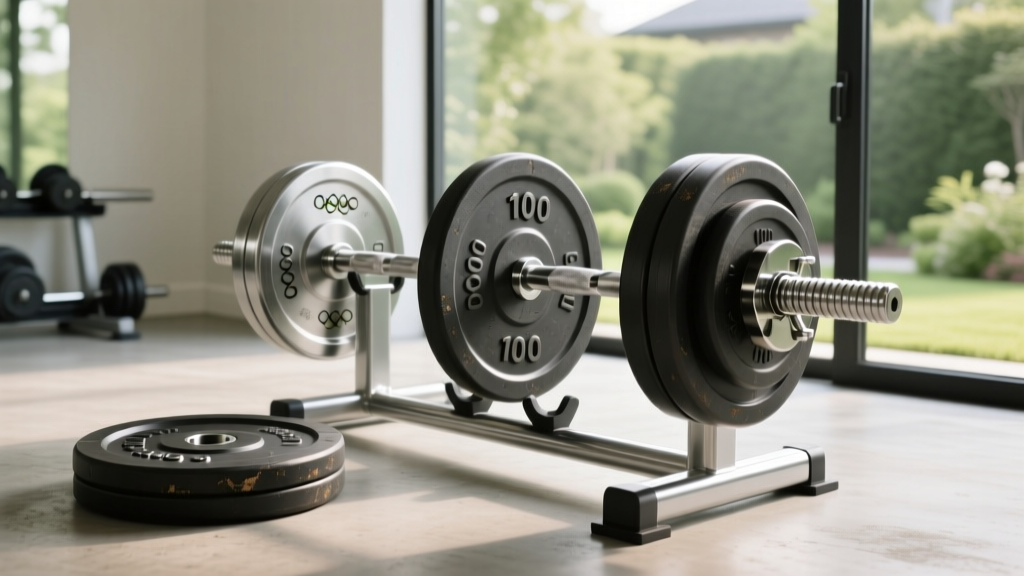
Olympic vs Standard Plates for Your 100 Pound Dumbbell Press
Discover why Olympic weight plates outperform standard plates for heavy lifters aiming for a 100 pound dumbbell press. Compare specs, costs, and safety.

The Heavy Lifter's Dilemma: Fixed vs. Plate-Loaded
Hitting a 100 pound dumbbell press is a landmark achievement in upper-body strength. It requires immense pectoral development, anterior deltoid power, and triceps stability. However, for home gym owners and garage lifters, reaching this milestone presents a massive logistical and financial hurdle. Purchasing a single pair of fixed 100 lb hex or urethane dumbbells can cost upwards of $600 to $800, and they occupy a disproportionate amount of floor space.
The logical alternative is a plate-loaded dumbbell system. But this immediately forces a critical equipment decision: do you build your ecosystem around standard weight plates (1-inch center holes) or Olympic weight plates (2-inch center holes)? While standard plates are cheaper upfront, they possess severe engineering limitations when subjected to the extreme cantilever forces of heavy dumbbell pressing. In this head-to-head comparison, we break down the metallurgy, biomechanics, and real-world costs of both ecosystems to determine which is actually capable of supporting a safe, effective 100 pound dumbbell press.
Olympic vs Standard Weight Plates: Core Specifications
Before analyzing the dumbbell handles themselves, we must understand the foundational differences between the plates they accept. According to comprehensive equipment guides from BarBend, the distinction goes far beyond mere hole diameter; it encompasses weight tolerance, material density, and drop-rating.
| Feature | Standard Plates (1-Inch) | Olympic Plates (2-Inch) |
|---|---|---|
| Center Hole Diameter | 1 inch (25.4 mm) | 2 inches (50.4 mm) |
| Material | Cast iron, cement-filled plastic | Cast iron, forged steel, virgin rubber |
| Weight Accuracy | +/- 5% to 10% variance | +/- 1% (Calibrated) to 3% |
| Plate Profile (Thickness) | Thick, wide outer flanges | Compact, high-density machining |
| Max Safe Load per Handle | ~50 - 65 lbs (Structural limit) | 150+ lbs (Depends on sleeve length) |
Head-to-Head: Engineering the 100 Pound Dumbbell Press
When you press 100 lbs per hand, the dumbbell handle acts as a lever. The torque applied to the center of the bar during the eccentric (lowering) phase and the stabilization phase at the bottom of the movement is extreme. Let us compare how both systems handle this stress.
The Standard Plate Ecosystem (1-Inch)
The standard 14-inch threaded dumbbell handle (such as the ubiquitous CAP Barbell models found in big-box sporting goods stores) features a 1-inch diameter cold-rolled steel shaft. The loadable sleeve space is typically around 4 inches.
To load a standard handle to 100 lbs, you would need to slide on multiple thick cast-iron plates (e.g., four 25-lb plates). Here is where the system experiences catastrophic failure:
- Sleeve Space Deficit: Standard 1-inch cast iron plates are incredibly thick. Four 25-lb plates will physically exceed the 4-inch sleeve length, leaving no room for the spin-lock collar.
- Yield Strength Failure: Even if you use thinner 10-lb plates to make the math work, the 1-inch solid steel shaft lacks the tensile strength to support 100 lbs of off-center weight. Under the dynamic load of a press, the bar will permanently bend, rendering the spin-lock collars useless and creating a severe safety hazard over your face and chest.
The Olympic Plate Ecosystem (2-Inch)
Olympic plate-loaded dumbbell handles—such as the Rogue Fitness Loadable Dumbbell Handles or the Titan Fitness Loadable Dumbbells—are machined from high-strength alloy steel, often boasting a tensile strength of 190,000 PSI or higher. They feature a 2-inch sleeve diameter designed to accept Olympic plates.
Let us run the math on loading a Rogue Loadable Handle (which weighs roughly 5 lbs and features a 5.25-inch loadable sleeve) to 100 lbs:
- Start with two Rogue Machined Olympic Steel Plates (45 lbs each). Because they are machined steel, each plate is only 1.15 inches thick.
- Add one 5 lb Machined Steel Plate (0.5 inches thick).
- Total plate weight: 95 lbs. Total thickness: 2.8 inches.
This leaves over 2 inches of sleeve space remaining for a secure spring or clamp collar. Furthermore, premium Olympic loadable handles feature rotating sleeves or deep knurling that accommodates the wider grip required to stabilize a 100 lb mass, drastically reducing wrist torque.
The Physics of Clearance: Plate Diameter vs. Range of Motion
Biomechanics play a massive role in heavy dumbbell pressing. As noted in the exercise analysis by ExRx.net, the dumbbell bench press requires a deep stretch and a converging arc at the top of the movement to fully shorten the pectoralis major.
'The converging nature of the dumbbell press allows for a greater range of motion and peak contraction compared to a fixed barbell, but it demands strict bilateral stabilization and adequate spatial clearance between the implements.'
When you use standard 1-inch plates, the outer diameter of even a 10 lb plate is quite wide, and the flanges (the raised edges around the center hole) add unnecessary bulk. If you somehow managed to load 100 lbs using standard plates, the wide profiles would clank together at the top of the press, prematurely stopping your range of motion and robbing you of the peak contraction.
Conversely, Olympic calibrated steel plates or high-density urethane Olympic plates have a narrow, uniform profile. You can load 100 lbs onto an Olympic handle, and the plates will sit flush against one another, allowing the dumbbells to touch smoothly at the apex of the press without jarring your wrists.
Biomechanics of the Heavy Kick-Up
Getting a pair of 100 lb plate-loaded dumbbells into the starting position is a lift in itself. According to hypertrophy and strength mechanics discussed by Stronger By Science, the setup phase of a heavy dumbbell press dictates the stability of the entire set.
With standard handles, the short overall length (14 inches) means the weight sits dangerously close to your wrists and forearms, making the thigh-kick technique awkward and prone to tearing the biceps tendon. Olympic loadable handles are generally 15.5 to 17 inches in total length. This extra real estate allows you to rest the heavy plates securely on your distal quadriceps, execute a controlled hip-kick, and safely guide the 100 lb masses into the slot without compromising your rotator cuffs.
Cost Breakdown: Building the 100 lb Setup in 2026
Let us look at the financial reality of building a 100 lb per hand setup (requiring a pair of handles and roughly 200 lbs of total plate weight, assuming you start with the handles empty).
| Equipment Type | Estimated Cost (Handles) | Estimated Cost (Plates) | Total Investment |
|---|---|---|---|
| Fixed Hex Dumbbells (Pair) | N/A | N/A | $600 - $850 |
| Standard 1' Setup | $40 (Pair of 14' handles) | $150 (200 lbs cast iron) | $190 (But fails at 100 lbs) |
| Olympic 2' Setup | $150 - $220 (Pair of loadable handles) | $300 - $450 (200 lbs steel/rubber) | $450 - $670 |
While the Olympic setup requires a higher initial investment than standard gear, it is significantly cheaper than buying fixed 100 lb dumbbells. More importantly, the Olympic plates you purchase can be transferred to a barbell for deadlifts and squats, making it a versatile, multi-purpose investment for your home gym.
Final Verdict: Which Ecosystem Wins?
When it comes to achieving a heavy, safe, and biomechanically sound 100 pound dumbbell press, the Olympic weight plate ecosystem wins by a landslide. Standard 1-inch plates and their corresponding handles simply lack the metallurgical yield strength, sleeve length, and spatial efficiency required for extreme loads. Attempting to press 100 lbs on standard gear is a fast track to bent bars, stripped threads, and potential chest injuries.
Invest in a high-quality pair of 2-inch Olympic loadable dumbbell handles from a reputable manufacturer like Rogue or Titan Fitness. Pair them with machined steel or high-density urethane Olympic plates to ensure a compact profile that allows for a full range of motion. This setup not only gets you to the 100 lb milestone safely but provides a scalable, durable foundation for your strength journey for years to come.
More gear to consider
All reviews
What Do Dumbbell Presses Work? 2026 Adjustable Dumbbell Setup & Review

Is Cable Lateral Raise Better Than Dumbbell? Loadable Dumbbell Guide

Power Rack vs Squat Rack & Dumbbell to Barbell Converter Calculator
Best Bowflex Dumbbells Rack & Storage Solutions for 2026

Best Dumbbell Racks of 2026: Storing Your Lying Leg Curl Dumbbell
