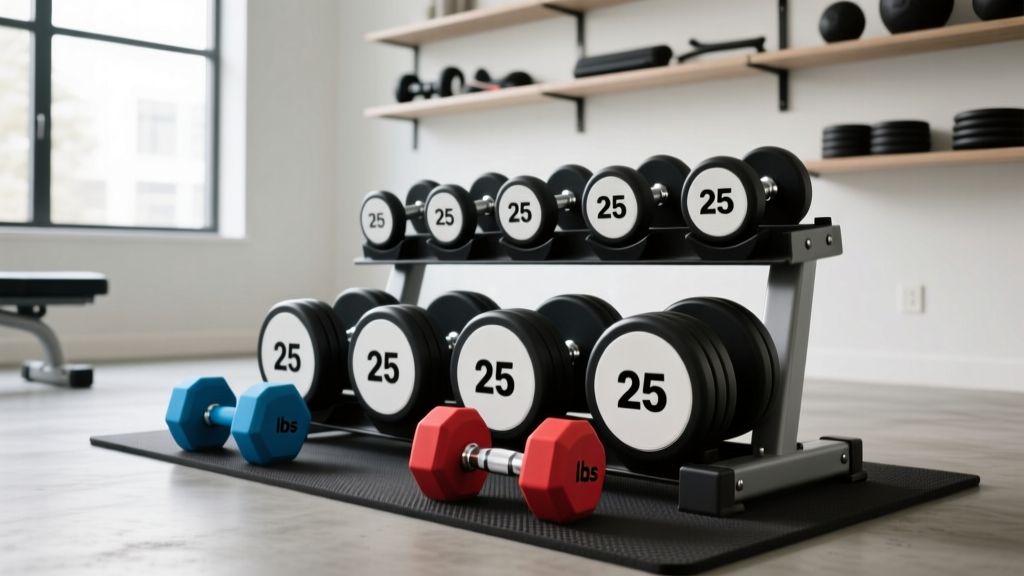
Olympic vs Standard Plates Setup & Dumbbell Training Program PDF
Master your home gym setup with our Olympic vs standard plates installation guide, plus tips to integrate a dumbbell training program PDF.

Architecting the Free Weight Zone: The Arbor Divide
When planning a comprehensive home gym installation in 2026, the foundational decision that dictates your entire equipment ecosystem is the choice between Olympic and standard weight plates. This isn't merely a matter of aesthetics; it is a strict compatibility issue rooted in arbor (center hole) dimensions. According to the International Weightlifting Federation (IWF) Technical Rules, Olympic plates must feature a 50.6mm (2-inch) center hole, designed to sleeve perfectly onto Olympic barbell ends. Standard plates, conversely, utilize a 25.4mm (1-inch) arbor, meant for lighter-duty, solid-steel or hollow-tube bars.
Choosing the wrong ecosystem during your initial setup walkthrough will result in severe compatibility bottlenecks, limiting your progressive overload potential and creating long-term safety hazards. Below is a complete setup, installation, and programming walkthrough to ensure your free weight zone is built for longevity and performance.
Ecosystem Comparison Matrix
| Feature | Olympic Ecosystem (2-Inch) | Standard Ecosystem (1-Inch) |
|---|---|---|
| Arbor Size | 50.6mm (Precision machined) | 25.4mm (Often cast with high variance) |
| Barbell Yield Strength | 190k - 215k PSI (Supports 500-1500 lbs) | Low Carbon Steel (Bends permanently at 200-250 lbs) |
| 2026 Avg. Cost (Cast Iron) | $1.50 - $2.20 per lb | $0.90 - $1.30 per lb |
| Plate Accuracy | +/- 1% to 2% (Calibrated bumpers) | +/- 10% to 15% variance on cheaper imports |
| Primary Failure Mode | Bumper rubber degradation, hub insert loosening | Arbor hole elongation, barbell sleeve scoring |
Step-by-Step Installation: Racks and Weight Trees
Proper installation of your storage and racking hardware is critical for safety and spatial efficiency. Here is the walkthrough for securing a standard 6-post power rack (e.g., Titan T-3 or Rogue SML-2) and an adjacent A-frame weight tree.
- Floor Preparation: Lay down 3/4-inch vulcanized horse stall mats. Do not install racks directly on 8mm interlocking foam tiles; they compress under point loads, causing rack instability and misaligned safety spotter arms.
- Anchor Drilling: If bolting down, use a 1/2-inch masonry bit to drill 4-inch deep holes into concrete. Insert 1/2-inch x 3-3/4-inch wedge anchors. Torque to 60 ft-lbs using a calibrated torque wrench.
- Weight Tree Assembly: Assemble the A-frame tree before loading plates. Tighten the central tension rod to 45 ft-lbs to prevent the frame from racking (twisting) when loaded asymmetrically with 45lb plates.
- Clearance Mapping: Ensure a minimum 36-inch walkway between the loaded weight tree and the power rack uprights to prevent knuckle scraping when loading the barbell.
Plate Storage Physics & Weight Tree Loading Limits
Weight trees are often the most abused equipment in a home gym. A standard 10-peg A-frame tree is typically rated for 500 to 800 lbs total. However, the failure point is rarely the steel pegs; it is the weld at the base plate. When installing your tree, you must understand load distribution. Always store 45lb and 35lb Olympic plates on the bottom-most pegs. Placing heavy bumpers on the top pegs raises the center of gravity, creating a tipping hazard if the tree is not bolted to the floor or if a user aggressively yanks a plate off the top rack.
Furthermore, standard 1-inch weight trees suffer from 'peg droop' over time. The continuous shear stress of cast iron plates causes the unpinned pegs to bend downward at a 15-degree angle within 18 months of heavy use. Olympic trees utilize pegs with internal support struts or solid 2-inch steel tubing, completely mitigating this shear failure.
2026 Market Realities: Sourcing Your Iron
As of early 2026, the fitness equipment supply chain has fully normalized, but raw material costs dictate new pricing tiers. Standard 1-inch cast iron plates are increasingly difficult to source from premium manufacturers, as the industry has almost entirely pivoted to the 2-inch Olympic standard for serious lifters. You will primarily find standard plates bundled with budget hollow-bar kits at big-box retailers. These kits typically cost around $150 for a 110lb set but represent a false economy due to the aforementioned bar-bending risks and rapid enamel chipping.
Conversely, the Olympic ecosystem offers immense modularity. You can start with basic cast iron (averaging $1.60/lb from direct-import brands) and gradually upgrade to competition-grade urethane or crumb-rubber bumpers ($3.50/lb+) as your training demands require dropped weights. This modularity is impossible in the standard ecosystem, which lacks bumper plate variations entirely.
Expanding the Setup: The Dumbbell Zone & Programming
A complete free weight installation extends beyond the barbell. The dumbbell zone requires a dedicated 6x6 foot clearance area to accommodate lateral lunges, Bulgarian split squats, and chest flies without striking the power rack. For 2026 home gyms, adjustable models like the Nuobell 80lb or PowerBlock Elite offer space-saving alternatives to full hex dumbbell racks, keeping the floor plan open for dynamic movements.
Integrating a Dumbbell Training Program PDF
Once your physical equipment is installed and calibrated, the focus shifts to periodization. Heavy Olympic barbell cycles tax the central nervous system (CNS) heavily. To manage fatigue while maintaining hypertrophy, elite coaches frequently recommend alternating blocks. This is where downloading and implementing a structured dumbbell training program pdf becomes a strategic asset. By following a pre-written PDF program, you can execute 4-week unilateral hypertrophy blocks that correct left-to-right strength deficits without overloading the spine.
'Unilateral dumbbell work reduces spinal compression forces by up to 60% compared to bilateral barbell movements, making it an ideal active-recovery or deload phase modality,' notes the National Strength and Conditioning Association (NSCA).
When utilizing your dumbbell training program pdf, track your progressive overload meticulously. If the PDF prescribes 3 sets of 10-12 reps for DB Romanian Deadlifts, use your adjustable dumbbells to micro-load in 2.5lb increments, ensuring continuous adaptation without needing to purchase an entire rack of fixed-weight iron.
Final Walkthrough Checklist
- Hardware Audit: Verify all rack bolts and tree tension rods are torqued to manufacturer specs.
- Plate Inspection: Check Olympic bumper plates for hub insert play; tap with a rubber mallet to ensure they seat flush.
- Zone Demarcation: Use gym floor tape to outline the 36-inch safety perimeter around the power rack and weight tree.
- Programming Sync: Load your dumbbell training program pdf onto a tablet or magnetic rack-mount phone holder for seamless tracking during accessory blocks.
By respecting the engineering differences between Olympic and standard plates, properly anchoring your storage solutions, and intelligently integrating dumbbell programming, your home gym will be engineered for decades of safe, progressive overload.
More gear to consider
All reviews
Best Adjustable Dumbbells for the 2 Arm Dumbbell Row (2026)

Setup Guide: Lat Muscle Dumbbell Workout With Neoprene Weights

Beginner Dumbbell Shoulder Press Workout Using Neoprene Weights

One Arm Dumbbell Thrusters Setup: Neoprene Home Gym Guide
Home Gym Setup for Incline Alternating Dumbbell Curls with Neoprene Weights