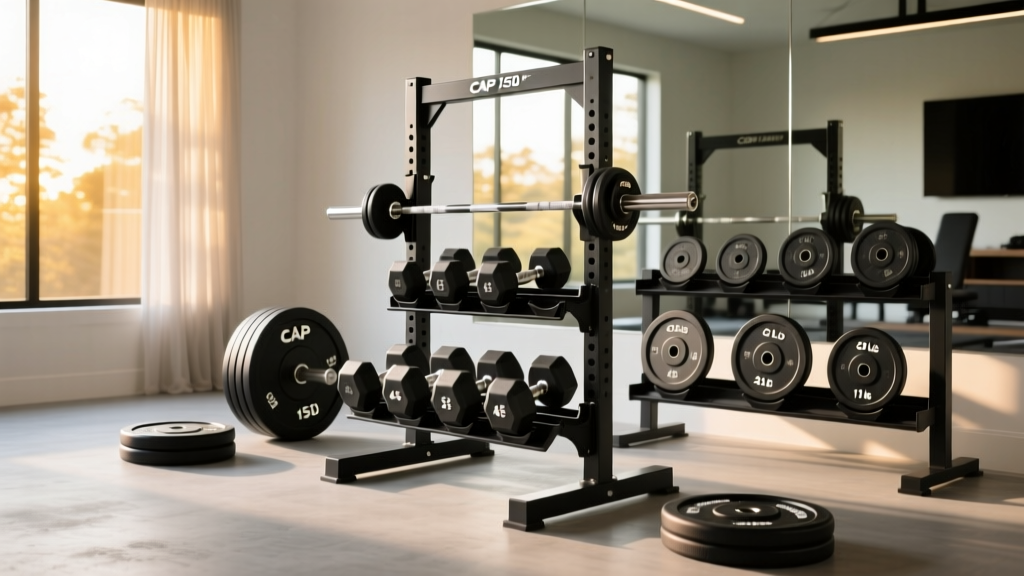
Olympic vs Standard Plates & CAP 150 lb Dumbbell Set with Rack Guide
Build your 2026 home gym with our step-by-step guide comparing Olympic vs standard plates and reviewing the CAP 150 lb dumbbell set with rack.

The 2026 Home Gym Blueprint: Navigating Free Weight Ecosystems
Building a home gym from scratch is one of the most rewarding investments you can make for your long-term health. However, beginners often hit a wall when confronted with the fragmented world of free weight sizing. The two most critical decisions you will make involve your barbell plate ecosystem (Olympic vs. standard) and your unilateral accessory station (specifically, integrating a reliable fixed-weight setup like the CAP 150 lb dumbbell set with rack). This step-by-step guide will walk you through the metallurgy, spatial requirements, and budget allocations necessary to build a safe, scalable, and highly functional home gym in 2026.
According to the CDC Physical Activity Guidelines, adults should engage in muscle-strengthening activities of moderate or greater intensity that involve all major muscle groups on 2 or more days a week. Having a properly configured home gym removes the friction of commuting, ensuring you hit these vital health markers consistently.
Step 1: Decode the Barbell Plate Divide (Olympic vs. Standard)
Before you purchase a single iron plate, you must choose your barbell ecosystem. The fitness industry is split into two primary diameter standards, and mixing them without expensive adapters is a recipe for frustration and equipment damage.
The Standard 1-Inch Ecosystem
Standard plates feature a 1-inch (25.4mm) center hole. They are typically paired with solid steel or hollow-core bars that weigh between 15 and 35 pounds. Standard equipment is the undisputed king of budget-friendly starter kits. You can often find a 300-pound standard plate and barbell kit for under $180. However, the primary failure mode of standard bars is tensile strength. Most 1-inch bars lack the yield strength of spring steel and will permanently bend if loaded past 200 to 250 pounds. Furthermore, standard sleeves do not rotate, meaning the torque from the plates transfers directly to your wrists during dynamic lifts like the clean and press.
The Olympic 2-Inch Ecosystem
Olympic plates feature a 2-inch (50.8mm) center hole and are designed for commercial-grade barbells. An Olympic barbell shaft is typically 28mm to 29mm in diameter, crafted from high-tensile spring steel, and features rotating sleeves equipped with bronze bushings or needle bearings. This rotation dissipates rotational inertia, protecting your joints. While an Olympic setup requires a higher initial investment (expect to pay $250 to $350 for a basic 300-pound plate set and $150+ for a quality bar), it offers a weight capacity ranging from 500 to 1,500 pounds. If you plan to progressively overload your deadlift or squat past 225 pounds, Olympic is the only logical choice.
Equipment Comparison Matrix
| Feature | Standard (1-Inch) | Olympic (2-Inch) |
|---|---|---|
| Plate Hole Diameter | 1 inch (25.4mm) | 2 inches (50.8mm) |
| Barbell Weight | 15 lbs - 35 lbs | 45 lbs (Men's) / 35 lbs (Women's) |
| Max Load Capacity | 200 lbs - 300 lbs | 500 lbs - 1,500+ lbs |
| Sleeve Rotation | None (Fixed) | Bushings or Needle Bearings |
| Avg. Cost (300lb Set) | $150 - $180 | $250 - $350 |
Step 2: Anchor Your Accessories with the CAP 150 lb Dumbbell Set with Rack
While barbells are exceptional for bilateral, heavy compound movements (like squats and deadlifts), they cannot address muscular imbalances. As highlighted by the Mayo Clinic's strength training guidelines, incorporating varied resistance modalities is crucial for joint stability and functional fitness. This is where a dedicated dumbbell station becomes mandatory.
For beginners and intermediate lifters, adjustable dumbbells (like dial-based models) can feel cumbersome and unbalanced during isolation movements like lateral raises or triceps extensions. Fixed-weight hex dumbbells offer superior ergonomics and durability. The CAP 150 lb dumbbell set with rack is a staple in the home gym community for several highly specific reasons:
- Weight Progression Breakdown: The 150-pound set typically includes five pairs of cast-iron or rubber-coated hex dumbbells: 5, 10, 15, 20, and 25 pounds. This allows for precise 5-pound micro-jumps, which is essential for upper-body isolation exercises where a 10-pound jump is often too steep.
- Hexagonal Anti-Roll Design: Unlike round dumbbells that can roll off uneven floors or bench pads, the CAP hex design ensures the weights stay exactly where you place them, mitigating a major tripping hazard in tight home gym spaces.
- Rack Footprint and Geometry: The included A-frame or 3-tier horizontal rack is engineered for high-density storage. An A-frame rack for this specific set typically measures roughly 22 inches wide by 14 inches deep, allowing you to tuck it into the corner of a spare bedroom or garage without sacrificing valuable floor space for your barbell deadlifts.
- Knurling and Grip: The CAP Barbell cast-iron models feature a moderate, diamond-pattern knurling on the handles. This provides adequate grip security for high-rep sets without tearing the calluses on your palms, a common issue with overly aggressive barbell knurling.
💡 Pro-Tip: Rubber vs. Cast Iron
If your home gym is located on a concrete garage floor or a hardwood spare room, opt for the rubber-coated version of the CAP 150 lb set. The thick rubber casing dampens acoustic shock and prevents floor scuffing. However, be aware that cheaper rubber coatings can emit an off-gassing odor for the first few weeks; leaving them in a well-ventilated area or wiping them down with a mild vinegar solution accelerates the off-gassing process.
Step 3: Map Your Space and Budget Allocation
Now that you understand the equipment, it is time to execute a practical decision framework based on your available square footage and financial bandwidth.
- The Budget-Conscious Starter (Under $400 Total): Purchase a 1-inch standard barbell and a 200-pound standard plate set ($150). Pair this with the CAP 150 lb dumbbell set with rack ($170). This setup will comfortably support a beginner for the first 12 to 18 months of linear progression. Allocate the remaining $80 for a set of standard spring collars and a basic foam mat.
- The Long-Term Investor ($700+ Total): Bypass standard plates entirely. Invest in a 700 lb-capacity Olympic barbell ($160) and a 300-pound Olympic cast-iron plate set ($280). Add the CAP 150 lb dumbbell set ($170) for accessory work. Use the remaining budget to purchase heavy-duty horse stall mats (typically $50 each at agricultural supply stores) to protect your subfloor during heavy barbell drops.
Step 4: Assembly, Safety, and Maintenance Protocols
Bringing heavy iron into your home requires strict adherence to safety protocols. Equipment failure in a commercial gym is an inconvenience; in a home gym, it is a severe liability.
Rack Stability and Anchoring
When assembling the rack for your CAP dumbbell set, ensure all locking nuts are tightened with a wrench, not just by hand. The vibration from repeatedly racking and un-racking 25-pound dumbbells will slowly back out hand-tightened hardware over a 6-month period. Perform a hardware torque check every 90 days.
Barbell Collar Discipline
Never perform a lift without collars, regardless of whether you are using standard or Olympic plates. For Olympic bars, upgrade from basic spring clips to lock-jaw collars or competition-style clamp collars. Standard spring clips often fail to secure plates during inclined bench presses, leading to dangerous lateral plate shifts.
Environmental Control
Cast iron plates and dumbbells are highly susceptible to oxidation (rust), especially in humid environments like unclimate-controlled garages. Once a month, wipe down your standard plates and the shafts of your dumbbells with a silicone-based lubricant or a light coat of 3-in-One oil. Avoid WD-40, as it attracts dust and degrades rubber coatings over time.
Final Thoughts on Your Free Weight Journey
Choosing between Olympic and standard plates dictates the ceiling of your barbell progress, while integrating a fixed-weight station like the CAP 150 lb dumbbell set with rack ensures your joint health and muscular symmetry keep pace with your raw strength. By understanding the exact dimensions, load limits, and spatial requirements of these tools, you are no longer just buying equipment—you are engineering a 2026 training facility built for longevity. Start with the fundamentals, respect the iron, and prioritize progressive overload safely.
More gear to consider
All reviews
Olympic Barbell Weight & Knurling Guide: Integrating WeGym Dumbbells
Dumbbell Rows vs Cable Rows: Budget & Dumbbell Rack Value Guide

Incline Dumbbell Front Raise Mistakes & Adjustable Dumbbell Reviews
EZ Bar vs Straight Bar and Dumbbell Seated Front Raise Budget Analysis
Best Racks for Heavy Dumbbell Romanian Deadlifts 2026
