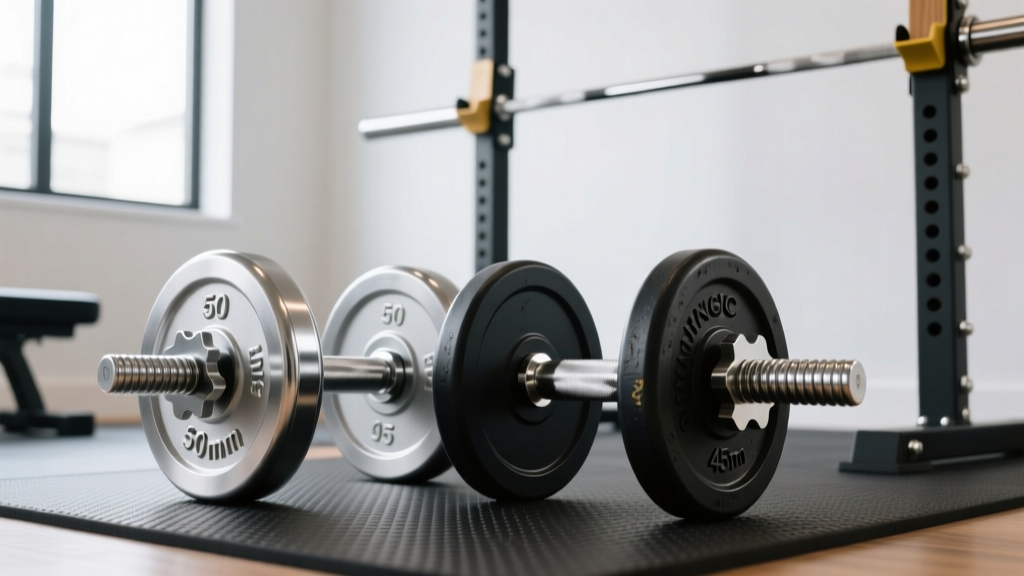
Olympic vs Standard Plates for Your Seated Bicep Curl Dumbbell
Compare Olympic vs standard weight plates. Discover which size fits your barbell, power rack, and seated bicep curl dumbbell routines for optimal home gym setups.

The Great Home Gym Debate: 1-Inch vs 2-Inch Plates
Building a functional home gym requires navigating a maze of equipment compatibility, and nowhere is this more evident than in the choice between Olympic and standard weight plates. While beginners often gravitate toward standard plates due to their lower upfront cost and widespread availability in big-box sporting goods stores, serious lifters almost universally transition to Olympic plates. But how does this choice impact your isolation movements, specifically when configuring a seated bicep curl dumbbell setup using adjustable plate-loaded handles?
In this head-to-head comparison, we break down the metallurgy, dimensional tolerances, real-world pricing, and biomechanical implications of both plate types. Whether you are loading a 7-foot barbell for heavy deadlifts or threading 1-inch plates onto a 14-inch spinlock handle for arm day, understanding these differences will save you from costly compatibility failures and suboptimal training mechanics.
Dimensional Tolerances and Engineering Specifications
The primary distinction between the two plate types lies in the center hole diameter, which dictates the entire ecosystem of bars, racks, and storage trees you can use. However, the naming conventions are somewhat deceptive.
| Specification | Standard Plates | Olympic Plates |
|---|---|---|
| Center Hole Diameter | 1.0625 inches (27mm) | 1.968 inches (50mm) |
| Compatible Bar Sleeve | 1 inch (25.4mm) | 2 inches (50mm) |
| Outer Diameter (Max) | Varies (often 11.5 to 14 inches) | 17.7 inches (450mm) for 45lb/20kg+ |
| Weight Tolerance | +/- 5% to 10% | +/- 1% to 2% (Calibrated) |
| Average Cost Per Pound | $1.20 - $1.80 | $2.00 - $4.50+ |
According to equipment testing by Garage Gym Reviews, standard plates suffer from massive inconsistencies in outer diameter. A standard 45-pound cast iron plate might measure only 14 inches across, whereas an Olympic 45-pound plate is strictly manufactured to the International Weightlifting Federation (IWF) standard of 450mm (17.7 inches). This discrepancy drastically alters the starting height of your barbell for floor-based movements and deadlifts.
Standard Plates: The Adjustable Dumbbell Specialist
Standard plates (1-inch) are predominantly cast from grey iron and painted or enamel-coated. Their greatest advantage is their physical footprint on smaller equipment. Because the center hole is small, the plates can be manufactured with a more compact overall profile for lighter increments (e.g., 2.5lb and 5lb plates), making them ideal for micro-loading adjustable dumbbells.
Real-World Application: The Seated Bicep Curl Dumbbell Setup
When executing a strict seated bicep curl dumbbell routine, balance and sleeve length are critical. Most standard spinlock dumbbell handles are 14 inches long, featuring a 5-inch grip and two 4.5-inch sleeves.
Biomechanical Insight: If you attempt to use an Olympic-to-Standard sleeve adapter to fit 2-inch plates onto a standard dumbbell handle, the adapter adds roughly 2.5 inches of dead space to the sleeve. This shifts the center of mass outward, creating a severe lever-arm imbalance. During a seated bicep curl dumbbell movement, this outward weight distribution places unnatural torque on the distal radioulnar joint (wrist), increasing the risk of tendonitis and reducing strict bicep isolation.
For a proper seated bicep curl dumbbell configuration using standard plates, you should utilize 10-pound standard cast iron plates (which are typically 1.1 inches thick). You can comfortably stack four 10-pound plates per side on a 14-inch handle, yielding a 40-pound dumbbell (plus the 2.5-pound handle weight). This provides a highly dense, balanced weight profile that keeps the load close to your palm, ensuring optimal force vector alignment during the concentric phase of the curl.
Olympic Plates: The Gold Standard for Heavy Lifting
Olympic plates are the undisputed kings of the weight room. Featuring a 50mm center hole, they are designed to mate with Olympic barbell sleeves, which utilize high-quality needle bearings or bronze bushings to allow the sleeve to rotate independently of the shaft. This rotation is crucial for Olympic weightlifting movements like the snatch and clean & jerk, as it prevents the rotational inertia of the plates from tearing the grip out of the lifter's hands.
Material Variations: Cast Iron vs. Urethane vs. Bumper
Unlike standard plates, which are almost exclusively cast iron, the Olympic ecosystem offers diverse material choices:
- Cast Iron / Machined Steel: Ideal for powerlifting. Calibrated steel plates (like the Rogue LB Competition Plates) offer ultra-thin profiles, allowing you to load over 800 lbs onto a single barbell sleeve. Pricing hovers around $3.50 to $5.00 per pound.
- Urethane-Coated: The premium choice for commercial gyms. Urethane resists UV degradation, chipping, and odors far better than rubber. Expect to pay $3.00 to $4.50 per pound.
- Virgin Rubber Bumper Plates: Designed to be dropped from overhead. Because they all share the same 450mm outer diameter regardless of weight (down to 10lbs), they protect both the flooring and the barbell. Rogue Echo Bumper Plates remain a top-tier benchmark in this category, priced competitively at roughly $2.75 per pound.
Head-to-Head Comparison Matrix
To help you decide how to allocate your 2026 equipment budget, here is a direct comparison of how each plate type performs across critical home gym categories.
| Category | Standard (1-Inch) | Olympic (2-Inch) |
|---|---|---|
| Barbell Compatibility | Poor (Bars bend under heavy loads) | Excellent (Supports 1,000+ lb capacities) |
| Adjustable Dumbbell Use | Excellent (Fits compact spinlock handles) | Poor (Requires massive, unwieldy handles) |
| Durability & Drop Rating | Low (Chips paint, cracks if dropped) | High (Especially rubber/urethane bumpers) |
| Rack & Storage Ecosystem | Limited to cheap, flimsy A-frames | Massive selection of wall-mounts, trees, and cradles |
| Resale Value | Low ($0.75 - $1.00/lb used) | High ($1.50 - $2.50/lb used) |
Compatibility Failures and Edge Cases
One of the most common mistakes home gym owners make is attempting to bridge the gap between these two ecosystems using adapters. While you can purchase Olympic-to-Standard adapters (sleeves that slide over a 1-inch bar to accept 2-inch plates), this is a mechanical compromise.
Warning: The Bending Moment Hazard
Standard 1-inch barbells are typically made from lower-grade steel with a tensile strength of under 40,000 PSI. If you use adapters to load heavy Olympic plates onto a standard barbell, the increased leverage and weight will cause the bar to permanently bend (plastic deformation) at the sleeve junction. Never exceed 150 lbs total on a standard barbell, even with adapters.
Conversely, you cannot use standard plates on an Olympic barbell without a specialized Standard-to-Olympic sleeve adapter. However, because Olympic sleeves are so long (often 16+ inches), standard plates will slide back and forth if not secured with heavy-duty spring collars, creating a dangerous shifting of weight during dynamic movements.
Final Verdict: Structuring Your Gym Arsenal
The choice between Olympic and standard weight plates is not necessarily an either/or proposition; rather, it is about assigning the right tool to the right job.
For your primary compound lifts—squats, deadlifts, bench presses, and Olympic movements—Olympic plates are non-negotiable. The investment in 2-inch plates ensures compatibility with high-quality barbells, power racks, and drop-safe flooring protocols.
However, standard plates retain a highly specific, valuable niche in the adjustable dumbbell ecosystem. When you need to quickly configure a seated bicep curl dumbbell for high-rep hypertrophy work, or when you are outfitting a compact adjustable dumbbell set for isolation movements like lateral raises and tricep extensions, standard 1-inch cast iron plates offer an unmatched combination of compact density, affordability, and ergonomic balance. By understanding the precise mechanical tolerances of both, you can build a hybrid 2026 home gym that excels at both heavy powerlifting and precise bodybuilding isolation.
More gear to consider
All reviews
Bumper vs Iron Plates: Gym Layouts for a World Record Dumbbell Curl

Barbell Collar & Clamp Types: Ivanko Dumbbells Set & Bar Safety
Barbell Collar Types Compared & Rogue Rubber Hex Dumbbell Setups
Cast Iron vs Competition Kettlebells: Beyond the Single Dumbbell RDL
Power Rack vs Squat Rack vs Squat Stand for Goblet Squat Dumbbells
