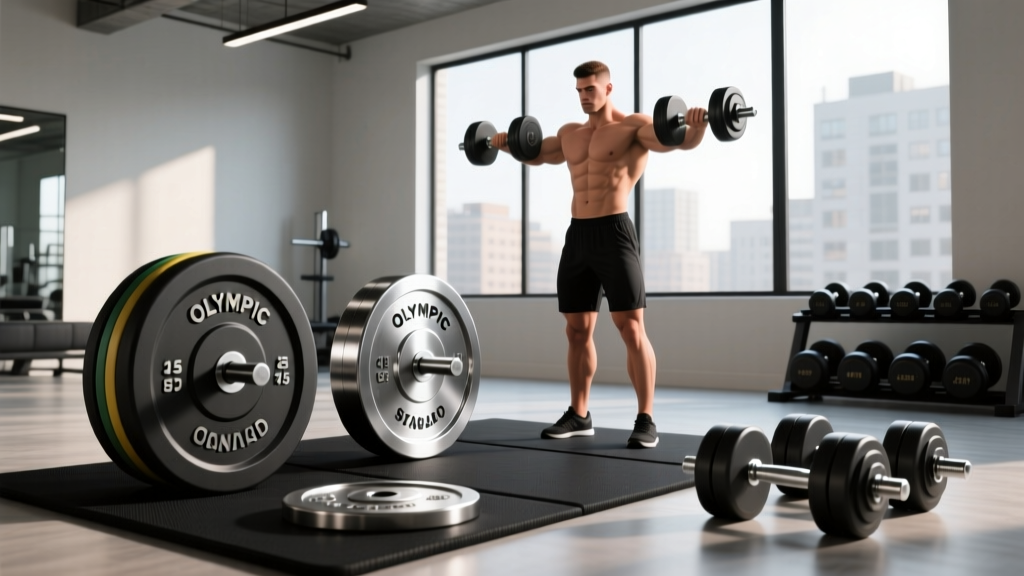
Olympic vs Standard Plates + Chest Workout With Dumbbells No Bench
Compare Olympic vs standard weight plates for your 2026 home gym, then master a highly effective chest workout with dumbbells (no bench required).

The Foundation of Your Home Gym: Olympic vs. Standard Weight Plates
Building a home gym in 2026 requires navigating a market flooded with specialized equipment, yet the most fundamental decision remains the choice between Olympic and standard weight plates. While both serve the basic purpose of adding resistance, their engineering, safety profiles, and long-term utility differ drastically. Whether you are outfitting a garage gym or a compact apartment workout space, understanding the metallurgical and dimensional differences between these two plate types is critical to avoiding costly mistakes.
At FitGearPulse, we frequently see beginners purchase standard 1-inch hole plates to save money upfront, only to outgrow them within six months. Conversely, Olympic plates (featuring a 2-inch center hole) represent the global standard for commercial and serious home gyms. But how do you choose? And once you have your gear, how do you train effectively if you lack the space for a traditional weight bench?
Quick Definition: The primary distinction lies in the center hole diameter. 'Standard' plates feature a 1-inch (25.4mm) hole designed for lightweight, solid-steel bars. 'Olympic' plates feature a 2-inch (50.8mm) hole designed for heavy-duty bars with rotating sleeves.Dimensional & Material Breakdown (2026 Market Standards)
The term 'standard' is actually a misnomer in the fitness industry. Unlike Olympic plates, which adhere to strict International Weightlifting Federation (IWF) guidelines, standard plates have no universal outer diameter regulations. A 25-pound standard plate from one manufacturer might be 12 inches in diameter, while another's might be 10 inches. This inconsistency causes uneven bar loading and alters the starting height of your barbell off the floor.
Olympic plates, specifically the 45-pound (20kg) variations, are universally calibrated to a 450mm (17.7-inch) diameter. This ensures the barbell is always exactly 8.66 inches off the ground, providing a consistent range of motion for deadlifts and presses. According to equipment specs from major manufacturers like Rogue Fitness, modern Olympic plates are typically encased in virgin urethane or precision-cast iron, offering superior drop-dampening and longevity compared to the cement-filled vinyl of cheap standard plates.
| Feature | Standard Plates (1-Inch) | Olympic Plates (2-Inch) |
|---|---|---|
| Center Hole | 1 inch (25.4mm) | 2 inches (50.8mm) |
| Bar Compatibility | Lightweight solid steel bars | Heavy-duty spring steel with rotating sleeves |
| Max Bar Capacity | Typically 200 - 300 lbs | 700 - 1,500+ lbs |
| 45lb Plate Diameter | Varies wildly (12-15 inches) | Standardized 450mm (17.7 inches) |
| Average Cost (2026) | $1.00 - $1.50 / lb | $2.50 - $5.00 / lb |
Failure Modes & Edge Cases: When Standard Plates Fail
When analyzing equipment failure modes, standard plates and their corresponding bars present significant safety risks under heavy loads. The most common failure point is bar bending. A standard 1-inch bar loaded with 200 pounds of standard plates will experience permanent plastic deformation (bending) because the steel lacks the tensile strength and thickness of an Olympic barbell.
The Vinyl Cement Hazard
Many budget standard plates are not solid iron; they are hollow vinyl shells filled with a cement-sand mixture. Over time, dropping these plates causes micro-fractures in the vinyl. Humidity and temperature fluctuations in a garage gym cause the internal cement to expand and contract, eventually splitting the shell and leaking abrasive sand onto your floor. In contrast, high-quality Olympic plates from brands like Titan Fitness or Rogue use solid cast iron or dense urethane that survives thousands of drops.
Calibration Drift
Standard plates are rarely calibrated. A '10-pound' standard plate might actually weigh 9.2 pounds or 10.8 pounds. While this matters little for casual bicep curls, it ruins progressive overload tracking for serious strength athletes. Olympic plates, especially competition-grade or calibrated iron models, guarantee a weight variance of less than 1%.
Application: The Ultimate Chest Workout with Dumbbells (No Bench)
You have invested in your weight plates and a set of adjustable dumbbells, but your home gym lacks the square footage for a traditional weight bench. Fortunately, biomechanical analysis shows that floor-based pressing movements are not just a compromise; they are a superior tool for isolating the pectorals while protecting the rotator cuff. The floor acts as a physical stop, eliminating the dangerous bottom stretch of the bench press and shifting the emphasis to the triceps and inner chest lockout.
According to kinesiology data referenced by ExRx.net, limiting the range of motion in pressing movements significantly reduces anterior shear force on the shoulder joint, making floor variations ideal for lifters with a history of impingement.
1. Neutral-Grip Dumbbell Floor Press
- Setup: Lie flat on the floor, knees bent, feet planted. Hold heavy adjustable dumbbells (e.g., Nuobell or PowerBlock Elite EXP) with a neutral grip (palms facing each other).
- Execution: Lower the weights until your triceps rest gently on the floor. Pause for 1 full second to kill the stretch reflex, then drive up explosively, squeezing the pecs at the top.
- Programming: 4 sets of 8-10 reps. Focus on a 2-1-1 tempo (2 seconds down, 1 second pause, 1 second up).
2. Glute-Bridge Floor Press (Decline Simulation)
Without a decline bench, you can simulate the lower-chest targeting angle by elevating your hips. By driving your hips into a glute bridge, you alter the torso angle relative to gravity, shifting the load to the sternal head of the pectoralis major.
- Setup: Assume the floor press position, then thrust your hips upward until your body forms a straight line from knees to shoulders.
- Execution: Maintain the bridge while performing standard dumbbell presses. The mechanical disadvantage will require you to drop the weight by roughly 15-20% compared to flat presses.
- Programming: 3 sets of 10-12 reps.
3. Dumbbell Floor Flyes (Limited ROM)
Traditional flyes on a bench put the shoulder in a highly vulnerable, hyperextended position at the bottom of the movement. The floor completely eliminates this risk.
- Setup: Lie flat, dumbbells extended above the chest with a slight bend in the elbows.
- Execution: Lower the weights out to the sides until your elbows touch the floor. The floor stops your elbows before your shoulders can overstretch. Squeeze the chest to bring the weights back together.
- Programming: 3 sets of 12-15 reps. Use lighter weights and focus purely on the isometric squeeze at the top.
4. Isometric Squeeze Press
This movement creates massive time-under-tension without requiring heavy loads or a bench.
- Setup: Lie on the floor, holding the dumbbells together above your chest, palms facing each other.
- Execution: Press the dumbbells into each other as hard as possible. Lower them to your chest while maintaining this intense inward pressure, then press back up.
- Programming: 3 sets to failure. This is an exceptional finisher to drive blood into the pectoral fascia.
Verdict: Which Plate System Should You Buy?
If your budget allows, Olympic plates are the only logical choice for a long-term home gym. The safety of a high-capacity barbell, the consistency of the 450mm diameter, and the resale value of Olympic gear far outweigh the initial cost savings of standard plates. Standard plates should only be purchased for ultra-budget, temporary setups, or for use with specific 1-inch dumbbell handles and lightweight isolation machines.
By pairing a high-quality Olympic plate set with a versatile pair of adjustable dumbbells, you unlock the ability to perform heavy compound barbell lifts and joint-friendly floor workouts—like the no-bench chest routine detailed above—without sacrificing an inch of your living space.
Frequently Asked Questions
Can I use Olympic plates on a standard bar?
No. Olympic plates have a 2-inch hole and will not fit onto a 1-inch standard bar. However, you can buy cheap plastic adapter sleeves that slide onto a standard bar to allow the use of Olympic plates, though this is not recommended for heavy lifting due to safety concerns.
Is the floor press as effective as the bench press for chest growth?
The floor press limits the range of motion, meaning it provides less stretch-mediated hypertrophy for the pecs compared to a full bench press. However, it is vastly superior for tricep development, lockout strength, and shoulder rehabilitation. Combining floor presses with dumbbell flyes provides a complete chest stimulus without a bench.
Why do my standard 45lb plates wobble on the bar?
Budget standard plates often have poorly machined center holes that are slightly larger than 1 inch, or the casting is warped. This wobble shifts the center of gravity during lifts, making heavy pressing dangerous. Upgrading to machined Olympic plates eliminates this issue entirely.
More gear to consider
All reviews
Rubber Hex vs Urethane for Your Boxing Workout with Dumbbells

Best Racks to Store Heavy Overhead Extension Dumbbells (2026)

Dumbbell Routine No Bench? Power Rack vs Squat Rack vs Stand Guide

Analyzing Pictures of Dumbbells: 2026 Loadable Market Trends

Best Neoprene Weights for a Dumbbell Routine for Beginners
