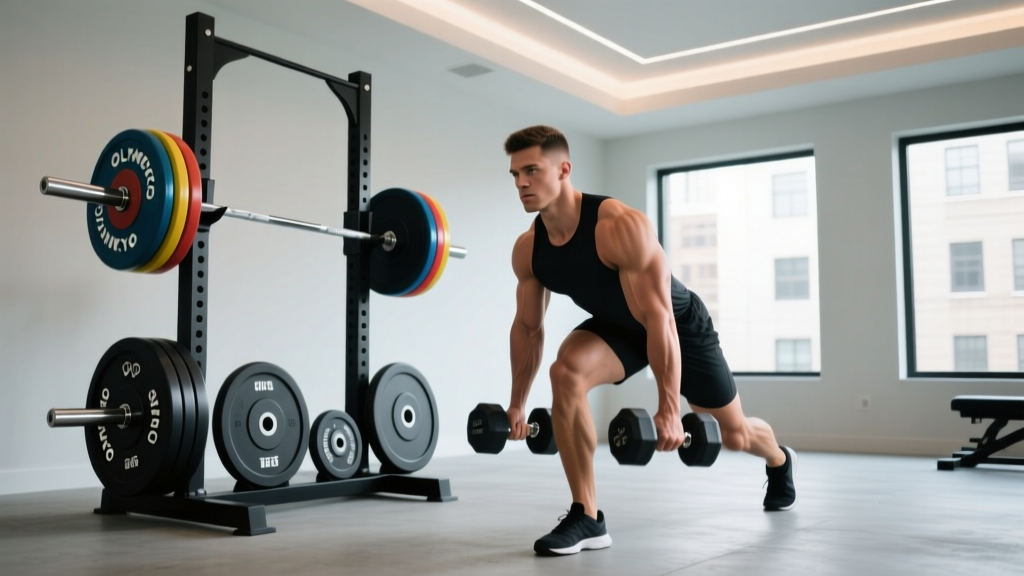
Olympic vs Standard Plates & B Stance RDL with Dumbbells
Master your home gym setup with our guide to Olympic vs standard weight plates, plus a step-by-step tutorial for the B stance RDL with dumbbells.

The Foundation: Building Your 2026 Home Gym
Designing an effective home gym requires navigating two distinct challenges: selecting the right foundational equipment and mastering the biomechanics of the exercises you perform on it. For beginners focusing on lower-body strength and posterior chain development, this means making a critical choice between Olympic vs standard weight plates for your barbell work, while simultaneously learning to isolate muscle imbalances using dumbbells. In this step-by-step guide, we will break down the exact specifications, pricing, and use-cases for weight plates, before transitioning into a masterclass on the B stance RDL with dumbbells to complete your ultimate leg-day toolkit.
The Great Plate Debate: Olympic vs Standard Weight Plates
Walking into a commercial gym, you will almost exclusively see Olympic plates. However, when outfitting a home garage gym on a budget, standard plates often enter the conversation. Understanding the metallurgical and dimensional differences between these two types of iron is crucial for your safety and long-term progression.
Dimensional and Structural Differences
The primary distinction lies in the center hole diameter and the corresponding barbell sleeve size. Standard weight plates feature a 1-inch (25.4mm) center hole, designed to slide onto standard barbells with 1-inch sleeve ends. These bars are typically constructed from lower-grade steel and are prone to permanent bending (yielding) when loaded beyond 200 to 250 pounds.
Conversely, Olympic plates have a 2-inch (50.8mm) center hole. As outlined by the International Weightlifting Federation (IWF) Technical Rules, Olympic barbells are engineered with high-tensile strength steel (often 190,000 to 215,000 PSI) and feature rotating sleeves with precision bearings or bushings. This allows the sleeves to spin during explosive lifts like the clean and jerk, reducing torque on the lifter's wrists. An Olympic barbell can safely support 1,000 to 1,500+ pounds without warping.
2026 Market Pricing and Material Coatings
If you are shopping for plates today, pricing structures have shifted. Standard cast iron plates generally cost between $1.00 and $1.50 per pound. They are almost always bare cast iron or painted enamel, which chips easily and rusts if kept in a humid garage. Olympic plates, however, range from $1.80 to $3.50 per pound depending on the coating. Urethane-coated Olympic plates (like those from Rogue or Rep Fitness) resist UV degradation and dropping, while crumb-rubber bumper plates are essential if you plan to drop the bar from overhead.
Quick Comparison Matrix
| Feature | Standard Plates | Olympic Plates |
|---|---|---|
| Center Hole Diameter | 1 inch (25.4mm) | 2 inches (50.8mm) |
| Barbell Sleeve Compatibility | 1-inch solid steel ends | 50mm rotating sleeves |
| Max Safe Load (Bar Yield) | ~200 - 300 lbs | 1,000 - 1,500+ lbs |
| Avg. Price Per Pound (2026) | $1.00 - $1.50 / lb | $1.80 - $3.50 / lb |
| Best Use Case | Light-duty home gyms, budget setups | Heavy lifting, Olympic lifts, longevity |
Transitioning to Unilateral Work: The B Stance RDL
Once your barbell and plate setup is established, you will quickly realize that bilateral movements (using both legs equally) can mask underlying strength asymmetries. This is where the B stance RDL with dumbbells becomes an indispensable accessory movement. Also known as the 'kickstand' Romanian Deadlift, this exercise shifts the focus entirely to the hamstrings and glutes of the working leg while minimizing the balance requirements of a full single-leg RDL.
According to the ExRx Kinesiology Concepts database, addressing bilateral deficits through unilateral training is critical for injury prevention and athletic symmetry. By using dumbbells instead of a barbell for this specific variation, you allow your arms to hang naturally at your sides, keeping the center of gravity closer to your base of support and reducing shear force on the lumbar spine.
Step-by-Step Execution Guide
Grab a pair of dumbbells (beginners should start with 15 to 25 lbs per hand to master the hinge pattern). Follow these steps to execute the movement safely:
- The Kickstand Setup: Stand tall with both feet together. Step your right foot back about 12 to 18 inches, resting only the toes of your right foot on the floor. Your left foot remains flat. Distribute 85% to 90% of your body weight onto your front (left) heel.
- The Brace: Hold the dumbbells in a neutral grip (palms facing your thighs). Pull your shoulder blades down and back, and brace your core as if preparing for a punch to the stomach.
- The Hinge: Initiate the movement by pushing your hips straight back toward the wall behind you. Do not bend your knees excessively; this is a hinge, not a squat. The dumbbells should slide down the front of your working thigh.
- The Depth: Lower the weights until you feel a deep, intense stretch in the hamstring of your front leg. For most lifters, this occurs when the dumbbells are just below the knee or mid-shin. Stop immediately if your lower back begins to round.
- The Return: Drive your front heel aggressively into the floor and squeeze your glutes to pull your hips forward, returning to the starting position. Keep the back foot strictly as a balance point—do not push off the back toes.
Biomechanical Cues and Failure Modes
'The back foot is a kickstand on a bicycle, not a second engine. It provides balance, not power.' — Biomechanical coaching cue for the B-Stance RDL.
As noted in the ExRx Database on Dumbbell Romanian Deadlifts, maintaining a neutral spine is the primary safety imperative. Here are the most common failure modes beginners experience and how to fix them:
- Lumbar Flexion (Rounding the Back): This happens when you push your hips back too far and run out of hamstring mobility. Fix: Reduce your range of motion. Only lower the dumbbells as far as your hips can travel while your spine remains rigid.
- Weight Shifting to the Back Foot: If you feel the calf or quad of your back leg burning, you are using it to help lift the weight. Fix: Imagine the back foot is resting on a pane of glass. Press only lightly with the toes.
- Squatting the Hinge: Bending the knees too much shifts the load from the posterior chain (hamstrings/glutes) to the quads. Fix: Keep a 'soft' knee (about a 15-degree bend) and lock that angle in place for the entire descent.
Programming Your Lower-Body Session
To integrate both your new plate knowledge and this dumbbell exercise, structure your leg day by prioritizing heavy bilateral movements first, followed by unilateral accessory work. Here is a sample 2026 beginner template:
- Primary Bilateral Lift: Barbell Romanian Deadlift (using your Olympic plates) — 4 sets of 6-8 reps. Focus on moving heavy, absolute loads safely.
- Unilateral Accessory: B stance RDL with dumbbells — 3 sets of 10-12 reps per leg. Focus on the deep hamstring stretch, muscle isolation, and correcting left-to-right strength imbalances.
- Hypertrophy Finisher: Lying Hamstring Curls — 3 sets of 15 reps to failure.
By understanding the structural limits of standard plates versus the heavy-duty capabilities of Olympic gear, you ensure your home gym is built for longevity. Pairing that heavy barbell foundation with the precise, asymmetry-correcting mechanics of the B stance RDL with dumbbells guarantees a comprehensive, injury-resistant approach to lower-body training.
More gear to consider
All reviews
EZ Curl Bar vs Straight Bar Care and One Dumbbell Front Raises Tips

Fix Your Neoprene Dumbbell Lifting Routine: 5 Common Mistakes

Front Squat with Dumbbells: Neoprene Home Gym Setup
EZ Curl Bar vs Straight Bar Care & Target 8 lb Dumbbells Maintenance
Barbell Collar Types: Securing the Dumbbell Crunch Press
